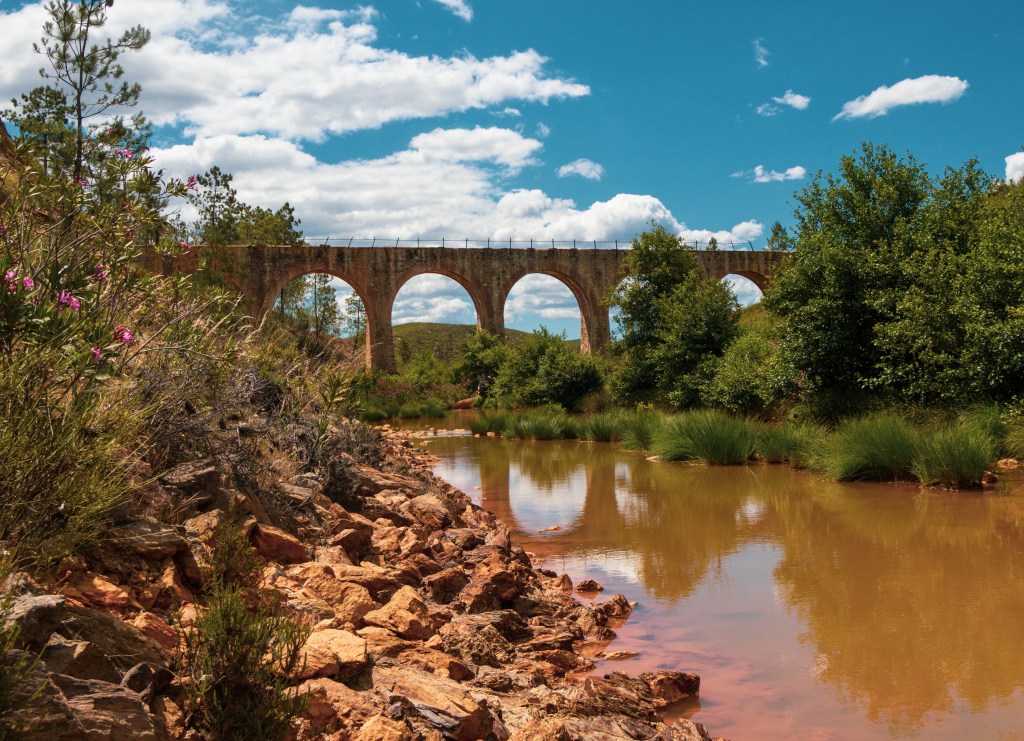
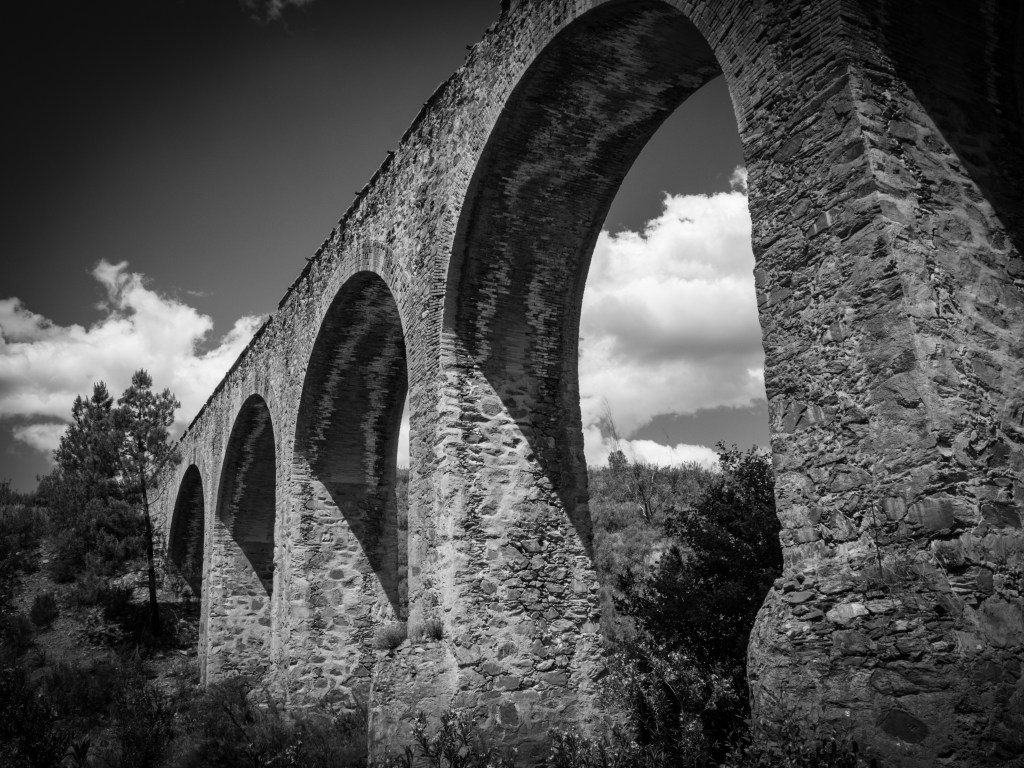
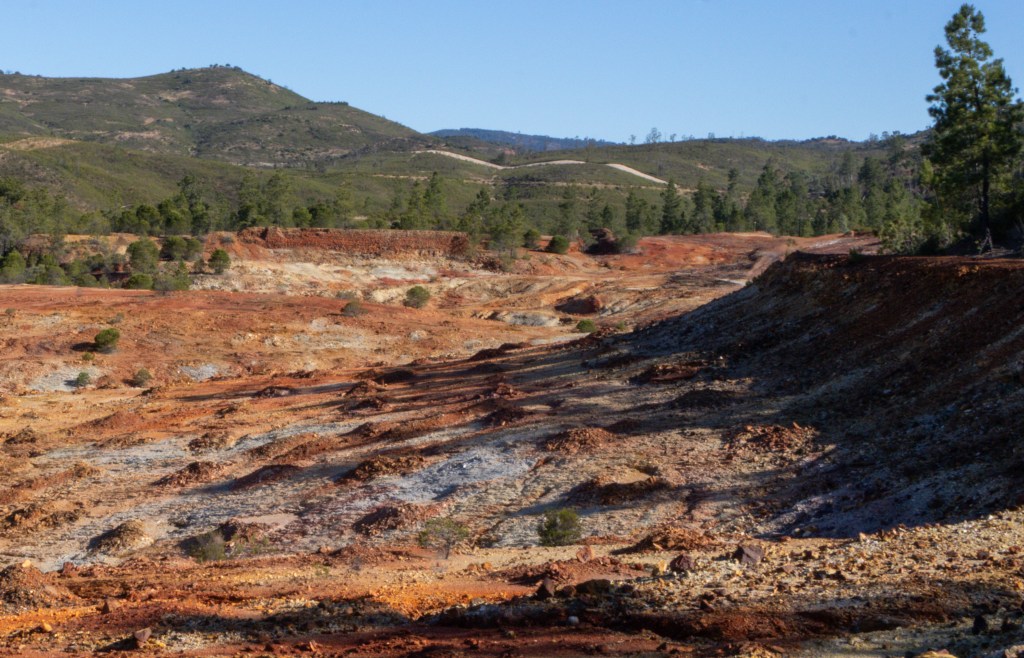
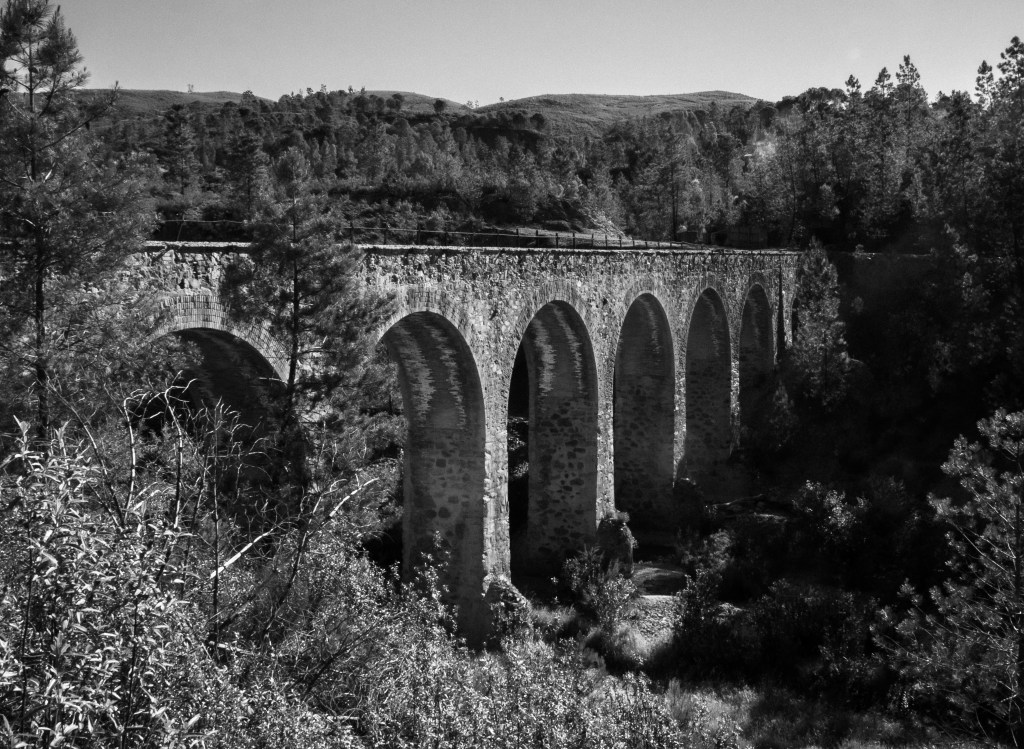
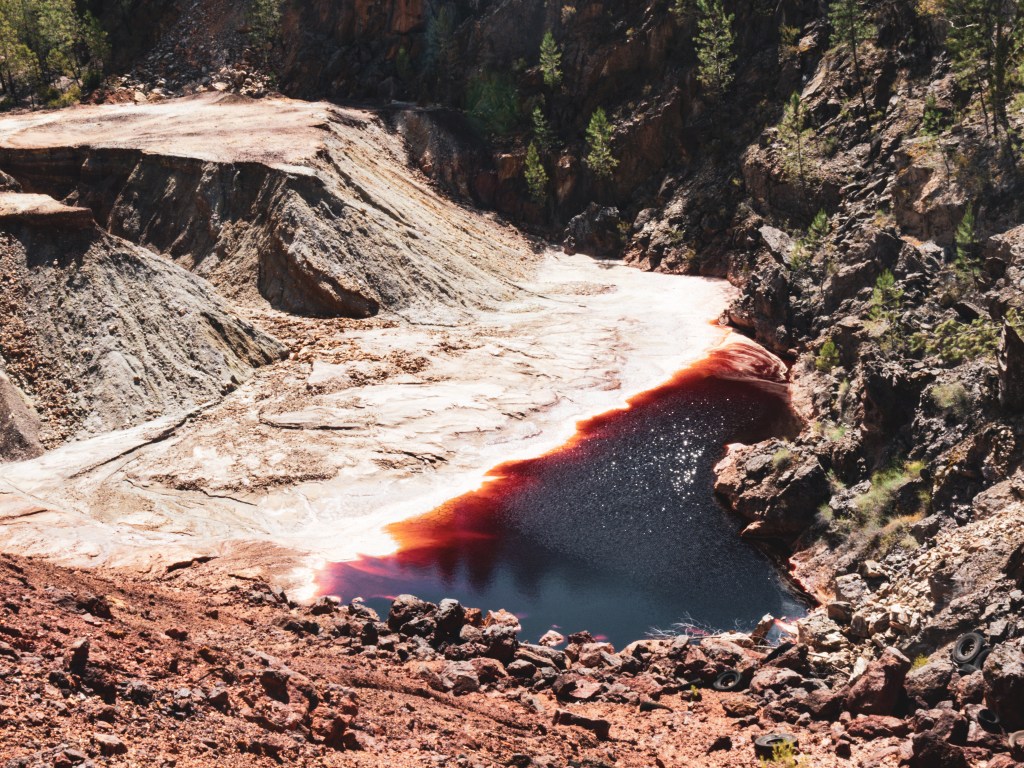
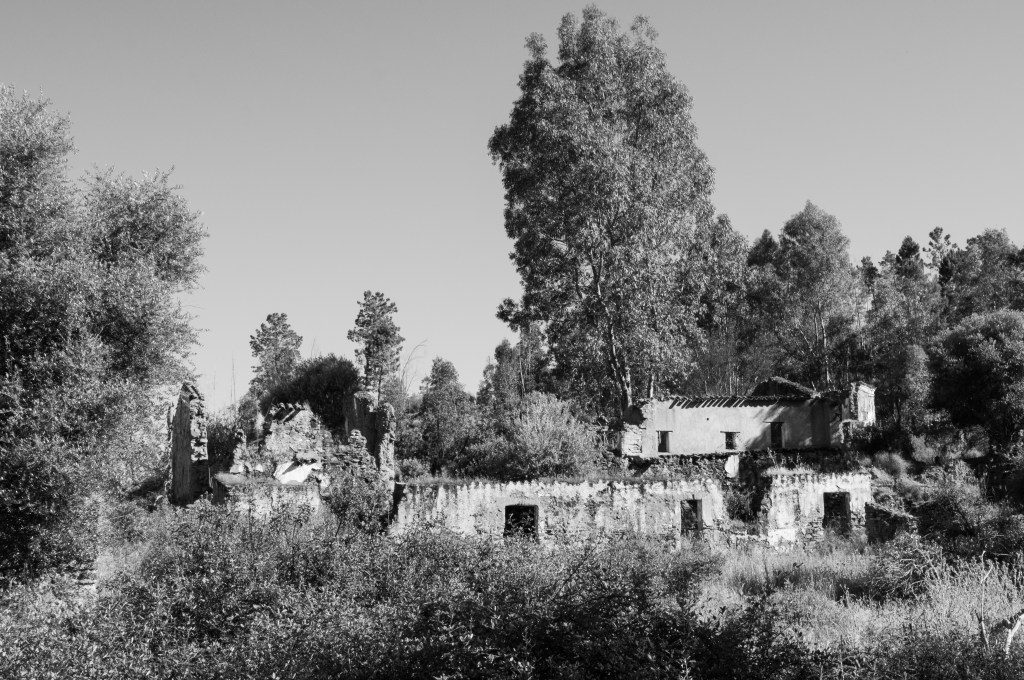
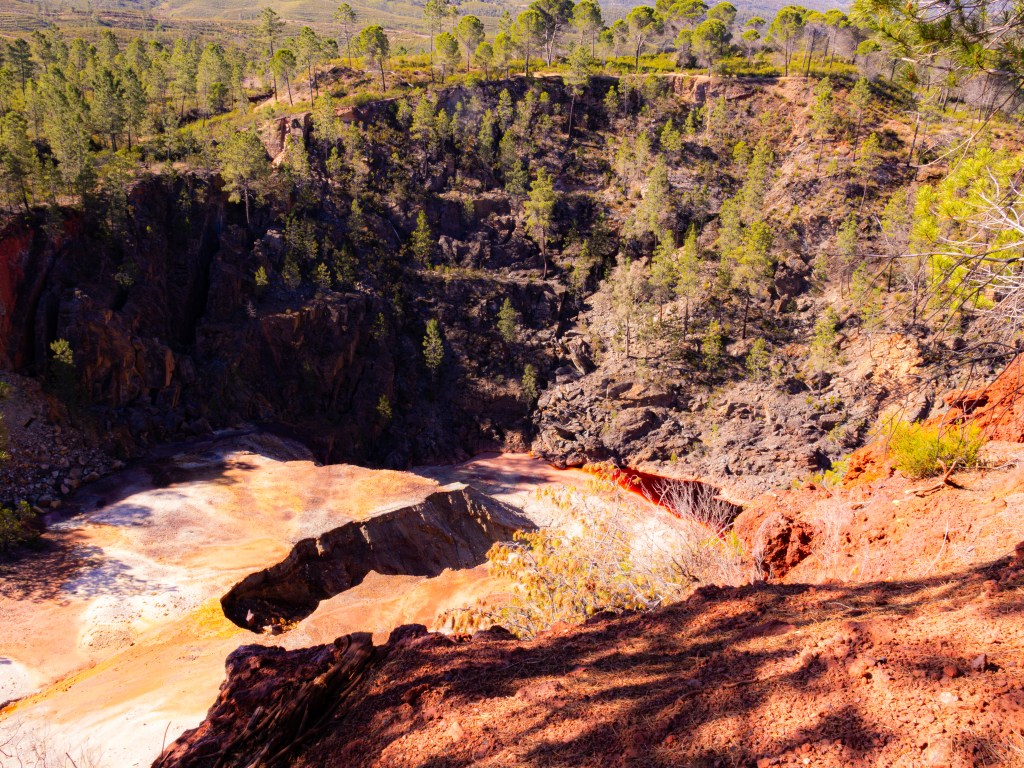
Today was an outing to San Miguel Mines in the north of the province. It took me 1.5 hours to get there from Huelva, including the 5km track from the N435. The track is easy to follow and can be found just opposite the turning for La Joya mine. You should really use a 4×4 but my old VW Golf got the job done well enough. The most impressive must-sees for the visit were the railway bridge over the Escalada River, the calcination grounds where the ore was roasted in teleras, the mining village in ruins and of course the open cast pit with its red acid waters. I’ve had this visit planned for quite some time due to its historical importance for Huelva mining tradition, so without further ado…
San Miguel is a volcanogenic massive sulphide deposit — which is a rather complicated way of saying that superheated, metal-rich fluids forced their way up through cracks in the ancient volcanic crust, replacing the surrounding rock with dense bodies of iron, copper, zinc and lead. The Romans worked the gossan, that rusty iron-rich cap atop the deposit, for its gold and silver, and the Sierra de San Cristóbal has had people digging into it in one form or another since at least the Phoenicians. The deeper sulphides, though, would have to wait for the nineteenth century.
The first modern concessions were granted in 1851 to the firm of Solá Hermanos, who ran a productive underground operation and processed the ore in reverberatory furnaces on site. Then, in February 1853, San Miguel received a visitor who would go on to transform the entire mining history of the province. Ernest Deligny was a young French engineer who had been working in Asturias on the Langreo–Gijón railway under the great civil engineer Eugène Flachat, when his employer sent him south on a mission of exploration for the Duke Decazes, who was looking for investment opportunities in Andalusia. His brief included two mines offered to Decazes — one of them being San Miguel — and a visit to Riotinto. Deligny duly came here, looked the place over, gave his recommendations for its exploitation, and moved on. But it was what happened next that changed everything. Riding across the sierra near Riotinto, guided by a sceptical shepherd who assured him the land was exhausted, Deligny recognised in the ancient slag heaps and rust-coloured outcrops above the village of Alosno something the locals had long since stopped seeing: an ore field of enormous potential. He abandoned his original mission entirely, rode back to Madrid, and told Decazes he had found another Riotinto. The place, he was told, was called Sierra de Tarse. Deligny immediately made the connection with the ancient Tarshish mentioned in the Bible and didn’t hesitate to name the area Tharsis, after the ancient Phoenician mines he believed had once stood there. Within weeks he had registered over 40 mining concessions across the region. San Miguel had been a waypoint; Tharsis was the revelation.
What followed was a decade of heroic and frequently desperate effort. Deligny formed the Compañía de Minas de Cobre de Huelva in 1855, moved his wife and children to Huelva, and threw himself into building what amounted to an entire industrial region more or less from scratch — roads, workers’ villages, processing facilities and plans for a railway to the coast. He left the company in 1859, his vision largely intact but his authority undermined by his successor. His own account of those years, written in Spanish out of affection for the people of Huelva, was translated into English in 1947 by W. P. Rutherford, then director of the Tharsis Sulphur and Copper Company — a pleasing continuity across nearly a century.
As for San Miguel itself, British capital eventually arrived here too. The mine passed through Portuguese hands in 1888, and then in 1898 was sold to British interests, eventually incorporated in London in October 1904 as The San Miguel Copper Mines Ltd., with a capital of £150,000. Under this company San Miguel reached its peak, and with it came all the infrastructure that a serious industrial operation in a remote sierra requires.
The most important piece of that infrastructure, and for me one of the most evocative things still visible on the site, was the narrow-gauge railway — approximately nineteen kilometres of track threading down through the rugged Sierra Morena, crossing the Rivera del Escalada on the bridge that still stands today, before reaching the junction at Tamujoso where the ore was transferred onto the main Zafra–Huelva broad-gauge line and dispatched to the loading piers at the port. The line was built between 1902 and 1905, and among the engines that worked it were two Kerr Stuart saddle tanks, named Escalada and Tamujoso after landmarks along the route. Standing by that bridge now, with the acid-red water moving beneath it and the silence of the abandoned sierra all around, it is not difficult to imagine the noise and smoke and purposeful activity that once filled this valley.
The San Miguel Copper Mines Ltd. wound down its operations around 1917–1919, but the British connection to the mine did not end there. The property was purchased in 1919 by the company’s last director, Erick Mackay Heriot, and the concessions remained in his family’s hands for decades — a private continuity that tends to get lost in the broader corporate history. It was only in 1959 that the Heriot family leased the mine to Productos Químicos de Huelva, a subsidiary of the Río Tinto company, who widened the open pit to something close to its present dimensions and extracted what sulphur-rich material remained. Operations finally ceased in 1970.
