
HOW THEY ARE USED AT SOUTHSEA
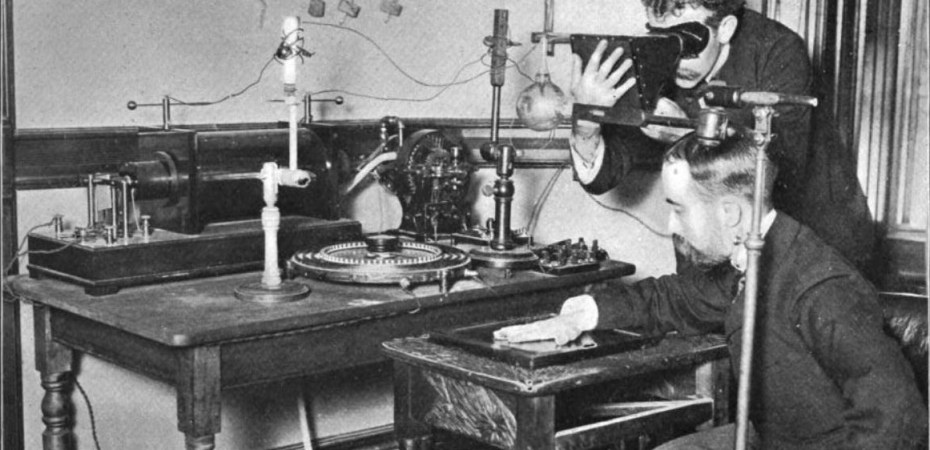
Everybody has heard of the Röntgen or ” X” Rays, whose mysterious power enables a man’s of bones to be pictured while he is yet alive, but comparatively few people have any direct knowledge of the process or any correct apprehension be of what it does. It was with a view to learning “how it’s done,” and gleaning some information to which might be of interest to readers of the the Hampshire Telegraph, that a reporter visited Mr. Debenham at his studio in Palmerston-road, is Southsea, a few days ago. Mr. Debenham has made a special study of the X-rays, and the has quite a large number of clients who sit for him for ” bone-pictures.” These clients or patients suffer from all sorts of injuries or malformations. Amputations, fractures, and shot wounds form a large proportion of the former, and the sufferers, have X-ray photographs taken so as to know exactly what damage has been done, no- or incases where a shot, needle, or similar object is embedded in a wound, to find out exactly where the trouble lies. A gentleman whose leg had been injured, the negative showing the broken was hone very clearly, preceded our reporter. When it came to the turn of the journalist he sat on a sofa in a slightly darkened room, with an electric apparatus in front of him. There was a large storage battery and a big induction coil, which was connected with a little glass bulb. It is in this glass bulb that the X-rays are generated. The bulb is something like that used in an incandescent electric lamp, but instead of a wire filament there is at one end a metal stem, with a little square plate of platinum, and at the other a round disc of platinum. The X-rays are generated in the vacuum inside the bulb or tube by the electric current. What they are no one exactly knows. This much is known, that they strike the metal disc, rebound on to the metal square, and, according as the square is bent, can be projected up or down or sideways. In this by case the rays were reflected downwards, and the photo was taken beneath the tube. First of all an ordinary photographic plate, wrapped in a black cover to exclude the daylight, was placed on the table underneath the tube. On this envelope our reporter laid his right hand. Then the current was turned on. There was a blaze of sparks and a crackle from the machine, and the bulb began to glow with a green light, which flickered to and fro. That was all. The X-rays are invisible and unfelt. The exposure was five minutes. In some cases it is longer, and in others shorter; for the leg or arm it the would be much longer. A few days later our representative had the pleasure of admiring his bones in the finished picture. The photograph is a wonderful production, and one of the best we have ever seen. Every bone is clearly the shown, even the thick bones of the lower part of the hand and wrist. Every joint is visible, every detail is plain in all its ghastliness. Mr. Debenham has succeeded in producing his skeleton portraits free from distortion or mistiness. They are, so to speak, works of art in their particular line.
The Röntgen ray is coming to the aid even of the lunatics. It has been exploited for the help of Miss Miller, the daughter of well-to-do parents of whose beauty and intelligence are clouded at times by hallucinations. She fancies she is engaged to this, that, and the other man. The the doctors applied the Röntgen rays to her head. The photograph of the skull told the tale. Inside appeared a row of bony growths, like buttons, which pressed down upon the brain and caused the trouble. The growths are to be removed; then all will be well.
(As published in the Hampshire Telegraph)
