
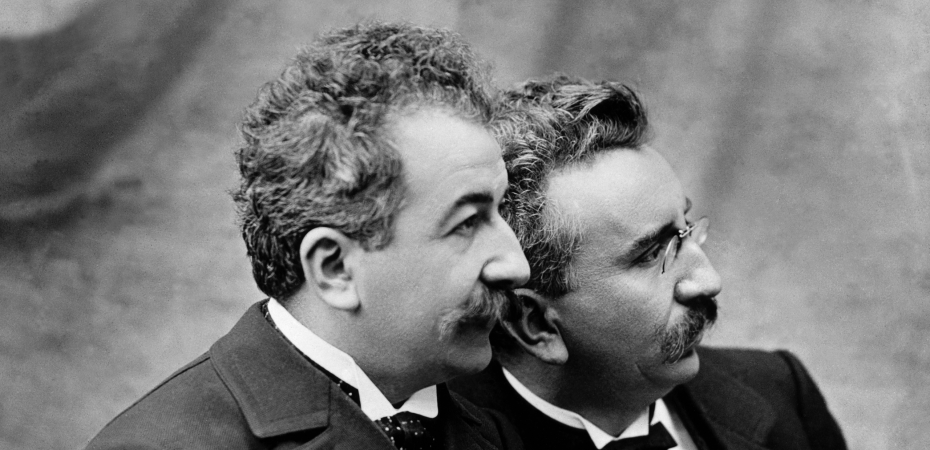
Photography, and, indeed, all pictorial art, has hitherto fallen short of reproducing a moving living picture. We have fixed portraits and scenes, but life and movement are entirely absent from the pictures. What would be thought of a reproduction of a busy street scene with cabs and omnibuses, and crowds of people, all in motion, or say of a great cricket match at the Oval, with Dr. Grace shown actually making one of his famous leg hits ? The thing seems well nigh impossible, but if we are to credit an exhibition of the “Cinematographe,” invented by Messrs. A. and L. Lumière, given recently at the Marlborough Hall, Regent-st., London, photographs can be reproduced so as to form a moving animated life-size picture. Such photographs were shown on a large , white screen, by means of the electric light. There was a railway station with a train dashing and passengers getting into the carriages and alighting when it had stopped, and the outside of a big factory with departing operatives issuing forth till the last worker was gone. A seaside photograph showed bathers jumping headlong into the sea from a spring board, and another depicted a gardener with a hose watering the flower beds while someone played tricks upon him. A domestic picture was shown of father and mother, with their infant prodigy, at a tea table, and the parents’ delight at the child feeding was a true bit of nature. Yet another photograph exhibited three gentlemen playing at cards outside an inn, and a waiter approaches with a bottle of wine, which is poured out and drunk. The whole action of card-playing, with the laughing of the group, and even the smoke ascending from their Cigars, was vividly displayed. Now, all these were photographed scenes from real life, as well as one showing a crowded thoroughfare. How, then, were they reproduced so that the spectators in front of the screen saw thereon the scenes enacted again before their eyes? The explanation is simply that the photographs were taken on a continuous band at the rate of 900 a minute, being instantaneous photography so rapidly continued—fifteen to the second—that every aspect of a scene is caught. These photographs being projected on the screen by the electric light at exactly the same rate of movement a changing picture is produced faithful to the original. By this means people in a room may have reproduced in lifelike style many scenes, even, say, the finish to the Derby at Epsom.
(As published in the St Helens Examiner)
