
(Pall Mall Gazette)
ON LAND NATIONALISATION AND THE RIGHTS OF LABOUR.
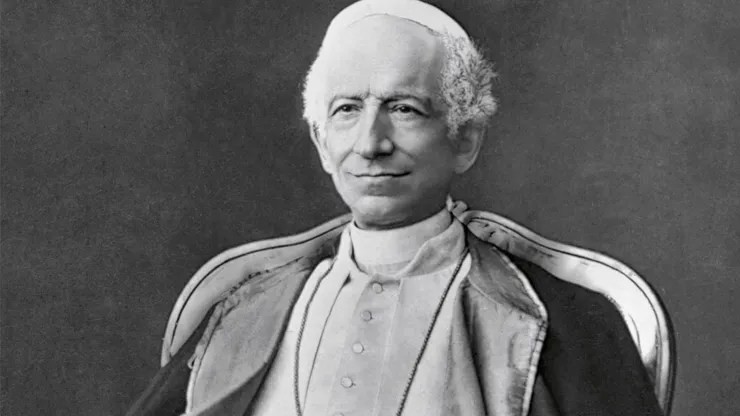
A CORRESPONDENT, who has access to the best sources of information, sends us the following forecast and estimate of the Pope’s labour-programme :— The Encyclical of the Pope has at last gone to press in its English dress. The Cardinal, with the assistance of the Archbishop of Dublin and the Bishop of Newport, has given the last finishing touches to the authorised official English translation, which will probably be issued this week. The Pope has himself translated the Encyclical into French and Italian. The Italian version only reached London the day before yesterday in time to enable the translators to compare the English and Italian translations.
In the original the title of the Encyclical is “De Conditione Opificum”— Of the Condition of the Workers. The English translators hesitated at first at translating this “On the Condition of Labour,” but they were relieved when they found that the Pope had himself described his Encyclical in Italian as “On the Labour Question”. They preferred the former rendering, because the Pope does not address himself merely to the Labour Question, but deals throughout with the condition of the worker.
The Encyclical, although necessarily dealing with principles rather than solutions, is likely to create a profound sensation throughout the whole world.
The Pope is written throughout as a thoroughgoing advocate of the rights of labour. The question of the condition of the worker, he proclaims aloud, is the one supreme question of modern Christendom. His unhesitating championship of the rights of the labourer to a human existence, and his reiterated insistence on the duties of employers to their employés, are sufficient to make this Encyclical memorable in the annals of civilization.
The Pope, however, does not content himself with preaching. He asserts, in the strongest and most uncompromising terms, the rights of the workers to form trade unions for all lawful purposes, and he expressly repudiates the false doctrine that the Christian doctrine of contentment implies stolid acquiescence in the evils of our lot. The Christian doctrine, he maintains, not only approves, but incites to the struggle for improvement. The Church says to the individual, as to society, Aspire to better things.
The Pope touches upon the woman question in order to condemn the brutality with which in some countries women are treated little better than beasts of burden. He asserts the claim of the home upon the mother and the wife, and defends the rights of the family even against the State itself.
Another subject upon which the Encyclical speaks with emphasis is the right of the worker to leisure. The Pope claims for labour not only cessation from toil one day in seven, but also a right to rest on holy days— the number of which is left judiciously blank.
As against certain of the French Bishops who have protested against the intervention of the State in questions between employers and employed, the Pope asserts emphatically that the State is fully justified in intervening even between members of the family in order to secure to each their rights. How much more then may it not interfere between capitalists and their workmen?
We are therefore all Socialists now, including the Pope. But his Holiness is very careful to point out that his Socialism is plus, not minus, the Ten Commandments. He starts off by a round assertion of the sanctity of private property, and especially of private property in Land. This he maintains is the very keystone of the social edifice, and if it is interfered with no one will suffer so much as the worker who has invested his life savings in his small allotment. Hence the Pope stoutly condemns Land Nationalization if this is based upon a denial of the rights of private owners. That is to say, he is against Land Nationalization without compensation. But there is not a word in his Encyclical which condemns Land Nationalization plus compensation. Such a system is merely the substitution of a collective for an individual ownership, which may be decided upon by the community at its own discretion without infringing any of the principles on which the Pope insists.
The Pope, as is usual in such Encyclicals, constantly speaks of himself and the section of the Christian Church over which he presides as if it were the only Christian Communion. This has the advantage of enabling every Christian to read it without offence, for every Christian can interpret “the Church” in his own fashion.
The Pope asserts, without compromising matters in the least, not only that the promotion of the improvement of the condition of the worker is the duty of the Church, but also that, if the Church does not take it in hand, it will never be improved. The social activity of the Church is therefore the sine qua non of the amelioration of the condition of the labourer.
The Encyclical, therefore, is a magnificent confirmation from the Papal Chair of Cardinal Manning’s doctrines. Had the Cardinal himself worn the Papal tiara he could hardly have worded the Encyclical otherwise. To those English Catholics of the old Conservative school who have long groaned under Cardinal Manning’s “rank Socialism,” and who have declared that his Eminence was raised up as a scourge of the Divine wrath in punishment for the sins of the Church, the Encyclical is as gall and wormwood. The Pope has now declared himself altogether such another as the Cardinal Archbishop of Westminster. That is the real and startling significance of the new Encyclical.
