(The Railway News. August 8, 1885)
THE great copper deposits of Spain appear to have been worked at a very early date; indeed, the gigantic remains of ancient workings now exposed to view belong, it is said, to the Phoenician age, and date from 1,013 to 1,000 years B.C. The Romans, however, were the first miners who left behind them unmistakable traces of their nationality, and in his report on the mining industries of Spain, Consul Joel says: ” One stands in wonder at the magnitude of their operations, and the knowledge and pertinacity they display. There is barely a single deposit they did not either work or investigate, abandoning it, after a trial of the ore, if it proved poor; and the best recommendation now-a-day in favour of a new mine is that it bears traces of Roman working.” Enormous deposits of slag are found near all the mines, estimated to contain, in all the Province of Andalusia, about 20,000,000 tons, representing a total amount of about 26,000,000 tons of raw ore smelted. As regards the modern workings, the first attempts seem to have been made under Philip II, and between the years 1560 and 1640 a number of mines were explored, but it was only in 1725 that Wolter, Tiquet, and Sanz obtained, practical results in Rio Tinto. In 1840 new activity was imparted to the mining industry; over 300 mines being denounced in the following years, owing, probably to the introduction of the wet process of cementation by.Prieto.
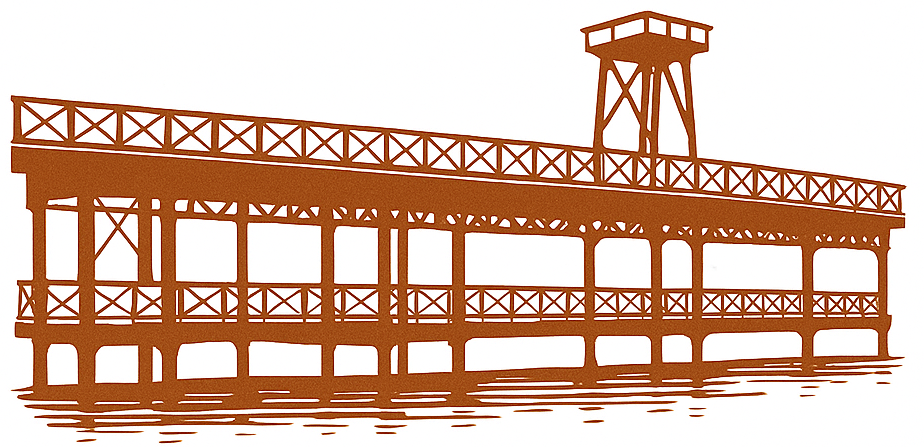
In the beginning of 1853 M. Ernest Deligny, a French engineer, came to the Province, and guided chiefly by the deposits of Roman slag he discovered and claimed successively Cueva del Mora, Poyatos, Herrerias, San Telmo, Tharsis, Zarza, and Santo Domingo, in several of which he started operations, After numerous vicissitudes a French company, formed by the Duke of Glucksburg and M. Duclerc, obtained at last tangible results at Tharsis in 1858. Since then the development of these mines advanced with rapid strides; in 1866 the Tharsis Sulphur and Copper Company was formed; and in 1873 the great Rio Tinto Company was started. In order to give an idea of what has been accomplished by these companies, it must be remembered that the difficulty of transport in a hilly country, utterly devoid of any sort of road (so much so that all carriage had to be effected on mule back, along rough bridle tracks), and the want of native enterprise in the construction of independent railways, soon rendered it imperative on them to construct railways of their own for the full development of their mines. The Buitron Company first constructed a three-feet six-inch gauge line, 57 kiloms. long, to San Juan, on the River Tinto, whence their produce is taken to the Odiel in barges for transshipment; then the Tharsis Company established a line 46 kiloms. long, with a four-feet gauge line, to a pier on the river Odiel where their produce is shipped ; And finally the Rio Tinto Company built a three feet, six inch gauge line, 83 kiloms. long, to the Odiel, where it is served by a magnificent pier. The Huelva and Seville Railway was next built, and the Huelva and Zafra line is nearly completed, both undertaken by independent railway companies. The great export traffic on these lines, and the imports of pig-iron, coal, and other, materials, together with traffic in the mining establishments, where large quantities of ore are turned over thrice for local treatment, necessarily implies a large amount of rollling stock and locomotives, and consequently the establishment of extensive workshops, with English foremen and workmen. The mines, also lying at some distance from the villages, require houses to be put up for the staff, and workmen, thus forming little English colonies, around which an enormous mining population soon gathered, so that these mines gradually developed into small towns, with all their requirements schools, churches, &c. As an example of this, it may be stated that the Rio Tinto Company is said to employ 10,000 workmen, with a total population of 30,000 souls; and the Tharsis, Company 4,000 workmen, with a total population of 7,000 souls.
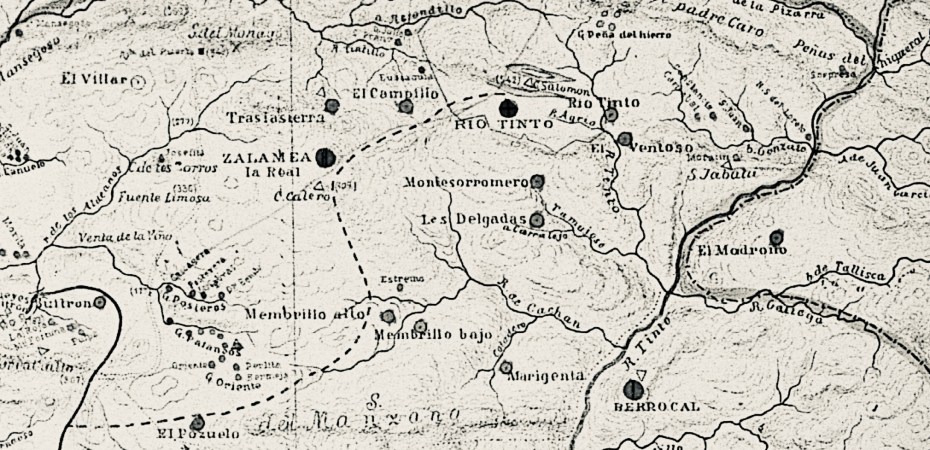
A very large amount of English capital is invested in the mining industries of Andalusia, especially in the Province of Huelva. The most important companies engaged in this industry are: The Rio Tinto Company, with a capital of nearly £5,600,000 working the extensive and well-known mines called Rio Tinto, situated about fifty miles N.E.of the port of Huelva, and connected with that port by a railway of its own, which terminates at a large and commodious shipping pier, at which several vessels can load and discharge at the same time. The Tharsis Sulphur and Copper Company, with about £1,235,000 capital, working the Tharsis Mines, situated about twenty-nine miles from the port Tharsis Mines, situated about twenty-nine miles from the port of Huelva, and also connected with that port by its own line of railway, terminating in a commodious shipping pier. The Bede Metal and Chemical Company, working the San Telmo group. This company ships its mineral at Huelva, and also in the River Guadiana, sending it from the mines on mule back. The Peninsula Copper Company working the Pena de Hierro Mine. The Spanish Copper Company, working the mines of San Vicente and Fronteriza. The Buitron Railway and Mineral Company now working the La Poderosa and other mines. This company possesses a railway which is open for public traffic from San Juan del Puerto to Valverde del Camino and Zalamea. The Rio Malago Copper Company, working the mines of Sierracilla, and exporting their produce to the River Guadiana. The Société des Mines d’Alosno (a French company), working the group called Lagunazo. The Aguas Tenidas Company (French), working the mines of that name. The Sotiel Coronada Company. (Portuguese), working the the mines called Sotiel-Coronada. The Companhia Portuguesa de Minas de Huelva, working the important mine called “Cueva de la Mora,” and shipping its produce by the Buitron Railway. These comprise the most important companies, and they represent an aggregate capital of many millions of pounds sterling.
