It’s hard, if not impossible, to understand the past from and in the past and not from and in the present. What was considered acceptable or normal in the past may not be so in our present. What is considered normal or acceptable nowadays will certainly not be considered so in the future. We have not yet reached the pinnacle of human development even though we, like every other generation, may have the feeling that we have arrived. It’s hard to avoid making value judgements on the decisions and actions of those who lived in a different age. The best we can do is to make an honest attempt to understand the realities of a different age from different perspectives before jumping to conclusions or claiming our monopoly on the truth.
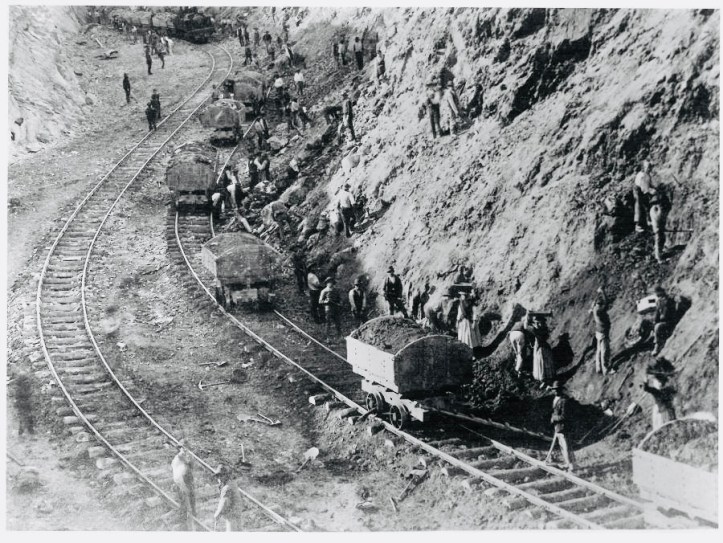
In the bottom right of the photograph below you can clearly see three women working at the Zarza open-pit Mine in 1887. This article presents a comparative analysis of labour laws in Spain and Britain throughout the 19th century, examining their enforcement and compliance (or lack thereof). The extensive employment of women and children in the Huelva mines will be the subject of a separate post; this article aims to provide essential context before exploring the specifics of the Huelva copper and sulphur mines. Was it normal for women and children to work in mines in Britain and Spain during the 19th century?
Labour Laws in Britain in the 19th Century
1832 Factory Act: This act was a milestone as it represented a shift in attitude from laissez-faire to some government intervention to soften the social impact of the Industrial Revolution. Interestingly, the Act established the figure of a government inspector (four in total) for the first time. Its key provisions included a prohibition on the employment of children under nine years of age in factories. Children aged 9-13 were restricted to working no more than 8-9 hours per day, with a maximum of 48 hours per week, and were explicitly forbidden from night work.
1842 Mines and Collieries Act: The interesting aspect of this act is the fact that it was driven by public outcry. One of Queen Victoria’s first actions as queen was to set up an investigation into the Huskar mining disaster in 1838 (26 children between 7 and 17 died underground when the coal mine flooded). The Royal Commission’s report was so damning as to the “horrendous” working conditions for women and children in coal mines, with some as young as five, that a landmark legislation was passed in 1842. The key provisions in the law were that women and children under ten were forbidden to work underground in mines.
Subsequent Refinements to Factory and Mine Legislation:
- The 1850 Coal Mines Inspection Act led to the appointment of dedicated coal mine inspectors.
- The 1860 Coal Mines Regulation Act raised the minimum age for boys working underground from 10 to 12.
- The 1872 Coal Mines Regulation Act mandated training for pit managers, enhancing safety standards.
- The 1881 Mines Regulation Act empowered the Home Secretary to initiate official inquiries into mine accidents, signifying increased state accountability for worker safety.
This series of acts demonstrates how the initial concept of government intervention to mitigate the social consequences of the Industrial Revolution gained traction, leading to a progressive build-up of protective legislation.
Labour Laws in Spain in the 19th Century
Spain’s industrial development significantly lagged behind other European powers throughout the 19th century, a delay clearly reflected in its legislation for the protection of women and children in the workplace.
The Ley Benot 1873: Considered to be the first labour law in Spain, this act was designed to protect children from abusive practices in industry and mining. Its key provisions included the prohibition of children under 10 in mines and factories, limiting the number of hours that children could work, as well as a ban on children working the night shift. It is widely accepted that compliance was low, drawing attention to the stark difference between de jure and de facto conditions.
The Mining Police Regulations 1897: This was the first regulation in Spain that explicitly prohibited women from performing underground tasks, a prohibition extended to children under twelve years of age. The drafting and approval of this regulation was a protracted process, taking 25 years from its initial draft in 1872.
The Ley Dato 1900: This was a pioneering law for work accidents, establishing the concept of employer liability and a system for economic compensation for workers injured at work. In March of the same year, another law was passed, further consolidating the rights and protections for women and children at work.
In summary, while labour laws evolved differently across Britain and Spain, by the end of the 19th century, the employment of women and children over the age of ten in the open-pit mines of Huelva, including those operated by British, Spanish, Portuguese, and French companies, remained largely legal and extensive, despite the often gruesome working conditions.
