
What is the connection between the sale of opium to China and the British investments in Huelva?
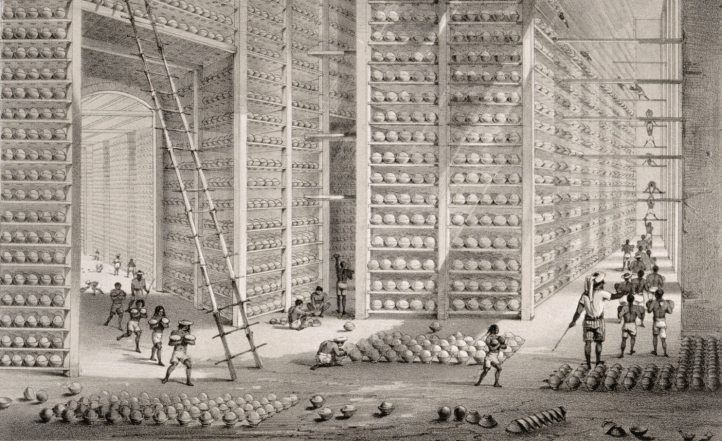
Early 19th Century (leading up to the war): The British East India Company significantly increases its illegal opium exports from India to China. This creates a severe trade imbalance, with China losing vast amounts of silver, and widespread opium addiction becoming a major social problem. The Qing government repeatedly tries to ban the opium trade, but it continues to flourish due to British smuggling.
March 1839: Lin Zexu, an imperial commissioner appointed by the Daoguang Emperor to halt the opium trade, arrives in Guangzhou (Canton). He takes decisive action, forcing British merchants to surrender over 20,000 chests (around 1,400 tons) of opium, which he then publicly destroys at Humen Beach.
July 1839: Tensions escalate after drunken British sailors kill a Chinese villager. The British official in charge, Charles Elliot, refuses to hand over the accused sailors to Chinese authorities, further inflaming the situation.
November 1839: Hostilities officially break out when British warships destroy a Chinese blockade of the Pearl River estuary at Hong Kong.
June 1840: A large British expeditionary force arrives in China, beginning a series of military campaigns. The technologically superior British forces, with their steam-powered ships and advanced weaponry, prove largely unstoppable against the Qing forces.
1841-1842: The British proceed to capture several key coastal cities and ports, including Canton, Amoy (Xiamen), Ningpo (Ningbo), and Shanghai. They eventually advance up the Yangtze River.
August 1842: The British capture Nanjing (Nanking), threatening the Grand Canal and forcing the Qing government to sue for peace.
August 29, 1842: The Treaty of Nanking is signed aboard a British warship. This treaty officially ends the First Opium War and is considered the first of the “unequal treaties” imposed on China by Western powers. Key provisions included:
- Cession of Hong Kong Island to Britain.
- Opening of five “treaty ports” (Guangzhou, Xiamen, Fuzhou, Ningbo, and Shanghai) to British trade and residence.
- Payment of a large indemnity by China to Britain.
- Granting of extraterritoriality to British subjects in China (meaning they would be tried by British law, not Chinese).
October 8, 1843: The Treaty of the Bogue (Humen) is signed as a supplement to the Treaty of Nanking, granting Britain “most-favored-nation” status, meaning any future concessions granted to other foreign powers would automatically apply to Britain as well. Other Western nations soon demand and receive similar privileges
Why is this important for our Huelva Chronicles?
Firstly, it’s worth noting that when reviewing the British press of the time there were many voices strongly opposed to the immorality of the opium trade and the invasion of Chinese sovereignty, it was by no means clear which way events could have unfolded, yet in the end, as often happens, economic interests took precedence. We sometimes have the impression that “The British Empire” was centrally planned, organised and heterogenous, and this is not the case.
More relevant to our Huelva Chronicles is the figure of Mr. Hugh Mackay Matheson who was instrumental in the purchase and formation of the Rio Tinto Company Limited in March 1873 by organising an international consortium to purchase the mines. Let it be clear, according to the sources consulted, that Matheson, a deeply religious businessman, was expressly against the opium trade and considered it immoral. He even convinced his brother Donald to stay out of this end of the family business. Nevertheless, the huge sums of money generated by his uncle, James Sutherland Matheson, together with William Jardine when they formed Jardine, Matheson and Company of Canton in 1832, was used to capitalise Matheson & Company in 1843. In 1848 Mr. Hugh Matheson, future chairman of Rio Tinto Company Limited took charge of a family company (Matheson & Company) that would not have come into being and would not have been able to diversify its investments without the huge amounts of capital that flowed from the opium trade to China at Canton.