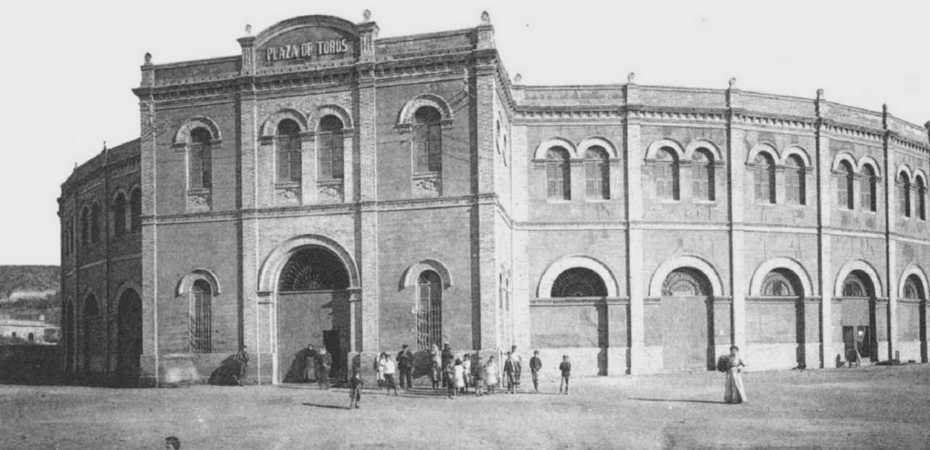
Huelva, like most great capitals, currently enjoys the possession of a beautiful and artistic bullring. Deficient and antiquated in relation to the development of the art of bullfighting were those built in previous years, whereas the one we shall presently describe has been constructed according to all the advancements that the craft demands.
Firstly, we must state that Huelva, capital of the province and head of the judicial district of its name, with 20,165 inhabitants and 1,800 buildings of one, two, and three stories, deserved to have, as any other capital of importance, its own great bullring. It is a maritime city of pleasant appearance, situated in the centre of the inlet formed by the confluence of the Odiel and Tinto rivers; its climate is healthy, and its hygienic conditions are unsurpassed. It possesses, furthermore, a High Court, a secondary education institute, a Normal School for Teachers, several public primary schools for both sexes, various private colleges—some of which receive subsidies—an Arts and Crafts School, a provincial hospital, a first-aid station, and municipal and lower courts. Five railway lines converge upon this city, namely those from Madrid to Zaragoza and Alicante, Zafra to Huelva, Buitrón, Tharsis, and Riotinto. The potable waters that supply the population come from two springs, being conducted by means of pipes over a distance of seven kilometres.
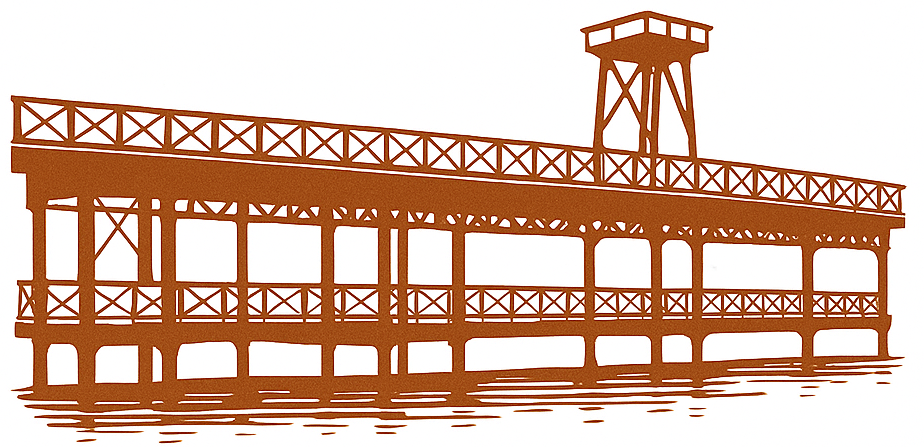
Innumerous strangers frequent its floating baths, a palpable proof of which is seen in those currently found here, where the climate is delicious and undoubtedly among the best in the world; evidence of this is found in the infinite number of families among us today, fleeing the intense heat felt in other provinces. Its buildings, for the most part, are of modern construction, as are its spacious and clean streets and squares.
Its commerce is currently flourishing, especially now that, with its newly built bullring, it will see its desired business multiplied. Such is Huelva at present. To conclude, we shall say that even at the cost of great sacrifices and struggling against ridiculous opposition and intentional hindrances, the initiative of a few enthusiasts has triumphed once more, providing Huelva with a bullfighting circus worthy of its importance and among the most perfect constructed to date. Here follows the description of such a beautiful edifice: the whole complex is developed over a surface of twelve thousand square metres, the combined part forming a regular polygon of forty-eight sides, its construction being of ordinary brickwork with a clean brick cornice.
The foundation is exceedingly solid, being entirely made of hydraulic concrete. The architect has known how to make great use of said material, both for decoration and for the handsome appearance of the building. The total exterior aspect of the circus is most elegant and extremely spirited and pleasing, as is the arena in its proportions; neither so small as to diminish the maneuvers, nor so large as to lose them, its diameter measuring fifty metres and the alleyway 1.80 metres.
Next comes a row of barriers, with a passageway seventy centimetres wide, followed immediately by the seating sections, composed of fourteen rows and nine wide entrances in the centres, distributed with perfect proportion. A wide and beautiful staircase provides access to the boxes, thirty-six in number, which are protected by an elegant railing, admirably designed for comfort, and in the centre, the great presidential box, projecting forward and with triple capacity. The main gate faces west, so that, with the presidential box situated above it, the ring remains divided, according to the general plan, into two halves: sun and shade. Opposite said entrance are the eight bull pens, and to the right and left of these are the exit gates for the bullfighters and the removal of bulls, and the entrance for the picadors and the removal of horses, respectively.
Across a very vast space extend the corrals for the livestock, the drafting area, the lead oxen, the skinning room, and the stables, along with all those dependencies necessary for the better service of the spectacle, such as the chapel, infirmary, pharmacy, bullfighters’ room, tack room, arena attendants, veterinarians, concierge, etc. The ring has a capacity for six thousand to six thousand five hundred spectators, who may enter through eight large gates, including the main one.
The seating sections are divided by two classes of vaults, some of angular form with buttresses, and others conical, no material having been employed other than hydraulic concrete for the foundations, along with stone, brick, and iron. It is a beautiful artifice and ornament at once, which honours the inventiveness of the provincial architect, Mr. Gallego, whose project, through its study and economic conditions, ennobles his technical and artistic career. It would be unjust not to likewise record those who, through their activity and zeal during the works, have known how to win the sympathies of the general public.
We refer to the intelligent master builders Mr. Francisco de P. Arenas and Mr. Juan Muñoz Beltrán, to whom from these columns we send our most cordial congratulations
(Text translated from Sol y Sombra 25th September, 1902)
