
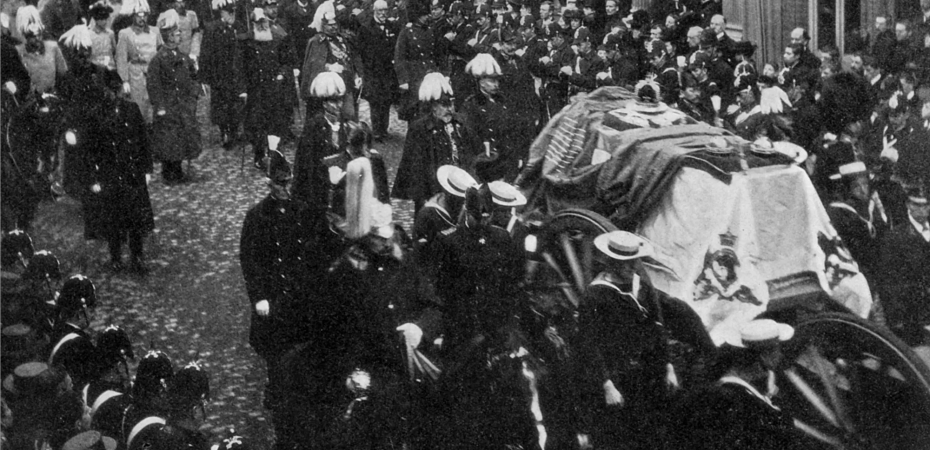
The funeral of Her Most Gracious Majesty Queen Victoria is fixed for to-morrow, but imposing first part of the programme takes place to-day, while the actual interment in the Mausoleum at Frogmore will be deferred till Monday. The Queen herself arranged her funeral down to the minutest details, leaving the directions in four sealed packets in case her death occurred either at Windsor, Osborne, Balmoral, or abroad.
The funeral arrangements include a mighty naval pageant between Osborne and Portsmouth, a great military and civil cortege from Victoria to Paddington, and a service in St George’s Chapel, Windsor. By order of the King, the day is proclaimed a day of general mourning, when the banks and places of business will be closed.
The mourners from abroad include the German Emperor, the Kings of Belgium, Portugal and Greece, the Tsarevitch, the Archduke Francis Ferdinand (future Emperor) of Austria, the Duke of Saxe-Coburg, and representatives of almost every civilized power.
It was the Queen’s own request that the Navy and Army should play a large part at the funeral, and that the coffin should be covered with the British flag. A mighty fleet of thirty warships will form a continuous line from Osborne Bay to the entrance of Portsmouth Harbour. The Kaiser has summoned a fleet of his own warships, and these, with warships representing other countries, supplemented by torpedo-boat destroyers and gunboats, will form a second line.
At a quarter to two to-day the body, on a gun carriage, will be conveyed to the “Alberta.” Pipers will play a lugubrious lament as it passes through the estate. At the Queen’s Gate, massed bands, with muffled drums, will break into mournful music. Behind the coffin will walk first the King, followed by the Kaiser and the other chief mourners. After the Princes will walk Queen Alexandra and the Princesses.
At Trinity Pier, Cowes, bluejackets will carry the coffin down the gangway to the “Alberta,” between lines of Grenadiers with arms reversed. During the embarkation the bands will cease playing but for the roll of the muffled drums. Between the lines of battleships the Royal yacht “Alberta,” conveying the body, will slowly steam, while minute guns will boom over the waves from the warships. The last voyage of the Ocean Empress is expected to occupy two hours. The body will remain during the night on the “Alberta.”
From Portsmouth to Victoria the body and the mourners will be conveyed on Saturday morning by a special train of eleven corridor carriages on the South-Western Railway. Between the landing-stage at Portsmouth and the station the body will be borne on a khaki-coloured gun-carriage, fitted with rubber-tyred wheels. A similar gun-carriage will be provided for the conveyance from Victoria to Paddington and a third for use at Windsor.
The cortege from Victoria will be a highly dramatic spectacle. The route to be followed is about three and a half miles, passing through St. James’s Park, St. James’s-street, before St. James’s Palace, Piccadilly, Hyde Park from Apsley Gate to the Marble Arch, Edgware-road, Boundary-road, London-street and across Praed-street to Paddington arrival platform.
The time occupied will be two hours, the procession leaving Victoria at eleven o’clock. The bearers at either end have been selected from the non-commissioned officers and men of the ten Queen’s regiments, every man being of exemplary character and not under six feet in height. Twenty thousand troops will line the route.
The King, the Kaiser and the other Kings and Princes will follow the body on horseback, as they followed the Queen in her Jubilee procession of 1887. Members of both Houses of Parliament and other representatives of the national life will fall into the procession. The Albert Chapel will be filled, it is expected, with wreaths. The King and other Royal mourners will occupy the stalls of the Knights of the Garter. About a thousand ticket-holders will be accommodated.
The service will be conducted by the Archbishops of Canterbury and York, assisted by the Bishop of Winchester and the Dean and Canons of St. George’s Chapel. In accordance with the Queen’s tastes simplicity will be the note of the service. Several of her favourite hymns will be sung.
The body will lie in the chapel over Sunday, watched by Grenadiers. On Monday morning it will be carried over paths lying within the Royal demesne to the Mausoleum, and there it will be committed to its last resting-place by the side of the much-loved husband. This last scene will be witnessed by none but members of the family.
(As published in The Examiner)
