
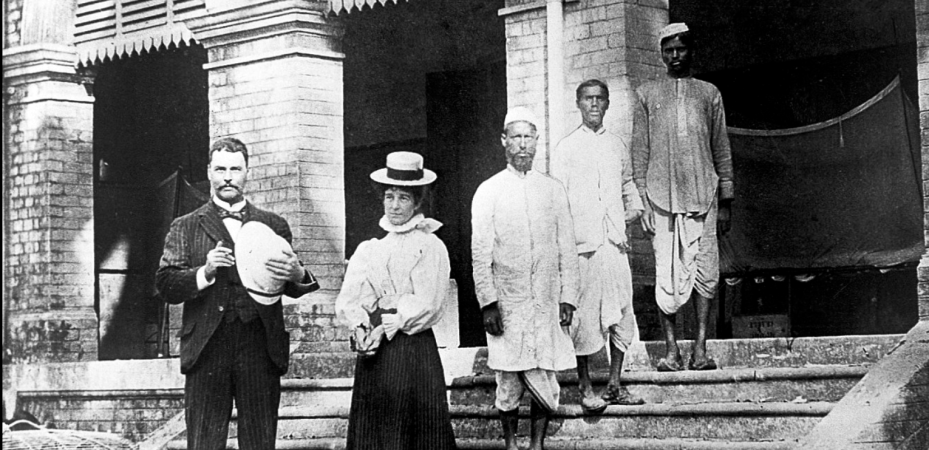
The cablegram from Sierra Leone in which Major Ross makes known to the new Liverpool School of Tropical Diseases the discovery of the “malaria-bearing mosquito,” has attracted a good deal of attention among scientific men, who are anxious for more precise information as to the nature of the doctor’s discovery. Mr. Chamberlain, who, it will be recollected, sent an encouraging message when the expedition was leaving Liverpool on the 29th ult., has now consented to receive a deputation at the Colonial-office in regard to Major Ross’s discovery and his request that the Government should at once send men to Sierra Leone.
In an editorial treating of the subject on Wednesday, the Times says:
“The forms of illness attributed to ‘malaria’—the very persistence of the term being a curious illustration of the vitality of a groundless hypothesis—have been known from the dawn of history; and the conditions of their prevalence have presented problems over which many generations of investigators have exercised their ingenuity in vain”.
Even within the last few years, “malaria” has been medically defined as “an earth-born poison, generated in soils the energies of which are not expended in the growth and sustenance of healthy cultivated vegetation”. This “poison” has been recognised as “the cause of all the types of remittent and intermittent fevers, commonly called malarial, and of the degeneration of the blood and tissues resulting from long residence in places where it is generated”.
The fevers in question are commonly known as “ague,” and they present marked differences of character and severity. A febrile paroxysm usually consists of:
- A stage of shivering.
- A stage of dry heat.
- A stage of profuse sweating, after which there is temporary recovery.
The paroxysm may recur in different patterns:
- Quotidian: Recurring daily.
- Tertian: Recurring on alternate days.
- Quartan: Recurring on every fourth day.
In the regular forms, the paroxysm begins and ends each day about the same time. However, in the quotidian form, the hour of commencement is often different on the alternate days—for example, it may be in the morning on Monday, Wednesday, and Friday, and in the afternoon on Tuesday, Thursday, and Saturday. Even the slighter forms of the disease are excessively disabling, and the more severe forms are attended by a frightful mortality.
It was declared by Dr. Cornish, Sanitary Commissioner of Madras, that “fevers, one year with another, destroy twice as many people in India as smallpox, cholera, and ll other epidemic causes put together.” The word “fever,” as thus used, would probably include typhoid ; but the malarial fevers would be mainly responsible for the results. When the British army under Wellington was in Extremadura it was assailed by a remittent fever of such malignity that, in the words of Ferguson, “the enemy and all Europe believed that the British host was extirpated.” In the so-called tropics “malaria” is the chief cause of “unhealthiness” and it appears to be the sacrifice of European life which has thwarted the best efforts of soldiers, of settlers and of merchants.
The formidable character of malarial fevers was firs abated by the discovery of the power of quinine to control them ; but is was not until 1891 that an examination of the blood of patients, conducted with the aid of the highest powers of the modern microscope, showed that actual cause of the disease to be innumerable exceedingly minute parasites inhibiting the red corpuscles of the blood. It was soon found that each paroxysm of fever coincided with the life history of a single brood of such parasites. The species producing tertian ague lived its life and brought its progeny to the same stage in seventy-two hours ; the species producing quartan ague in ninety-six hours ; while quotidian ague was found to be, so to speak, a double tertian, produced by broods reaching maturity on alternate days. In the irregular forms yet another parasite was discovered, characterised by the formation of certain crescent-shaped bodies which eventually developed line threads or “flagellae,” a circumstance which led to the inference from analogy that they were adapted to pass a portion of their lives as parasites in insects. The microscope showed that effect of a dose of quinine, given in propel quantity and at the proper time, was fatal to the blood parasites, insomuch that such a dose given to a patient suffering from quotidian ague, might cure him for alternate days only—that is to say, might cure one of his two tertian agues, leaving the other uninfluenced and requiring another dose to be given at a time corresponding to a particular stage in the existence of its causes. It had already been suggested in America that there was a distinct connection between the prevalence of malarial fevers and the activity of mosquitos ; but the Italian physicians who had the best European opportunities of observing the disease, were unable to accept this hypothesis. They pointed out that there were plenty of mosquitos in districts in which fevers did not prevail, and that a febrile was often separated from a non-febrile district by a boundary over which mosquitos might be expected to pass. It was reserved for Major Ross, in India, to suggest that the differ once might depend on the species of mosquito, and to establish his hypothesis by discovering, in the bodies of one particular species, undoubted remains of the malarial parasite. Soon afterwards Dr. Grassi, in Italy, obtained three different species of mosquito from Maccarese, where fever was present, and succeeded in producing the disease, by the agency of their bites, upon a man who consented to submit himself to the experiment. In view of this history, it must probably be presumed that the recent search of Major Ross has been rewarded, not, as might be supposed, by the discovery of what was already known, the malaria-bearing mosquito of Europe, but by the discovery of at least one of the species which produces, or rather which communicates, the much more severe and fatal fevers of the tropics.
If this be so, it is evident that at least the first step has been taken towards the control of these diseases, but it does not follow that either the next step or the subsequent ones will be easy. A mosquito is practically a gnat, and has a similar life history. Its eggs are deposited on water, either in pools or in domestic cisterns, and its larvae and pupae are easily recognisable aquatic insects, of curious forms and active habits. Their presence in the domestic cistern, at least in countries where fevers are common, might probably be prevented without serious difficulty ; but it is hardly likely that it will ever be possible to destroy them in the pools and ponds of countries which they infest. Something may perhaps be done to protect Europeans from that bites ; and in some regions anointing with coal-tar oil is said to be efficacious for this purpose. It is not unreasonable to hope that some less unpleasant prophylactic will be found, or even some means of effecting the wholesale destruction of the mature insects in the neighbourhood of human habitations. As to the actual mode in which the human subject becomes infected, it has been suggested that the mosquito fills itself with infected blood and then contaminates the sources of drinking water. But the more natural sequence of events seems to be that the mosquito communicates the parasite and the consequent disease to man by its bite, instead of first receiving it from him. The doubt will probably soon receive experimental solution.
(Adapted from the Weekly Courier)
