255 Seamen Drowned and 90 Injured–Bravery of Spanish Seamen
(Telegram from a Special Correspondent) Havana, February 16, Morning.
About a quarter to ten o’clock last night the entire city was thrown into a state of mad excitement by the sound of a terrible explosion, followed by the red reflection in the skies of what seemed to be a great conflagration somewhere in the harbour. The solid ground shook and houses trembled as though the city had been struck by an earthquake. For a short time that explanation of the phenomena was generally accepted, and hundreds of people began to move out towards the open country in order to get out of the danger, which appeared to be imminent, of being overwhelmed in the ruins of the city. But thousands more rushed to the quays and wharves and other points from which the harbour could be viewed. There they say a great display of colour, and were oterrified by the noise of further explosions. Then a rumour spread that the Spanish cruiser Alfonso XII was fighting a battle with an American warship, and wild excitement seized upon all, but at this moment the Alfonso XII, whose position in the harbour was known to all, turned her search lights on the crowded quays, and so demonstrated that she was safe. About a quarter of a mile away from the Spanish cruiser a big vessel was blazing, and that it was in dire distress was apparent from the fact that the boats had put off from every vessel in the harbour to her assistance.
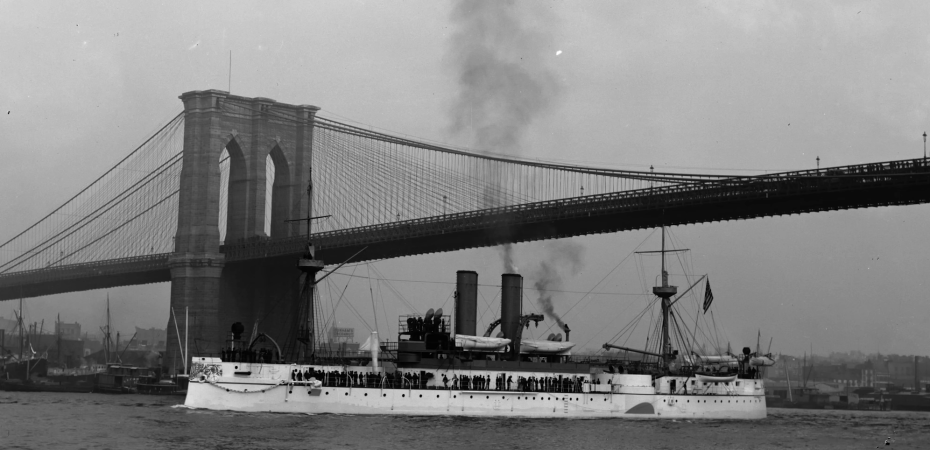
It was half-past ten before it became generally known that the ill-fated vessel was the great American cruiser Maine, but long before that the cruiser had disappeared from view. She had foundered at her moorings and over 100 men had gone down with her. What actually occurred on board the Maine has been most clearly described by one of her officers. Most of the officers, he said, had obtained leave to accept invitations to dinner on board another American vessel in the harbour, and were therefore absent when the disaster occurred. None of the men had been allowed to go ashore, so that there were nearly 400 souls on board. With the exception of the watch, all were below, and the majority were in their bunks asleep.
The Maine was at anchor, but her fires were alight. Precisely at a quarter to ten o’clock a fearful explosion occurred. It seemed to come from the main stokehold, and nobody on board doubted that one of the boilers had exploded forward of the ship. The cruiser strained at her anchors, and her plates appeared to bulge. Simultaneously flames burst out in two or three places as though the wrecked furnaces had scattered their contents in all directions. The bugles sounded the alarm, and scores of men rushed on deck. They were first ordered to fire stations, but almost immediately there was another, and even more tremendous, explosion, the flames having reached the main magazine.
Great holes were torn in the cruiser’s side and bottom, and she began quickly to settle down. Efforts were then directed to getting out the boats, and while some of the men were so engaged a third explosion occurred. Then Captain Sigsbee authorised a sauve qui puet. All around the doomed vessel flocked boats and steam launches, so that the most of those who threw themselves into the sea from the sinking vessel were picked up without difficulty. Most of the boats, it must be said, kept at a respectable distance from the burning warship, for explosions continued to occur as the now furious flames reached magazine after magazine. But the boats and launches from the Spanish warships, especially those from the Alfonso XII, moored hard by, most gallantly stood almost alongside, and it was owing to their heroic conduct that at least 200 lives were saved. The Spanish cruiser, too, rendered valuable assistance by the skilful manner in which she kept her searchlights full upon the Maine. This was the only light by which those on board could work, for the Maine’s own electric light was extinguished after the second explosion. The greater credit is due to the Alfonso XII, inasmuch that there was for a time a good deal of confusion and excitement on board, she having experienced the force of the explosions on the Maine so directly as to be torn from her moorings.
The crowds on the quays were greatly excited and terrified by the sight of the burning warship, and there were repeated wild stampedes, in which many persons were injured, as explosion after explosion occurred. At the first alarm on shore the fire brigade and the garrison were turned out, and complete preparations were made for maintaining order throughout the city.
Marshal Blanco, as soon as the news of the awful disaster reached him at the Palace, sent an aide-de-camp to Consul-General Lee, the representative of the United States, to express his deep sympathy, and to place at the disposal of the Consul-General all the resources at the command of the Cuban Government.
The Spanish general Solano, who was on f the earliest on the scene of the disaster, had a conversation with Captain Sigsbee, commander of the Maine, who remained on his vessel almost to the extreme moment, and yet escaped almost unhurt. He said he was entirely at a loss to explain the cause of the disaster, and he had telegraphed to that effect to his Government at Washington. He himself was on board when the explosion took place, and had an almost miraculous escape in one of the boats which they managed to get clear a the last moment. Many of the survivors of the Maine were badly wounded and they received every attention from the medical officers of the Spanish warships and other vessels, including a larger liner which was in the harbour at the time.
A later but quite unconfirmed version is that the crew of the Maine were engaged in cleaning torpedoes when one of the latter exploded. The survivors say that this statement is entirely untrue.
Reception of News in America
(Telegram from a Special Correspondent)
At an early hour this morning, after most of the newspapers had gone to press, a despatch was received from Havana stating that the United States cruiser Maine had been blown up in Havana Harbour, and had subsequently foundered with over 100 men. Special editions of the evening papers commenced publishing hours earlier than usual, and continued to issue “Extras” as each item of news came in. No event of recent years has caused such an enormous and widespread sensation in this country.
In Washington the terrible news was received at the Navy Department from Captain Sigsbee, commander of the Maine. His cable despatch ran as follows:–
Deeply regret to inform you that the Maine was blown up in Havana Harbour at 9:40 p.m. and destroyed. Many are wounded, and doubtless many more were killed and drowned. The wounded and others are on board a Spanish man-o’ -war and the Ward Line steamer. Send lighthouse tenders from Key West for the crew and the few pieces of the Maine’s equipment still above water. No ione saved was got off with anything but the clothes upon him. Public opinion as to the cause of the disaster should be suspended till further report. All the officials are believed to have been saved. Lieutenants Jenkins and Merritt are as yet unaccounted for. Many Spanish officers, including representatives of Marshal Blanco, are no with me, and express their sympathy.
The receipt of this despatch caused great commotion in Governmental circles at Washington. Mr. Long, Secretary of the Navy, was at his desk without a moment’s avoidable delay, and at once despatched orders to the Key West as requested by Captain Sigsbee. Then he sent round the news to the White House, and to the other members of the Cabinet, all of whom proceeded as quickly as possible to the Navy Department, and then to the White House. The President received them. He as inexpressibly shocked by the awful news, and expressed deep grief concerning the fate of the Maine’s brave officers and men. Mr Long is said to have shed tears on the first shock of the news, but he soon recovered his nerve, and was engaged more or less the entire day in consulting with the officers of his department, and with the President and members of the Cabinet.
Here in New York the details of the disaster came through with exasperating slowness and it was well on to noon before the newspapers had much beyond what was contained in Captain Sigsbee’s first despatch. Some the New York newspapers, particularly the “Evening Journal,” declared without hesitation that the Maine was treacherously torpedoed, and adhered to this theory throughout the day, and supported the publication of numerous sensational despatches. All the despatches agreed that the majority of the crew were asleep when the explosion occurred, and were drowned before they could reach the upper deck.
Fortunately for the public peace some of the more sober newspapers came out with statements designed to show the probability that the explosion was due to accidental causes, and in this connection it was pointed out that if it had been the fiendish work of Spanish conspirators Captain Sigsbee would have cabled for avenging warships and not for lighthouse tenders. Men in responsible positions unanimously declared that they would comply with Captain Sigsbee’s request and suspend judgement pending authoritative investigation on the spot.
The experts of the Navy Department all repudiate the torpedo theory, and most of them inclined to the belief that the fire commenced accidentally in the paint and varnish compartment, and that thence the flames spread to the magazine unseen until the actual mischief had been done. Not one of the numerous despatches from Havana states that any effort was made to extinguish the conflagration, and this is taken to confirm the theory that the first intimation of the disaster came with the actual explosion in the magazine. Nevertheless, the receipt of detailed despatches for Captain Sigsbee is feverishly awaited by the Government, and the delay in their arrival is considered almost inexplicable. The State Department officials are particularly anxious for the earliest possible publication of all the facts, as they fear that delay many further inflame the popular mind against Spain and everything Spanish. The whole country is in a perfect ferment this afternoon. Here and in every town and village where there are newspapers or telegraph officers crowds are gathering clamouring impatiently and even fiercely for news, especially for the official lists of killed and wounded.
The Navy Department is arranging for the despatch of another cruiser to Havana to replace the Maine. The lighthouse tender Mangrove and the despatch boat Fern have sailed from Key Wast for Havana and a steamer with physicians and surgeons from the monitor Ericsson has left Torrugas for the same destination.
A despatch just to hand from Captain Sigsbee says he estimates that at least one-third of the crew were killed and injured.
The Number of Lives Lost
(Telegram from a Special Correspondent) Havana, February 16, Noon.
There can be no doubt that every man who was below in the fore part of the Maine when the fist terrible explosion took place mush have perished. That was the actual seat of the first and most serious explosion, and the cruiser settled down rapidly at the bows immediately afterwards, so that even had the poor fellows escaped the effects of the explosion, they could not have escaped in time to the upper deck. At Midnight the Maine was entirely submerged except for the extreme end of her stern, which was then just above water, and still burning furiously.
Eye-witnesses who were on board adjacent ships in the harbour declare that the outbreak of fires was followed almost immediately by the first explosion. There seems to be a pretty general agreement that the disaster was due to the accidental ignition of a shell or signal rocket in the magazine. Altogether 90 of the Maine’s crew were treated on board the Alfonso XII. The majority had attained only slight injuries, but a number were very seriously injured some of them mortally and all these were carefully removed ashore and placed in the hospitals already crowded with wounded Spanish soldiers.
The crew of the Maine numbered 397 seamen and marines and 26 officers. Two officers were killed and one injured, the remainder escaping unhurt. The 90 men taken on board the Alfonso XII, will, it is feared, prove to be the only survivors, so that the loos of life must unhappily be put at the dreadful figure of 300. Most of the bodies which have been recovered are shockingly burned and mangled, and nearly all the survivors are burned more or less severely.
The survivors are loud in their praise of the gallantry and kindness of their rescuers. Captain Sigsbee has expressed his appreciation of the energy and kindness of the Spanish authorities. Marshal Blanco has cabled to Washington an expression of his deep sympathy. It has transpired that the first boat to reach the burning cruiser was one from the Alfonso XII., in which were two Spanish doctors. They had scarcely got alongside the Maine when an explosion occurred, and the two doctors and several of the boats’ crew were somewhat seriously injured.
Reception of the News in Spain
(Telegram from a Special Correspondent) Madrid, February 16, Evening
A special cable despatch to the “Imparcial” from Havana states :–
A painful sensation has been caused here by the discovery that several American newspaper correspondents have been telegraphing that the explosion on the Maine was caused by a torpedo or dynamite infernal machine, maliciously placed against the cruiser’s bows. It is feared that this infamous allegation may be amplified, sent by steamer to Key West, and thence telegraphed to the newspapers of the United States. It is entirely false. It should be remembered too, when discussing the suggestion of malice that the Maine’s crew were a composite lot, consisting of Englishmen, Germans, negroes, and Chinese besides Americans.
