(From our Special Correspondent at the Huelva Gazette)
Statesman, Historian, and Friend to Huelva
Born Málaga, 8th February 1828 – Assassinated Santa Águeda, 8th August 1897
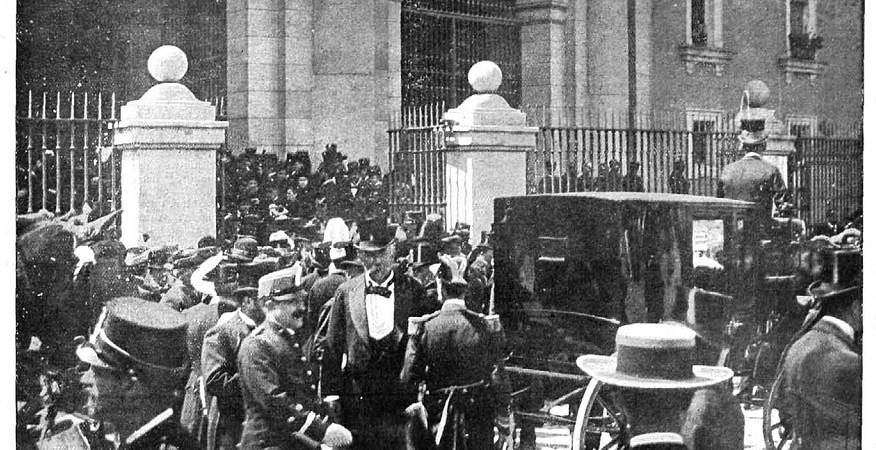
It is with solemn respect that we record the untimely death of Don Antonio Cánovas del Castillo, Prime Minister of Spain, historian of note, and the foremost architect of the Bourbon Restoration. On the 8th of August, while taking the cure at the thermal baths of Santa Águeda, the distinguished statesman was struck down by an anarchist’s hand, in a crime as cowardly as it is deplorable.
Born in Málaga in the year 1828, Cánovas rose from scholarly pursuits in philosophy and law to early prominence in journalism, though he swiftly abandoned the pen for the tribune. Elected to the Cortes in 1852, and appointed shortly thereafter to the Ministry of the Interior, he began a political career that would extend for over four decades, marked by unwavering service to Crown and Country.
He was in turn Minister of Gobernación, Finance, and of the Overseas Colonies. Following the revolution of 1868, he was exiled, yet remained ever a vigilant guardian of national order. It was he who designed and brought about the Restoration of the monarchy under His Majesty Alfonso XII, following the pronunciamiento of General Martínez Campos in 1874. The institutions he founded have granted Spain a measure of stability long absent from her public life.
He held the Presidency of the Government on no fewer than five occasions. Though often resigning from office—either by conscience or conflict—he ever returned, summoned by duty and by royal confidence. His was a hand firm yet constitutional; his loyalty to monarchy and Catholic tradition unbending. In matters colonial, he bore a stern but steady purpose, believing Cuba and Puerto Rico to be not mere holdings, but inseparable parts of the Spanish nation.
Yet it is not only in the lofty matters of statecraft that his name is revered. Here in Huelva, we remember Cánovas not only as a statesman, but as a patron and protector of our province’s honour and development. It was he who lent political weight to the Zafra-Huelva Railway, and gave warm reception to British financier Mr. Hugh Matheson, Chairman of the Río Tinto Company, whose philanthropic efforts in the region Cánovas personally lauded. He marvelled at the schools and hospital established for the working classes and is known to have praised the Company’s social conscience.
But above all, Huelva remembers Cánovas as the champion of La Rábida. When the nation prepared to commemorate the Fourth Centenary of the Discovery of the New World, it was Cánovas who ensured that Huelva, and not some distant capital, would be its rightful stage. As President of the Government, he penned the preamble to the Royal Decree that placed La Rábida at the heart of the celebrations. He was named honorary president of the IX International Congress of Americanists, and his vision lent dignity and grandeur to the festivities of 1892, which brought together scholars and dignitaries from both sides of the Atlantic. In grateful recognition, the Sociedad Colombina Onubense named him a protector and patron.
Cánovas was also a historian of singular insight. His writings on the decline of the Spanish monarchy, the House of Austria, and the reign of Felipe IV remain authoritative. As Director of the Royal Academy of History and President of the Ateneo of Madrid, he sought to unite past and present, believing history to be the very lifeblood of political action. “Politics,” he wrote, “is the realisation of history in each moment.”
In an age of shifting ideologies and fragile pacts, Antonio Cánovas del Castillo stood for continuity, tradition, and order. Though often accused of obstinacy, he was ever guided by a profound sense of Spain’s historic mission. His passing leaves a void in the councils of the nation, and a shadow upon our shores.
May his name be honoured among us, in Huelva as in Madrid, not only for what he governed, but for what he made possible: a renewed awareness of Spain’s place in the world, and a restored pride in the land from which Columbus sailed.
Requiescat in pace.
