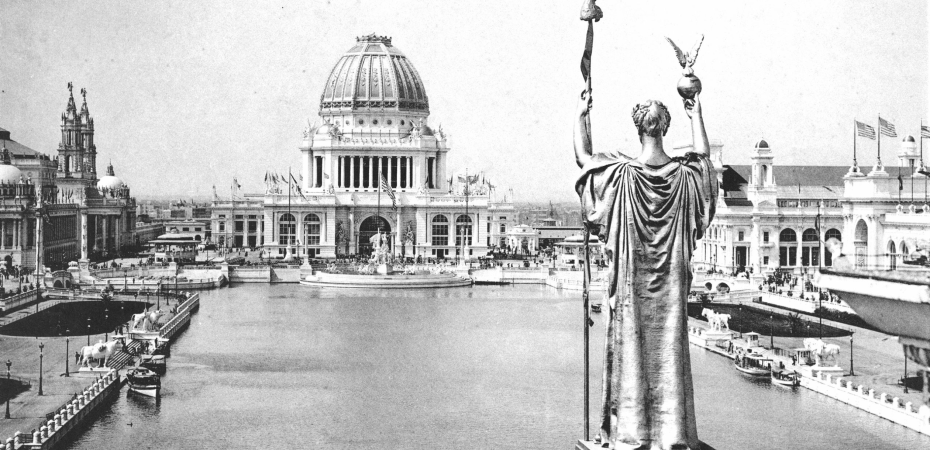
Chicago, March 11, 1893. President Cleveland having accepted an invitation to open the World’s Fair in person, the Committee on Ceremonies has resolved to ask the Queen Regent of Spain to permit King Alphonso to take part in the inaugural proceedings as the reigning representative of the country from which Columbus set out on his voyage to the West. The committee proposes that the signal for the commencement of the opening ceremonies should be transmitted by cable, direct telegraphic communication being established for the purpose between Madrid and Chicago, so that His Majesty will be enabled, by merely touching the transmitter, to set the elaborate inauguration machinery in motion. The idea is a pretty one, and has met with general approval.
Spain is taking a prominent place in the Fair. Her building on the lake front is fast taking shape under the direction of Commissioner de Lorne, and the first shipload of exhibits is daily expected at New York. The reproduction of the Convent of La Rabida is now complete, and is much admired on account of its quaint and picturesque features. Within it the relics of Columbus contributed by the museums of the Court of Spain will be exhibited. The Infanta Eulalia and her husband are expected to be present in Chicago at some time during the Fair.
The original will of Queen Isabella, which is regarded as the most interesting and remarkable document in the hands of the Spanish Government, is to be sent for exhibition. This document is interesting, since it contains instructions as to the treatment of the natives of America. The Spanish Government have also lent the original portrait of Columbus, from the National Gallery. This portrait is considered the most authentic now extant. In addition to these, the Dukes of Alba and Veragua will send a number of valuable manuscripts, including 42 original letters of Columbus and Queen Isabella.
In almost every department foreign exhibitors are now far ahead of the American, both in respect of the progress that has been made in the various courts and pavilions, and in respect of the quantity of goods actually on the ground. Among recent arrivals from Great Britain are:
- The big cheddar cheese, valued at £100, sent by Mr. Edward Manning of Bristol.
- Models of steamships, valued at £2000, sent by Messrs. James & George Thomson, of Clydebank, Glasgow.
- The carved oak panelling for Victoria House.
The next big English exhibit to reach the Fair will be the locomotive and two carriages sent by the London and North-Western Railway. They arrived safely at New York on board the Runic. The engine, which is called the Queen Empress, was built at Crewe, and weighs 13 tons. The whole train will be boxed up while en route to Chicago. The sleeping saloon is expected to excite considerable interest, as it is modelled on a plan totally dissimilar from that adopted in this country.
In the naval department, Architect Grogan is erecting for the Inman Line a full-sized reproduction of a section of an Atlantic liner. Laird Brothers’ exhibit has already arrived, including a model of the famous Confederate cruiser Alabama.
Sir Henry Trueman Wood has established his headquarters at Victoria House. He states, “The best of our large displays will be found in the Art Palace.” The collection of paintings has been insured for one million dollars and includes:
- Herkomer’s “Last Muster”
- Sir Frederick Leighton’s “Alcestis”
- Stanhope Forbes’s “Forging the Anchor”
- Briton Riviere’s “Daniel in the Lion’s Den”
- Watts’s “Love and Death”
- Millais’s “Ornithologist”
- Alma Tadema’s “Audience at Agrippa’s”
Queen Victoria has intimated to President Higinbotham that the splendid collection of historical tapestries at Windsor Castle will be lent for exhibition. The telegram read: “Queen cordially approves loan of tapestries to Chicago.” A fine model of Windsor Castle, built to scale, will also be exhibited by Messrs. Lever Brothers, of Babington.
Scotland is well to the fore in the Women’s Building. Contributions include:
- Quaint needlework from Mrs. Morrison Duncan of Naughton, Fife.
- Ancient embroidery (1660) from Lady Strathmore.
- A portière (1740) from Lady Aberdeen.
- Fine specimens from the Royal Edinburgh Repository.
- Homespun tweeds and knitted stockings from Lady Mackenzie of Gairloch.
There is every prospect that Burmah will make a good show, with rare specimens of Burmese carving, metal work, and workmanship in ivory, silver, and teak, including idols obtained from the natural caves near Moulmein.
On April 1 the Fair will be closed to all visitors in anticipation of the immense amount of work to be done before the 1st of May. Already, visitors on a fine Sunday have exceeded 10,000, each willingly spending a shilling to see the Fair in its unfinished condition.
(Adapted from The Glasgow Herald)
