(Extract from Spain of Today by W. R. Lawson 1889)
To-day we bring to your attention the account of our Columbus Hotel, or Hotel Colon as we know it, taken from William R. Lawson’s Spain of To-day which was published earlier this year.
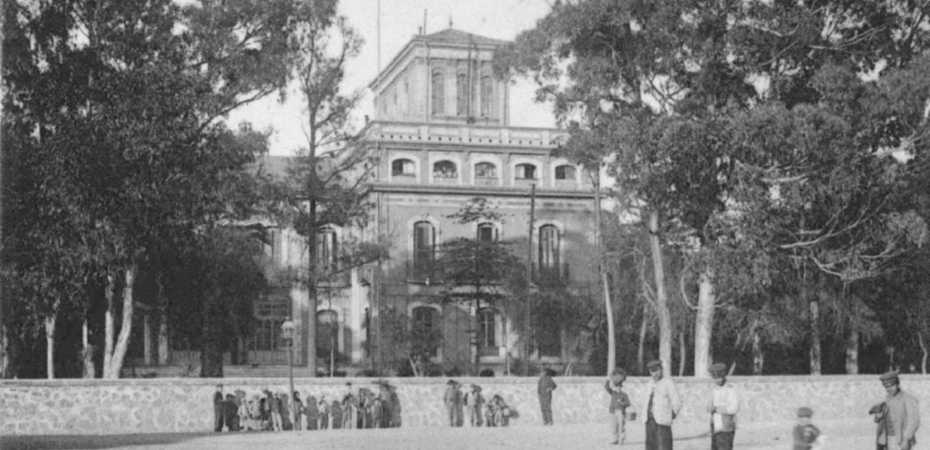
The best hotel in the Peninsula I found in a very unexpected spot, and I have hardly yet got over my surprise that such a palatial establishment should be so little known. The Colon or Columbus hotel is one of the sights, as well as one of the institutions of Huelva. In size, in arrangement, in furniture, and above all cuisine, it is the best I have met with in Spain, or in fact south of Paris. The Rothschilds, the Rio Tinto Company, the two local railways – Seville-Huelva, and Zafra-Huelva – were all at the founding of it ; so if they could not produce a model hotel, for whom is one to be expected? It is situated in the outskirts of the town, well up the bay, and near what will ultimately be the principal water front. There are four distinct block enclosing a quadrangle of an acre or two in extent. The front block is divided into suites of apartments, of which there are fourteen. – sitting-room, bedroom, and bath-room to each. These are fitted up in various styles, not two alike, but all in charming taste. Much of the furniture was specially designed fro the rooms by distinguished French and German makers. The royal apartments at the Hotel Bristol and other caravanserais for crowned heads are like Tottenham Court Road beside them. The late King Alfonso had heard so much about their beauty, and was so partial to Huelva otherwise, that in his las illness he wished to go to the Hotel Colon. Political reasons required another selection to be made, but Huelva expects that his won will, at no distant date, carry out his unfulfilled wish.
The State apartments open on the garden behind, through a large marble-paved hall. This garden, which is beautifully laid out in shrubberies, flower pots, fountains, and shady walks, is enclosed on either side by a block containing the single bed-rooms, and at the back are all the public rooms, admirably arranged in a single building. The dining-room is a magnificent hall, which can also be used as a ball-room, and on these occasions it can accommodate nearly a thousand people. The ceiling is decorated with designs by Seville artists, and the fireplaces are of china, all specially made at the Royal Porcelain Factory in Meissen. A broad corridor runs around the hall, in which are the reading-room, billiard-room, card-rooms, &c. Fronting the whole of this block is a smooth paved terrace, where guests can drink their after-dinner coffee, gaze on the inconstant moon, and listen to the nightingales. Dost like the picture? I think you would if you saw it.
