(As published in La Provincia)
I. The question which we are about to address has, in recent months, assumed truly extraordinary proportions, which have prompted us to devote a careful and meticulous study to it; consequently, we deem it most convenient and useful to examine it in all its phases so that public opinion, enlightened by certain and authentic data, may judge for itself what is the best and only legal solution that shall harmonise these opposing interests.
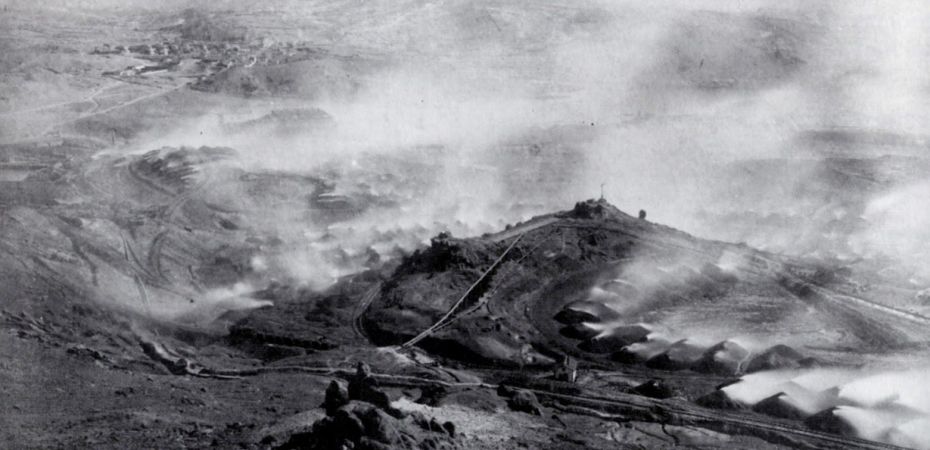
Our hope for such a solution was based upon the facts, which we came to know, occurring between the years 1877 and 1880. In 1877, complaints were formulated by some against the procedure in question, concerning public health and agriculture, and the Government, after studying the matter by means of local inspection by most competent persons, the hearing of towns, companies, and corporations, and the report of the Council of State, issued on the 22nd of July, 1879, a resolution of a general nature, with which all interested parties complied. By virtue of this resolution, the Government presented a bill to the Cortes, which imposed upon the mining companies the obligation to indemnify the damages that the calcinations might actually cause.
Great, for this reason, was our surprise when we received word through the local press a year ago that the Town Council of the village of Calañas had taken the resolution to prohibit the procedure of open-air calcination within its municipal boundaries. This surprise has since increased upon seeing the numerous incidents that have originated by virtue of that resolution, and the no less numerous articles and reports published by persons claiming to represent the affected towns and by the mining companies.
II. … This Royal Order was founded upon the Official Gazette of the province of Huelva from the 15th and 16th of August, 1879, with the following notice from the Governor of the province: ‘Which is made public in this official newspaper for the knowledge of the interested towns, the company aforementioned (Rio-Tinto), and other private individuals whom the pre-inserted Royal Order may affect’.
Prior to this resolution, several points were established and declared: 1st, That the results demonstrated that the fumes are not detrimental to public health. 2nd, That the question was reduced to a conflict of interests between the agricultural industry and the mining industry, and that it was necessary to opt for the most important one; nevertheless, the mining industry remained under the obligation to duly indemnify the agricultural one. 3rd, That it was a fact, recognised by all and sufficiently proven, that the mining industry is the most important and that which has brought wealth to the country. 4th, That it was not possible to prohibit or limit the freedom of the mining industries regarding the procedure, nor was it authorised by current legislation, which grants miners the most complete freedom to adopt in their operations the procedure they deem most appropriate. 5th, That such a prohibition could not be imposed upon the Rio-Tinto company, understanding that the same has the right to calcine in the open air without being exposed to a petition for the rescission of the purchase contract or for the indemnification of damages.
