(As published in La Provincia)
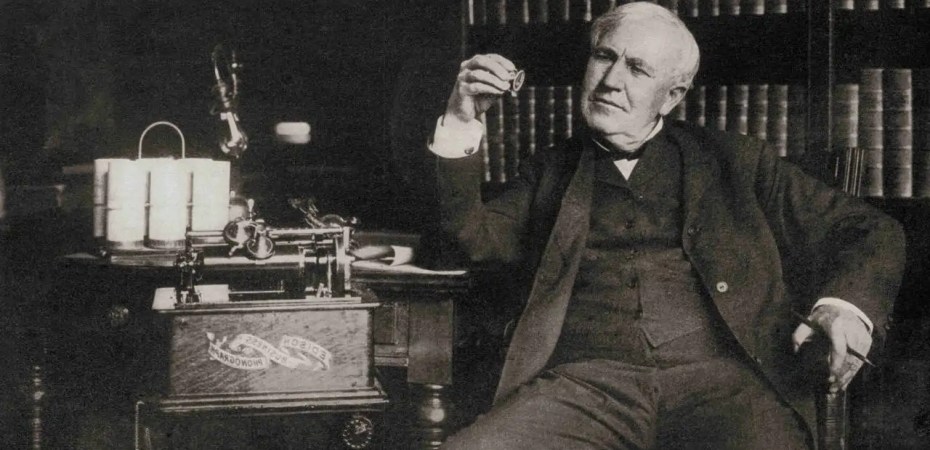
History of electricity. This great force of nature, which already possesses so many and such useful applications, although we do not yet know its causes and appreciate it only by its effects, has been studied since antiquity by men such as Thales, in all ages and especially in the present by scholars and observers among whom are counted masters like Edison, who is the most celebrated of contemporary electricians.
The stages of electrical science are as numerous as they are worthy of study. Its origin was simple, like that of all great discoveries. A simple observation marked the path which has not yet been fully traversed, but in which much progress has been made.
Everyone knows the property of the magnet; other bodies like it thus attract things placed within their reach. This constitutes an electrical phenomenon.
This phenomenon was observed in amber.
The observation dates from antiquity, and it was Thales of Miletus who first made it. As amber in the language of the Greeks was called elektron, from this word proceeds that of electricity which we employ.
Who could have told Thales, when he rubbed the amber, that many centuries later he would be considered the discoverer of electricity!
Indeed, those who have applied electricity to lighting and locomotion, those who use the lightning conductor, the inventors of the electric telegraph, all recognize in Thales of Miletus the precursor of electricity, the first of the electricians.
But although the ancients sensed more than they knew electricity, neither antiquity nor the Middle Ages were as fortunate as our era in discoveries and wonders. Since 1709 the impulse began with the work of Gilbert, an English physician devoted to magnetism.
Otto von Guericke, a German, was the first to construct an electrical machine worthy of the name, in 1670; that is to say, before Gilbert had written his work. In 1733, Dufay discovered that all bodies are electrical, but that some retain electricity while others lose it if they are not insulated.
Dufay established the existence of these two classes of electricity, calling them positive and negative. The French physicist contributed greatly to the knowledge of electricity.
Among the electrical machines are included: that of Ramsden, which is electrified by friction; that of Nairne, which likewise collects electricity; that of Holtz, which achieves the continuous production of electrical force. Condensation or accumulation is achieved by means of an apparatus called a condenser:
One of the most justly celebrated physicists, the Italian Volta, invented his electric pile at the end of the 18th century; another Italian physician and physicist, Galvani, made most estimable discoveries regarding animal physics. Duchenne de Boulogne succeeded in concentrating electricity for medico-surgical applications.
Difficult and long would be the task of recording the names, the inventions, the physical and magnetic discoveries related more or less to electricity. The chain which began with Thales of Miletus 2,500 years ago did not end with Franklin, nor will it end with Edison; it shall endure eternally so long as thinking humanity subsists, for there must always be some truth to discover or some procedure to perfect.
For the present, electricity has suppressed night and distance. With these elements, God alone knows where human progress shall reach.
