(As published in La Provincia)
Most of the press in Madrid and Seville is occupied, with great praise, by the Hotel Colón and the excursions made by correspondents to Punta de Umbría, La Rábida, and Rio-Tinto. Finding it impossible to publish everything said by such illustrious dailies, we shall select the letters from the correspondents of a few newspapers. Those we reproduce today are from El Correo, a ministerial daily from Madrid, and El Orden, a conservative paper from Seville.
Huelva, June 27. To the Director of EL CORREO.
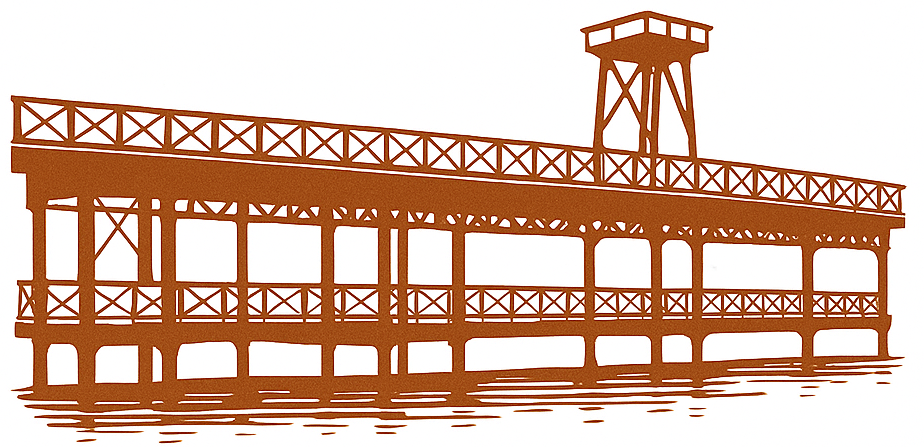
In the early hours of the morning, we visited the magnificent loading and unloading pier that the Riotinto Company has constructed in the Odiel estuary. It is a grand work that deserves a moment of description. This pier, divided into two sections—one of wood and the other of iron—measures a total of one kilometre in length. It consists of three platforms solidly constructed upon numerous groups of eight iron columns each, and the overall construction forms an irregular “S” shape.
The movement along the upper body of the pier is ingenious; without the intervention of steam, water, or compressed air—and solely by virtue of initial momentum and a well-conceived combination of gradients—the wagons loaded with ore travel from the point where the engine leaves them to the unloading platform. The discharge itself is carried out by another procedure, equally simple and novel.
At the sides of the platform, there is space for four steamships. When the wagons have been placed over the opening in the track, a worker easily slides the cylinder that joins the two halves of the wagon’s bottom via beveled rings; the ore then descends through a hopper, adapted for the needs of this operation, into the holds of the ship. The empty wagons travel with a small push along the track of the second platform (also on a decline) which serves as an auxiliary to the first, until they reach the start of the pier, where the engine collects them and pulls them back to dry land.
It is remarkable to see that over a distance of 800 meters, thousands of tons of ore are transported and discharged into ships daily without the deafening noise of machinery, without costly production power, and with hardly any intervention from laborers. Undoubtedly, ingenuity in mechanics is more productive than in literature. The lower body of the pier is leased by the Riotinto Company to the Madrid, Zaragoza, and Alicante Company, and on the platform of the upper body, there are several offices, including a telephone station that notifies the shipping agents of the arrival of vessels at the entrance of the bay.
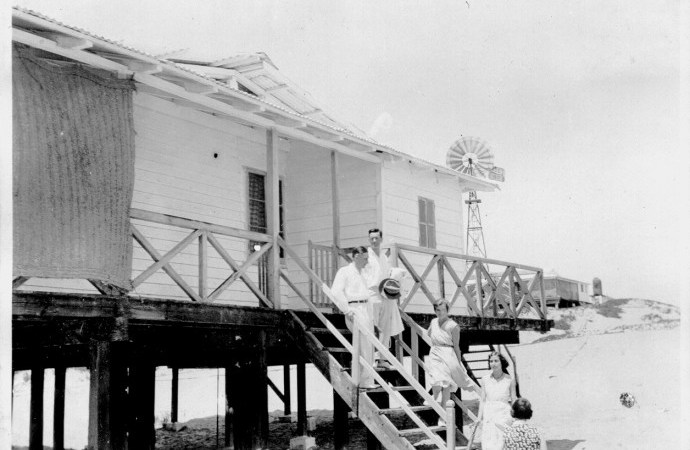
After today’s lunch—as succulent as last night’s dinner—Mr. Sundheim, religiously fulfilling the second part of the program, placed a company steamer at our disposal. More than twenty journalists from Madrid, Seville, and Huelva embarked, accompanied by Messrs. Sundheim, Soto, and Santamaría. After half an hour of a most pleasant journey along the Odiel, we arrived at Torre Umbría, built upon a tongue of land that reaches out to form the mouth of the port.
Breathing deeply—as if we could never feel satisfied—great columns of purest air moved by a constantly fresh and playful breeze, and running through the sand in cheerful play or peacefully seeking the pearly shells that abound there, we spent three hours, surely the most agreeable of the expedition.
The well-being we all felt at Torre Umbría has drawn my attention to the conditions of this beach; I have no doubt it could become one of the best in Europe. The mild temperature of the Atlantic coast at Huelva’s latitude; the pine forests near Torre Umbría that saturate the air with healthful properties; the varied and cheerful panorama; and the complete absence of endemic diseases are conditions that—should the local administration support the powerful initiative of Mr. Sundheim or any other private individual—could make Torre Umbría an enchanting summer residence and Huelva a hygienic winter station for tourists.
The English, more practical than ourselves in taking advantage of the elements nature grants their properties or country, have built several very elegant summer cottages in Torre Umbría, where they spend the months of suffocating heat with their families, although in Huelva one never feels the stifling heat for which Andalusia is famous.
After a splendid lunch offered by Mr. Sundheim—who is tireless in honoring his guests—we headed on the same steamer to the other side of the sandbar, to the famous Monastery of La Rábida. It stands humbly upon a small hill of sparse vegetation half a league from Huelva. If the glories attached to its name were not so well known, no one could gather from the humble appearance of that Monastery that in its refectory was discussed the boldest thought and the most adventurous undertaking recorded through the centuries.
Something of Columbus’s own modesty is noted in the Monastery of La Rábida. Even today, though history has honoured the intrepid mariner, there is hardly a notable object of art to point out. From ancient times, only one well-finished sculpture remains. For the centenary of the discovery of America in 1892, great festivities are being planned which, if my information is correct, will culminate in the solemn inauguration of a monument to Columbus worthy of his genius and grandeur.
At dusk, we returned to Huelva, regretting that the day did not have more than twenty-four hours. Tomorrow at seven, we depart for Riotinto; therefore, until tomorrow.
