(As published in La Provincia)
To the Director of EL ORDEN (Seville)
My Dear Sir: I complained of fatigue yesterday, and today I realize I complained needlessly. If I were to do so now, there is no doubt I would have ample reason; yet I consider it all well-spent. Much like a soldier who, having achieved victory, finds joy in having shared the dangers of battle, I feel an internal satisfaction for having endured the heat, sleeplessness, and discomforts, which have been repaid by the sight of locations and unutterable scenes such as those I witnessed today.
At six in the morning, when those of us who spent the previous night—or rather, the early morning hours—writing to our respective newspapers had barely closed our eyes, the diligent waiters knocked discreetly on our doors to warn us it was time to rise for the Rio-Tinto train. Mr. Sundheim, who forgets no detail regarding our hospitality, had arranged for breakfast to be served at the Hotel Colón. Once finished, we headed to the railway station, taking our seats in the comfortable wagons that were to carry us to the premier mining establishment in Spain.
From the moment we passed Niebla, I did not leave the carriage window for a second, absorbed in contemplation of the Rio Tinto. Like an artery of immense magnitude, it snakes through the mountain glens, rushing its blood-colored waters toward the sea; I was truly in awe.
But my admiration grew and intensified until it reached its limit when we came in sight of the famous ruins. What animation! What life, movement, and grandeur! Yes, that is the word: grandiosity. Everything in Rio-Tinto is grand: the high, lead-coloured mountains where the vapours of copper and sulphur, seeking an exit through the rock, have withered the vegetation; the numerous railways crossing the land in every direction; the dizzying movement of innumerable ore carts which, laden with minerals, travel from the lode to the teleras (roasting heaps), and from there to the washers and other points.
I observed the “anthill” of thousands of workers—men, women, and children—their faces darkened by sulphurous vapours and dust, as they tear, move, transport, load, and unload minerals without a moment’s rest. I saw the infinite chimneys casting black plumes in spirals toward the clouds, and heard the confused roar of voices, locomotive whistles, the rolling of trains, the pounding of forges, and the blast of boreholes. Everything, I repeat, is grand in Rio-Tinto.
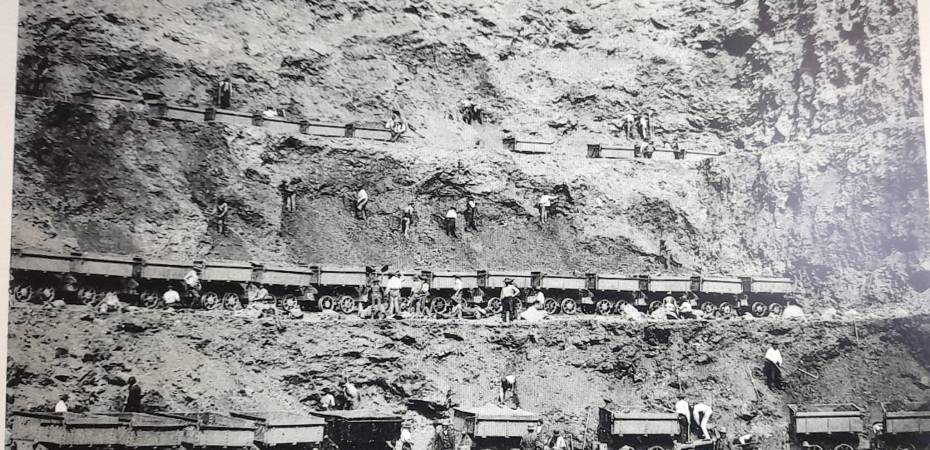
The kindness of the mine director, Mr. Charles Prebble, was shown by placing at our disposal a train composed of several platforms, on which we began our visit to the facilities. First, we headed to the South Lode, which is worked as an open-pit mine. A visit there is worth the journey alone. Imagine, Mr. Director, an immense cone whose vertex sinks into the bowels of the earth, its walls formed by six or seven ramps traversed by trains and teeming with thousands of labourers.
To work it, one must first remove the layers covering the seam—earth and stone rich in iron—which, given their depth and extent, involve the movement of millions of cubic meters. The main levels are named Santa Bárbara, San Pedro, San Roque, and San Luis.
After examining the pit, we passed the teleras—heaps of mineral in combustion whose suffocating vapours made us cough frequently against our will. To our right lay the North Lode, which is exploited via underground shafts and galleries. While we did not descend into them then, we examined the great 100-horsepower steam engines used to pump water and minerals out of the mines, and saw the compressed air machines that power the drills in the subterranean galleries. From there, we visited the washers, smelting furnaces, cementation tanks, and finally, the Santo Domingo lode.
By half-past twelve, our guides—Messrs. Prebble, Kranford, and Sundheim—decided, to everyone’s applause, that we should go to lunch. In a lovely small house situated on a height, its windows framed by green foliage and the national and various foreign flags flying from tall masts, an exquisite dejeuner à la fourchette awaited us.
During the toasts, eloquent speeches were made by Messrs. Sundheim, Kranford, the Marquis of Valdeiglesias, and others, wishing for the progress of the region and the Rio-Tinto Company, and hoping that intelligence, capital, and labor might walk hand-in-hand to achieve wonders like those we had seen. Mr. Mas y Prat even recited an ode to labour.
After lunch, we returned to our platforms and headed into the interior of the mines. What an imposing and strange spectacle those underground galleries presented! Some areas were electrically lit, while others were illuminated only by the oil lamps of the workers. We passed groups of blackened laborers, forges where worn tools were being repaired, and steam engines powering the electric lights. My mind could not help but turn to mythological memories; I felt as if I were in the domains of Pluto.
The main gallery we traversed, which is not yet finished, will eventually connect the South and San Dionisio lodes. Returning to the light of day and bidding farewell to the directors, we arrived back in Huelva near eight o’clock at night.
The dinner that followed was as notable as those of previous days. Mr. Sundheim was the first to toast, thanking the press and expressing his regret at having to part from the gathered journalists. He also noted the importance of the press supporting the upcoming Columbus Centenary.
To summarise my impressions in three phrases: my stay in Huelva has introduced me to a mining establishment of the first order, a Hotel (the Colón) which is the best in Spain, and a host, Mr. Sundheim, whose splendor and kindness know no limits.
Yours most affectionately, The Correspondent
