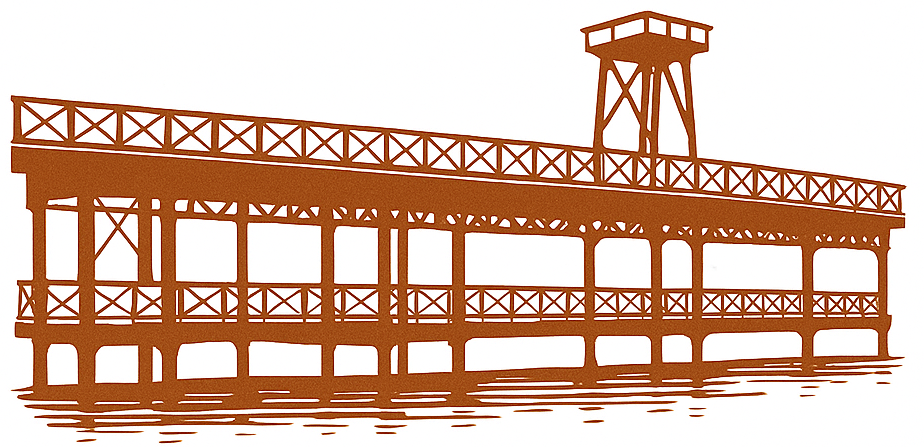
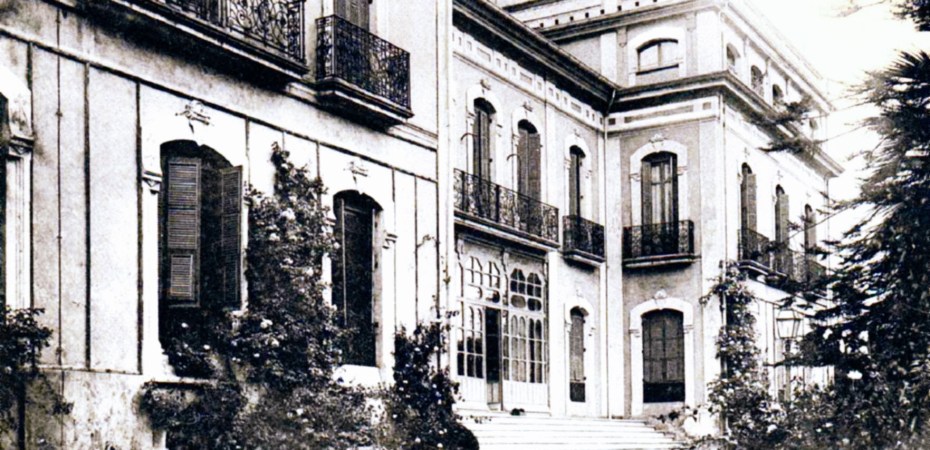
On Tuesday at six in the evening, the special train carrying the guests for the inauguration of the Grand Hotel Colón arrived; an immense crowd awaited them at the station. The banquet, with nearly two hundred covers, began at eight. It was attended by the authorities of Seville and Huelva, several foreigners, numerous shareholders, and—representing the press—the following gentlemen:
- La Época: The Marquis of Valdeiglesias (Director) and Mr. Alfredo Escobar.
- La Correspondencia: Mr. Conrado Solsona.
- La Ilustración Española y Americana: Mr. Bernardo Rico (Artistic Director).
- El Imparcial: Mr. Joaquín Oliver.
- El Liberal: Mr. Mariano Arauz (Director).
- El Progreso: Mr. Rafael Comenge.
- El Día: Mr. Federico de la Fuente.
- El Correo: Mr. Modesto Sánchez Ortiz.
- Sevillian Press: Mr. Luis Montoto (El Español), Mr. Federico Piñal (El Porvenir), Mr. Emilio Jimeno (El Progreso), among others.
- International Press: The Viscount of la Craverie (correspondent for Le Figaro), a collaborator from The Times, and correspondents from Belgian newspapers.
The dining room offered an admirable sight. The guests confessed that, despite having heard great praise for the hotel, they did not imagine it would possess such sumptuousness, luxury, and comfort. The meal was splendid. To keep this review brief, we will not transcribe all the toasts, noting only that the Director of the Hotel Company toasted the institutions and the Spanish nation, followed by Admiral Pinzón, General Polavieja, and the Marquis of Valdeiglesias.
Mr. Sundheim read the following report:
“In the name of the Directors and the shareholders of this establishment, I welcome you and thank the distinguished authorities and members of the press. I could fulfill my duty simply by asking you to toast the prosperity of the Hotel Colón, but I would fail your natural curiosity and the sacrifices made by the shareholders if I did not explain the origin and future of this house.
For more than twenty years, I have traveled abroad annually. The general idea held of Spain abroad is changing—now that our young Monarch has proven his talent and the country has understood that there is nothing but misery outside of peace and order. But while opinion is changing, it is far from being ‘good.’ A nation cannot isolate itself; it must enter the progressive march of civilisation or be left behind.
Four years ago, while at the baths of Kissingen, we decided to link Extremadura with Huelva, its natural port. Later, a rough sea delayed me for a day in Ostend. At the Kursaal, I overheard two families discussing travel. One advised the other to abandon the idea of going to Spain. They complained that mail trains only connect with slow ‘mixed’ trains; that the title of fonda (inn) is but a mask for hovels where the traveler is left ‘shattered’ in every sense; and that in large capitals, mendicancy is the most flourishing industry, where foreign ladies are hounded by entire families of beggars. ‘For the same money,’ they added, ‘you will be much better off in Italy.’
Unfortunately, they were right. Nothing is done here to attract the traveler. In Irun, customs officers search the smallest baskets of English ladies, making them pay duties on a single kilo of embroidery wool. In Madrid, the disabled are told they must take a slow train to reach the south. In Seville and Huelva, they suffer new baggage searches as if they hadn’t already crossed a border. Most inns offer poor rooms, worse service, and abysmal food, yet the bills are exorbitant. The tourist will always choose Italy, where they do everything to attract him, whereas Spain offers nothing but ‘monumental’ bills.
This state of affairs results in the loss of millions for Spain. I do not hesitate to say that today in Germany, the average person is less frightened by a trip to the center of the United States than a trip to Spain. It is time for patriotism to wake up.
I do not know what the thousands of Spaniards who fill the hotels of Biarritz and Paris think of themselves—spending millions there while doing nothing to improve their own country. In Paris, they are seen as ‘morsels sent by Providence’ to be devoured by luxury, alongside Russians and Peruvians. These Spaniards return across the Pyrenees to subsist on chickpeas just so they can return the following year to impress French tradesmen with ‘Castilian splendor.’
The truth is bitter, but I speak my mind when I believe I am doing good. The remedy is the Hotel Colón. Many of you may think: ‘What a pity this inn isn’t in Madrid or Barcelona… who will come to Huelva, a tiny capital of the third order?’
I have faith in this work. As a summer and bathing station, no town in southern Spain is cooler than Huelva, and the beach at Torre Umbría has no rival in Europe. As a winter station, Huelva is destined to flourish. While in Italy the ‘mistral’ winds and fevers kill the sick, and snow falls in the streets of Naples and Palermo, in Huelva no one has ever seen a snowflake descend from the firmament. From December onwards, the green of our fields contrasts brilliantly with the storms of the rest of Europe.
We have the climate; we only lacked a facility to make the stay pleasant. This hotel ensures the greatest comfort. As for food and drink, the Management has ensured it will be difficult to eat better in Paris or London, and certainly not at such a low price. Soon, Huelva will also be provided with the purest water obtainable.
For the success of this project, which is of interest to all of Spain, I appeal to the powerful protection of the press. I invite you now to drain a glass of Champagne to the progress of Spain and the prosperity of the Hotel Colón.”
This speech was met with vivid signs of agreement and heavy applause.
