(Translation and adaptation of Huelva y La Rábida By Braulio Santamaria)
The luxurious hotel currently under construction is being developed by the company “The Huelva-Hotel Company Limited,” established by Mr Guillermo Sundheim, whose firm, Sundheim y Doetsch, is already credited with much of the province’s prosperity and is a source of hope for its future growth due to the scope of the ventures it undertakes.
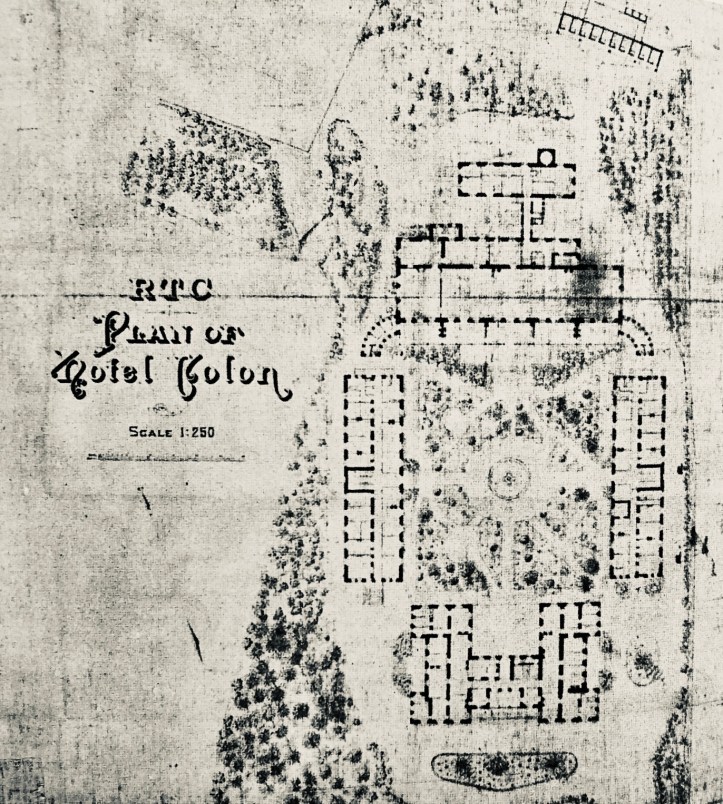
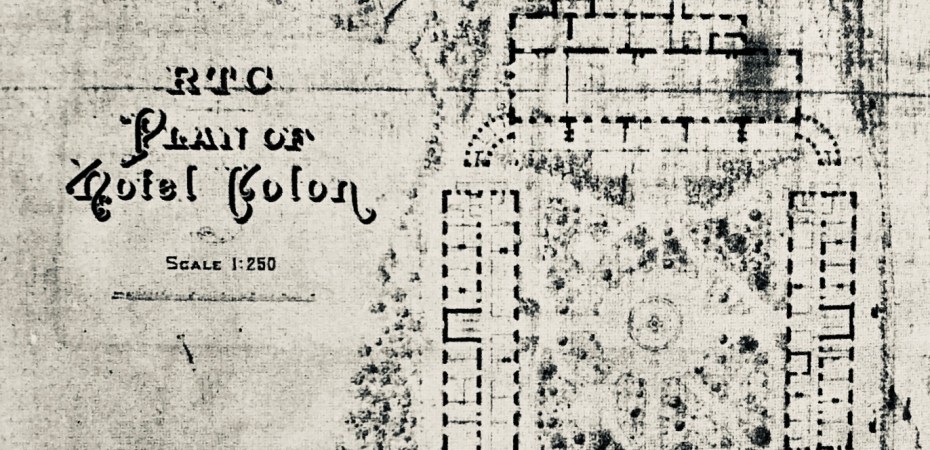
The land on which the hotel is being built measures 20,000 square metres and forms a rectangle of 200 by 100 metres (see hotel layout below). It is located to the southeast of the town, at the end of Calle Sevilla and Calle Enmedio, soon to be joined by a wide road to the pier, which will become the city’s finest thoroughfare. It faces the station and workshops of Rio-Tinto and the grand station of Seville. A little further on is the Rio-Tinto pier, and in the far distance, the Odiel river estuary. To the left are the charming gardens of Mr Sundheim’s chalet-style residence and the San Cristóbal road, which is currently Huelva’s main promenade. Behind the hotel lie hills covered in vineyards and orchards that mark the edge of the city. The location could not be more picturesque: pure air, lush vegetation, vast and majestic horizons—all the conditions for a comfortable and delightful residence.
The hotel is composed of five large, fully separate buildings, four of which are arranged in pairs, forming a square 60 metres wide at the centre, where a garden will be planted. The main building faces the road and is set back about 30 metres from it, measuring 50 metres in length and 26 metres in width.
The area in front will form a large parterre, separated from the public road by an elegant iron fence. In the centre of the fence will be a large gate for carriage access and, at one end, a smaller gate for pedestrians. The building is slightly elevated from ground level, and access is via a marble staircase. Entry is through three large central arches that open onto a spacious portico.
To the right is the concierge’s quarters, and to the left, the manager’s office. Between them lies a wide hallway leading to the second section of the building. Two central corridors, one to the left and one to the right, each provide access to three family apartments. Continuing from the first to the second section, there is a wide marble staircase to the right, which splits at the first landing to reach the main floor. To the left of the staircase is a waiting room, and between the two is a wide open space leading to the central garden.
The ends of this building project outward by four metres for a length of twelve. To better understand its layout, one can imagine the ground plan forming an H shape. The ground floor contains six family apartments. The four in the corners each have a reception room, bedroom, bathroom, lavatory, and dressing room, with views on two sides. The front apartments overlook the parterre and adjacent garden; the rear ones face the same and the central garden. Between these are two other apartments with the same layout except for the absence of a bathroom. In compensation, they have direct entrances via side staircases with marble steps leading to small landings, each covered by a decorative canopy.
The main floor has the same layout, with seven apartments instead of six, using the space occupied below by the concierge and manager’s offices. The rooms are spacious, each apartment measuring 85 square metres. Ceilings are five metres high, and the decoration will match the grandeur of the establishment.
The building as a whole has only two floors, but a garret (sotabanco) rises on the right wing and main facade corner, containing rooms for servants. Above it is a tower, the upper floor of which is a large salon with arched openings on all sides, offering panoramic views of the railway stations, the bay and piers, the estuary, Saltés Island, Punta Umbría, La Rábida, Palos, Moguer, and a horizon bounded by mountains and sea.
The two side buildings are identical in form and layout, each measuring 45 by 13 metres and containing two floors. Each has a room for the floor steward and a general bathroom at the entrance. A central corridor runs the length of the building, with eight rooms on either side, totalling 16 rooms per floor, or 32 per building. The rooms, over 20 square metres each, can be connected or isolated as desired.
The fourth building, behind the main one and 60 metres away, is slightly elevated. Its main facade faces the central garden. A broad marble staircase leads to a 20 by 5 metre landing and a gallery of iron and glass, which runs the length of the building and will serve as a reading room and café. In winter, it will be enclosed with glass; in summer, the glass can be removed and replaced with curtains. Behind this is a vast dining room, 50 by 14 metres, with frescoed walls and ceilings. A removable partition will divide it into a public restaurant with a separate entrance. Next to it will be billiard rooms.
Behind the dining room will be the staff dining area and kitchen. Due to the height of the dining room, the back of the building has two floors: one with the staff facilities, the other with a grand tribune for musicians or special guests and additional rooms for female staff.
Below this building are two basement levels: one just above ground level, the other three metres below. These contain rooms for male staff, storerooms for firewood, coal, and lighting materials, a pantry, fresh and salted meat storage (the latter refrigerated by proximity to the icehouse), and extensive wine cellars.
The fifth building, connected to the main one by a gallery, houses the kitchens, oven, and servants’ dining room. North of this will be a garden and grove. At the foot of a nearby hill, a steam engine will pump water to two large tanks: one of 200 cubic metres for fresh water, and a slightly smaller one for seawater. The elevation will ensure adequate water pressure throughout the hotel.
There will be fresh and salt water in all rooms, fountains in the gardens, and 39 taps for irrigation and fire prevention. The gardens, main entrance, and dining areas will be lit by electric light, while service areas will use gas, and bedrooms candles.
Sanitation has been carefully planned. Dirty laundry will be stored far from guest areas. Ground-floor rooms are built on raised platforms to avoid contact with the earth and ensure ventilation.
There will be a telephone service. At the main gate, a small building will contain rooms for the porter, a waiting room, and a telephone room connected to the concierge’s office and all hotel facilities.
The gardens are managed by a German gardener trained at the Royal Agricultural School of Gaisenheim.
The furnishings, decorations, and tableware are expected to match the hotel’s luxury. Construction has proceeded at astonishing speed: only seven months since work began, and the roof structures of the four main buildings are already being installed. It is expected that the Grand Hotel Colon will be open to the public before the next bathing season.