(The Daily Free Press—April 7, 1882)
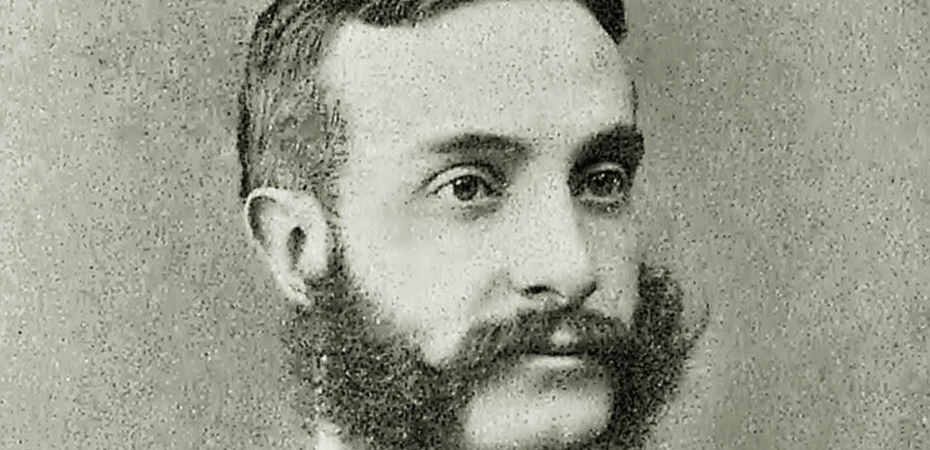
The popular young King of Spain, while on his visit to the southern part of his dominions, signified his Royal pleasure that he wished to see these mines, now of world-wide fame. Six hundred years had elapsed since the Province of Huelva had been visited by a King of Spain.
It had been mooted that there was a likelihood of His Majesty visiting the mines, but nothing definite was known till the beginning of the week, when the manager received a telegram to the effect that the King, his Consort, and the Infanta Doña Eulalia, with the Ministers of Marine and State, and other distinguished officers, would arrive at the Rio Tinto on the evening of the 3rd of March. Then all became bustle and stir, habitations had to be prepared for the Royal personages, and for their numerous retinue, and decorations had to be thought of and carried into effect. Under the special direction of the able and highly respected manager, Mr. Charles T. Prebble, all preliminary arrangements were carried out in the most satisfactory manner ; and the transformation which the little town underwent in the few days which were given for preparation was truly remarkable.
The general and varied display of decorations was all that could be desired. Throughout the town and neighbourhood flags and bunting were spread to the breeze in profusion, and these, with an abundance of plants and evergreens from the neighbouring hills, soon gave the place a very gay and festive appearance. Photographs of several of the buildings and of a beautiful arch erected on the parapet of the Santa Barbara bridge were taken, as well as a panoramic view of the whole mine.
One of the principal difficulties was how to provide accommodation for so many, in a town so crowded as is the “Minas de Rio Tinto.” This was in a great measure got over by the happy thought of turning for the moment the new and commodious offices of the Company into sleeping apartments, which was effected with the utmost alacrity and with great taste, under the superintendence of Mr. J. S. Hudson, Chief of the Construction Department.
On the morning of the 2nd a telegram was received from the chairman that the King and his suite, without the Queen and Princess—they remaining with the Duke of Montpensier at San Lucar de Barrameda—proposed to arrive that evening at the mines, and asking if they were in a position to receive his Majesty. A reply in the affirmative was at once sent, and additional pressure was put on to have everything in readiness for his reception.
Arriving at Huelva in the afternoon, and after having taken lunch at the old Monastery, The Rabida—the place from which the great navigator Christopher Columbus sailed when he discovered America—His Majesty received on board his ship the chairman and two directors of the Rio Tinto Company, who had come out on a business visit to the mines. He was thereafter enthusiastically received on the Town Pier by a large crowd, who followed him to the chambers of the Provincial Deputation, where he received addresses and congratulations from various corporate bodies, and where the principal people of the town and district were presented to His Majesty. After visiting the Agricultural and Mercantile Club, the church, and other places of interest, he proceeded to the railway station of the Company, which was suitably decorated, and was lustily cheered by the hundreds of workmen who turned out from the Company’s shops to witness his departure to the mines. Under the guidance of Mr William Langdon, the chief mechanical engineer, locomotive, and traffic superintendent, His Majesty reached the mines safely at 10 p.m. At the various stations along the line there was no lack of decorative display and no absence of cheering.
Besides the Minister of Marine and others in high authority, His Majesty was accompanied by Mr Matheson, the chairman, and Messrs Doetsch and Schroder, directors of the company. Long before the train arrived an immense crowd had congregated to view the King, on whom but few present had gazed before. On His Majesty stepping from the carriage to the temporary platform which had been erected in front of the open cast of the mine, he was received by a simultaneous and hearty British cheer, six times given, which burst forth from the English members of the staff who were assembled at the foot of the platform to the number of 50—such a cheer as can only be given by a body of true and loyal Britons. A number of their ladies were also present, who likewise heartily cheered and waved their handkerchiefs.
Immediately on the last hurrah being ended the band struck up “La Marcha Real,” or national air, during the playing of which the Royal traveller with his party took their way to the “Casa Grande” amidst the vivas of the multitude. The pathway was splendidly illuminated by the electric light, one of the five lamps of 6000 candles each being so placed as to throw its light on the advancing crowd.
At intervals along the line of march hussars where posted, and these, together with the civil guards and the Company’s guards, kept the pathway comparatively clear for the Royal party, who without difficulty reached the house where they wer to dine, and where the King with several others were to sleep.
The concourse of people in the Plaza in front of the Royal residence was very large—probably. from 10,000 to 15,000—and from them the young monarch received a very warm and enthusiastic reception.
About midnight His Majesty sallied forth, accompanied by the directors, the manager, and several others, for the purpose of visiting the underground workings of the south lode. At the place where they had left the carriages earlier in the evening a couple of locomotives, with two platform waggons covered with a canvass awning and suitably seated, were in readiness to convey them to the South Tunnel, being the principal entrance to this part of the mine. A smart drive through the strongly-built arching in the tunnel brought them to where the miners were at work, and where they were met by Mr James Osborne, the mining engineer, who was to conduct them through the mine. After reaching as far as the locomotives could proceed—a distance of about 1500 yards—the party alighted from the waggons, and went on foot to the end of the tunnel, where the M’Kean rock drills are at work, driving onwards to the San Dionisio lode, His Majesty the while putting very pertinent questions regarding the working of the mine, &c. Retracing their steps to the waggons and taking their seats, they soon found themselves at the “Casa Grande,” retiring soon after to their respective bedrooms, now about 3 o’clock a.m.
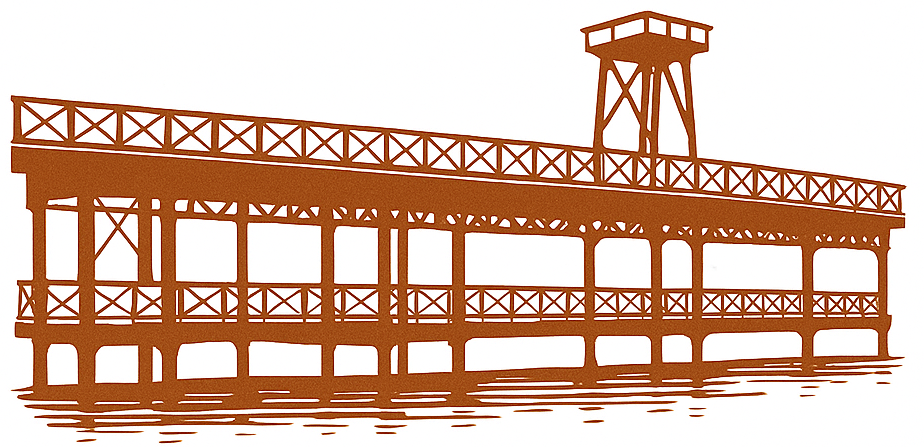
At 8.30, and after having breakfasted, the whole party proceeded to the large open cast, which they viewed with astonishment. As time was on the wing and much had to be seen, they at once took their seats on three platform waggons, and were driven to the north end of the San Dionisio Lode, the train being in charge of Mr Thomas H. Perry, the local traffic manager. At the principal shaft of this lode they inspected a powerful Cornish Pumping Machinery lately erected by Messrs Harvey of Hayle, the not less powerful winding machinery of Messrs Dagleish of St Helens, Lancashire, and the air compressing machinery also by Messrs Harvey. The Albert, Edward and Alice shafts sunk in this lode, and now in working order, were pointed out to the party as they passed them. The train was then run through the calcination grounds and down to the cementation tanks where the copper is precipitated. Here His Majesty was greatly interested, and evinced the greatest desire to become thoroughly acquainted with the working of this department which was evidenced by the very pertinent questions he put through Mr Doetsch to Mr Francis Bawden, the chief of the department, as to the percentage of the copper in the liquors, the quantity of pig iron consumed per ton of copper produced, and so on. Leaving this interesting part of the the Company’s operations, the next halt was made at the large ore-crushing works recently erected by Messrs Tannett, Walker, & Company, of Leeds, through which His Majesty was taken by Mr Henry B. Fulton. Proceeding by the high level line of railway, they soon reached the north lode, an enormous deposit of mineral only recently begun to be worked, and observed the numerous shafts which have been sunk, and at some of which heavy winding machinery is in the course of erection. While here, the King having expressed a desire to inspect the houses of the workmen, he was conducted to a serious of cottages which have been lately constructed, into two of which His Majesty entered, and so pleased was he with the efforts that are being made by the Company to provide suitable dwellings for their numerous work-people, that he left a handsome sum to be divided between the fortunate occupants of the two houses he inspected. No time was lost in returning and taking the points of the low-level line of railway that leads into the heading which has been driven in this lode ; and very soon the party found themselves with no more light than that produced by a few miners’ oil lamps. On reaching that part of this tunnel where the principal mining operations are being carried on, the train was stopped, and His Majesty conversed freely for some time with one of the miners, asking question about the hours of labour, the effect of the cupreous water on the clothes, &c. Both in going in and in coming out of this heading, the awnings of the platform waggons come in contact at one spot with the roof and sides of the gallery, causing a little excitement amongst the travellers. His Majesty, however, seemed to enjoy the little incident, for while there were loud calls to slacken speed the King sang out, “Adelante la maquina”—full speed—which order was instantly obeyed, and the train soon thereafter emerged from the tunnel. The numerous workmen at the North Lode, as everywhere else, loudly cheered His Majesty, and hailed him with “Viva el Rey,” “Viva Alfonso XII.” and to these acclamations the King bowed right and left. In due course the party reached the “Casa Grande,” and after having partaken of dejeuner they were escorted to the Royal train, and went off at 3 o’clock p.m. amidst the vociferous cheering of the English and the “Vivas” and acclamations of the assembled multitude. Arriving at Huelva about six o’clock in the evening, the train proceeded along the magnificent pier of the Rio Tinto Company, and His Majesty had the pleasure of seeing several waggons of ore safely deposited in the hold of the fine s.s. Valentia, of Ardrossan, Captain Ewer doing honour to the King by firing a Royal salute.
After dining in the house of Mr Sundheim, the German Consul, who has done much for the Province of Huelva, the King at a late hour went on board the frigate Ligera, en route for Sanlucar de Barrameda, to rejoin his consort and the Princess.
The reception given to His Majesty on this his first visit to this part of his dominions was truly enthusiastic—perhaps the most hearty one he has received since he ascended the throne. He has expressed himself as gratified in the highest degree, and that nothing could have exceeded the hearty and cordial welcome he received at the Rio Tinto Mines. The above is the substance of a telegram sent to the manager by Mr Matheson, and in which the latter, in name of the directors, expressed themselves as personally grateful for the arrangements made for the King’s reception.
Considering the importance of these mines to so many, both in England and in Scotland, and of the enormous amount of British capital invested in them, it may not be out of place to give a few statistics as to the work being carried on at them. From the number of men employed and the output of mineral during the past year, a very fair idea of the vastness of the undertaking may be gathered. On the pay-sheets for December last there figured no less than 10,500 employees at the mines, Huelva workshops, and railway. The ore extracted and disposed of during 1881 was in round numbers 1,000,000 tons. For the same period over 10,000 tons of metallic copper were produced and sent to England. Of the ore extracted about 230,000 tons were shipped to England and other countries, over 50,000 tones were left in the Deposit at Huelva, and the balance was treated at the mines for the production of copper. Besides the copper ore exported, about 7,000 tons of iron ore were despatched, chiefly to the United States. Of this ore millions of tons of excellent quality can be had simply for the quarrying. From the south lode, which lies at the base of and partly under Mounts Colorado and Solomon, the larger portion of the copper ore hitherto extracted has been taken. The dimensions of the open cast of this lode are about 450 yards in length by 125 yards in breadth, and 90 in depth. To uncover this upwards of 3,293,000 cubic yards of overburden have been removed from the slope of the hill overlying the immense deposit of ore. From 500,000 to 600,000 tons of ore are annually taken from this spot, while the underground workings of the same lode produced last year no less than 320,000 tons. The utmost skill is being displayed in laying out the mine for a large economical yield, and new and powerful machinery is being erected at various points. During the year just past the opening up of the San Dionisio and north lodes has gone on very rapidly in order to get them readly for the largest demands that the future of the trade will probably bring. The main tunnel in the south lode, which is already 1500 yards in length, is being driven on towards the San Dionisio Lode, and on its reaching the principal shaft of the latter it will be over 2 ½ miles in length—about 1¼ miles of which will be in solid mineral. A heading has been driven in the north lode to the extent of 700 yards—nearly 300 of which are in mineral—and, as previously mentioned, this lode has only recently been begun to be opened.
The precipitating tanks at present in use for the manufacture of copper, if joined together, would form a line of nearly 6 miles in length, and the yearly consumption of pig-iron in effecting the precipitation of the copper is from 15,000 to 20,000 tons.
A new reservoir capable of containing over 7,000,000 cubit feet of water is in course of construction at a distance of five miles from the mines, and from it the water for washing the calcined and other ore will be gravitated on to the calcination grounds. The cost of this reservoir will be about £25,000, but the saving in the present cost of pumping which it will effect to the Company must be very considerable.
When the Company took over the mines from the Spanish Government nine years ago, the annual output of ore was about 50,000 tons, and there was a yearly loss on the working of the mine—rather a contrast from the history of the past year.
About 40 miles of railway are already laid down at the mines, and from 20 to 25 locomotives are to be seen plying daily in all directions.
From the foregoing a faint idea may be gathered of the vastness of the undertaking, and of what British money and British enterprise have done to develop an turn to good account the immense deposits or ore which were first burrowed by the Phoenicians, afterwards by the Romans, and subsequently mined at different periods by the Government of the country.
