(As published in La Provincia)
Fulfilling what we have offered to our readers, we are going to provide as detailed a description as possible of the sumptuous Hotel being built in this city.
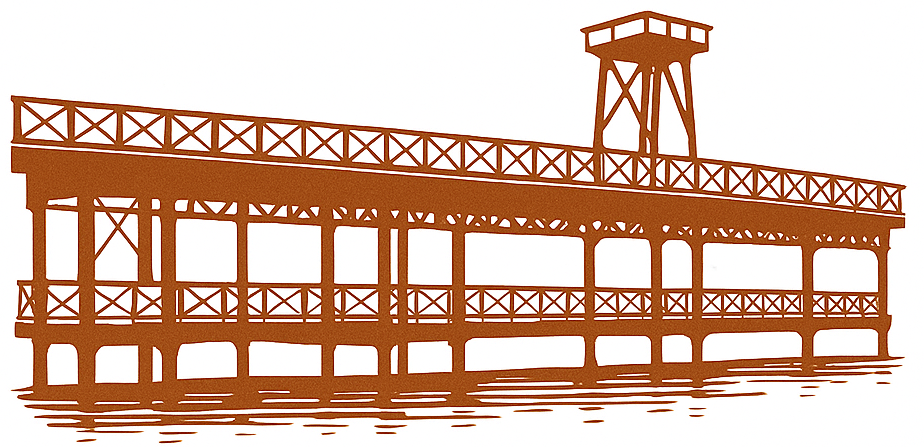
The terrain where it is located measures 20,000 square meters and forms a rectangle of 200 by 100; it is situated to the S.E. of the town at the end of Sevilla (formerly Berdigon) and Enmedio streets, and of what will very soon form the spacious highway that goes to the pier and which within a few months will be the best in the city; it has in front of it the station and the workshops of Rio-Tinto and the magnificent station of Seville, a little further off the celebrated Rio Tinto pier, and in the final background the estuary, which extends south to the sea. To the left it has the beautiful gardens of Mr. Sundheim’s chalet-house and the San Cristobal highway which today forms the main promenade of Huelva, and to the back the picturesque range of hills that limits the city at that point. The situation could not be more picturesque; pure air, lush vegetation, extensive and majestic horizons—all the conditions, in short, that can make a dwelling comfortable and delicious.
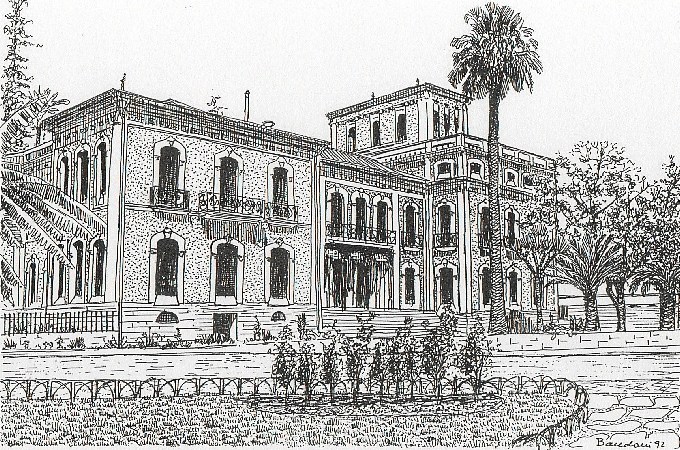
Four large buildings, completely separate, parallel two by two and leaving in the center a square sixty meters on each side where a garden will be formed, will constitute the Hotel. The main building will be situated facing the highway about thirty meters from it, and will have a length of 50 meters by 26 in width.
The ground remaining in front will form a vast parterre, separated from the public road by an elegant iron fence; in the center of this fence a large gate opens which gives entry to a circular carriage path and at one end a smaller one that gives way to a footway. The building will be slightly elevated above the natural ground and will be reached by a marble staircase, with entry being made through three large central arches that open onto a spacious peristyle. To the right will be found the concierge’s room and to the left the office of the establishment’s manager, leaving in the middle a wide passage to the second structural bay; at this point two spacious central corridors converge, one to the left and another to the right, each of which gives entry to three family apartments. Continuing straight from the first to the second bay, one will find to the right a large, wide, and comfortable marble staircase; it starts divided into two sections that meet at a landing and from here a single central one departs in the opposite direction; to the left of the stairs there will be a waiting room and between one and the other a wide space that communicates with the central garden. The ends of this building project forward four meters for a length of twelve, and so that one may form a closer idea of its configuration, we will say that its floor plan takes the shape of an H. The ground floor of this building will have six family apartments; the four corresponding to the four corners will consist of a reception room, bedroom, bathroom, toilet, and dressing room, and will have views over two facades; those at the front to the parterre and the corresponding lateral garden; those at the back to these same areas and the central garden. In the middle of these four apartments there are two others, which only have views of the lateral gardens and consist of the same rooms, except for the bathroom. In compensation, they will enjoy the advantage of having a direct entrance, for which the building has in the center of each lateral facade another marble staircase ending in a landing at the level of these apartments, which landing is covered by an elegant marquee.
The main floor has the same distribution as the ground floor, with the only difference that instead of six apartments, it will have seven, utilizing the space occupied on the ground floor by the peristyle, concierge’s room, and office. The rooms are spacious, as 85 square meters correspond to each apartment; the ceilings will have an elevation of five meters and the decoration will correspond to the grandeur of the establishment.
The building in general has only these two floors; but in the right wing and at the corner of the main facade, an attic will be raised comprising several rooms destined, we believe, for the servants and attendants of the guests, and above this attic, another floor, the two forming an elegant small tower. This last floor is not divided into rooms; it is entirely a hall, and instead of balconies or windows like the others, it has large arches on all facades. It forms, therefore, a magnificent lookout, from which the view can encompass an extremely vast and varied panorama. One will be able to contemplate from there the movement of the Rio-Tinto and Seville stations, that of the bay and piers; the estuary from above Corrales to the sea, the confluence of the Odiel and Tinto rivers, the Island of Saltes, Punta Umbria, Torre de la Arenilla, la Rabida, Palos, the Rio Tinto Channel, Moguer, etc.
The two lateral buildings are completely identical, both in their exterior form and in their interior distribution. They are rectangles of 45 meters by 13. They have a ground and a main floor. As one enters, on each floor is found, on one side, a room for the waiter on duty and on the other, a general bathroom. A central hallway runs the length of the building; to the right and left are the rooms, eight on each facade, therefore 16 on each floor, 32 in each building. These rooms can, at will, be put in communication with each other or isolated; they are quite spacious, as each has more than 20 square meters. The exterior decoration, both of these two buildings and the main one, is elegant. The ground floors receive light through large windows with sills and the upper floors through elegant cast-iron balconies.
We still have to describe the fourth building, parallel to the main one and 60 meters from it. It is situated a bit higher above the natural ground than the others. Its main facade faces the central garden. In the center a wide marble staircase ending in a landing of 20 meters by five gives access to a hall or exterior gallery of iron and glass, which runs along the entire length of the building, being about 50 meters long by five wide. This hall will be destined as a reading room. In the winter it will be enclosed by glass, but these can be removed and replaced with curtains that soften the light and impede the passage of the sun’s rays while allowing air circulation and thus forming a summer hall, which decorated with flower pots and fountains, will be delightful. One passes from here to an immense hall, nearly 50 meters long by about 14 wide and of proportionate height; it is the dining room, whose decoration will be truly sumptuous. The walls and the ceiling will be painted in fresco; a small partition, the lower half of wood and the upper of glass, which can be removed and replaced and which will be half the height of the hall, will form a department for public cafe and restaurant, which can be entered directly from the street; next to it the billiard rooms will be found.
Behind this hall will be the kitchens with all necessary dependencies. As the height of the dining hall is very great, the building at the back has been divided into two floors; on the ground floor are, as we have said, the kitchens; on the upper floor there are rooms for female domestic staff. At the entrance of this floor is the head maid’s room, followed by six others, each for two maids. There is on this same floor a room for dirty laundry, a sewing workshop, and another for ironing and washing.
Beneath the kitchens and half of the length of the dining hall are two basements having a height of approximately four meters, three below the natural ground and one above it, so that they have the greatest light and ventilation possible. In these is found a room for the head waiter and others for the rest of the male staff. At the entrance are found a warehouse for firewood and another for coal; opposite and completely isolated another for lighting supplies and materials, and further in a storage for preserves, another for fresh meats, another for salted meats, and another for ice; this is located precisely in the middle of the previous two, so as to take advantage of the low temperature the ice produces for the better preservation of the meats. Opposite are the cellars. One for a few dozen wine casks, and two smaller ones at the sides for several thousand bottles of liqueur in one and several thousand bottles of wine in the other.
To the N. of this building lies a large stretch of land, where a garden and a grove will be formed; the land ends on this side with a hill, at the foot of which there will be a small house for a steam engine that will raise the waters to the peak of the same; here there will be two large reservoirs, one with a capacity of 200 cubic meters for fresh water and another slightly smaller one for seawater. The height is sufficient so that the waters have enough pressure to rise to all floors of the Hotel. A great distribution of water will therefore be made to all departments; baths can be taken in salt or fresh water; there will be a multitude of fountains in the gardens and fifteen outlets for irrigation and fire.
The parterre and main entrance of the Hotel, the gardens, and the dining room will be lit by electric light; the other general dependencies and service rooms by gas light, and the rooms and bedrooms by wax candles.
A very special study has been made to give an outlet to rainwater and sewage and fecal substances, particular care having been taken in everything relating to hygiene. The dirty laundry room is isolated and far from the guest departments; so that there is no humidity in the ground rooms, they are constructed in such a way that they do not touch the ground at any point; they go over basements, which utilizing the natural slope of the soil, in some points will be two meters high and will be used for offices, a barber shop, and other dependencies.
The Hotel will have a telephone service. At the gate of the fence, a small house with three rooms will be placed: one for the porter, another which will be a small waiting room, and the third destined for the telephone, which will communicate with the concierge’s room in the main building, and from there with all the establishment’s dependencies.
The interior and exterior gardens are in the charge of a special German gardener who has just arrived from the Royal School of Horticulture in Geisenheim. The furniture, tableware, decoration, etc., will correspond in their luxury and good taste to what we have described. When the appropriate time arrives, we will provide a minute review of this part as well as the arrangement and dispositions of kitchens; and bear in mind that it will not be long, as the works are moving with amazing speed. It has been about three months since they were started, and the side buildings are already at the height of the upper floor; the main one is out of the foundations and in the other the basements and cellars are about to be finished, which is, perhaps, the most intricate part of it. They will be roofed by September and finished before the end of the year.
If some time ago we had said that this was going to be done, surely many would have smiled or would have taken our narration for a tale like those of the Thousand and One Nights; but it is necessary to yield to the evidence, there are the works. For a long time Mr. Guillermo Sundheim cherished the idea of providing Huelva with an establishment of this kind which will so much enhance the name and credit of our city and contribute so much to increasing its prosperity, an idea he cultivated with singular affection, which he placed almost on the same line as the Seville railroad, the Extremadura railroad, and the Portugal railroad, despite its secondary importance regarding the magnitude of business; an idea of which he often spoke to us with enthusiasm calculating its importance and its transcendence, considering it as a necessary starting point, indispensable for the planning and development of other thoughts and other projects that are to change the face of our town. In men like Mr. Sundheim, to project is to execute; but to realize this work it was necessary to wait for the opportune moment, and this had to be when the Seville railroad was open to the public and the construction of the Extremadura one was assured; that is, when Huelva had comfortable and rapid communications and the security of obtaining greater ones in a short term. In July of last year, there was nothing but the general thought of the Hotel; in August Mr. Sundheim communicated the thought to Mr. Jose P. Sentamaria charging him to immediately make the plans and budgets; in October both were concluded, which imply an immense amount of work; in November the society was constituted in England; before the end of the year the works were inaugurated which currently find themselves in the state of progress we have said, and which before a year will be completely finished.
Mr. Sundheim, with that perspicacious eye he has for the choice of persons, has made a most successful one in entrusting this work to Mr. Sentamaria. The plans submitted in England to a board of professional persons have earned complete approval and unanimous praise. These and the direction of the works entrusted to the same gentleman will always honor his name and will form for him an enviable reputation.
Next year the “Gran Hotel” will be in operation, and Huelva may well be proud that neither in the Court, nor in the Northern provinces designated as summer spots by fashion, will there be another that equals it, nor even resembles it. Then will be the occasion to convert Huelva into a summer station calling on families who flock to other towns, which surely have it more uneven and less pleasant, to enjoy the mild temperature enjoyed here. Then Huelva could be a bathing station, thinking not only of improving those in the bay, but creating a bathing establishment on the beach of Umbria, a beach that is infinitely superior to all the most credited bathing spots. Then those who suffer from some affection of the respiratory organs can come in winter to enjoy a constantly spring-like climate, since here winter is known to exist because the Almanac says so. Then, finally, nationals and foreigners will be able to come visit the celebrated Monastery of la Rabida, where the conferences that decided the discovery of the New World were held between Columbus and Marchena, and the port of Palos, from where the famous caravels departed; then will be the occasion to resume the celebration, with great festivities, of the anniversary of their departure. Then, finally, the moment will have arrived to realize many other thoughts; but for this must Mr. Sundheim’s initiative be left isolated? No, we all must contribute to the common work. The City Council with its works, the Provincial Council transforming the site of la Rabida and making a palace in Huelva for its offices; the “Society of Friends of the Country” with its enlightened cooperation, and all the neighbors cooperating for the success of these enterprises.
And in concluding this first article, it only remains for us to pay a vote of fraternal praise to our sister Seville, the beautiful capital of Andalusia; wherever Mr. Sundheim calls asking for cooperation for his work, he finds a sympathetic reception, some more, others less, all those from whom participation in the Society is requested, all hasten to take it, Seville understanding that the construction of a large Hotel in Huelva, in current conditions, is not an act of competition (which does not fit) but that, apart from local needs of a province that always, for many reasons, must be tributary to Seville and each year on a larger scale, the construction carries in itself the general thought of converting Andalusia into a winter station diverting the current of travelers from the Mediterranean and directing it to what in the opinion of wise medical specialists, lends itself much better to the treatment of certain affections, by the influence of the Atlantic, than the Mediterranean region, and this current of travelers if it is managed to be brought to Andalusia, must benefit Seville as much or more than Huelva.
The interests of Seville and Huelva are, therefore, brothers in the construction of the grand Hotel Colon.
