(Translated and adapted from La Provincia)
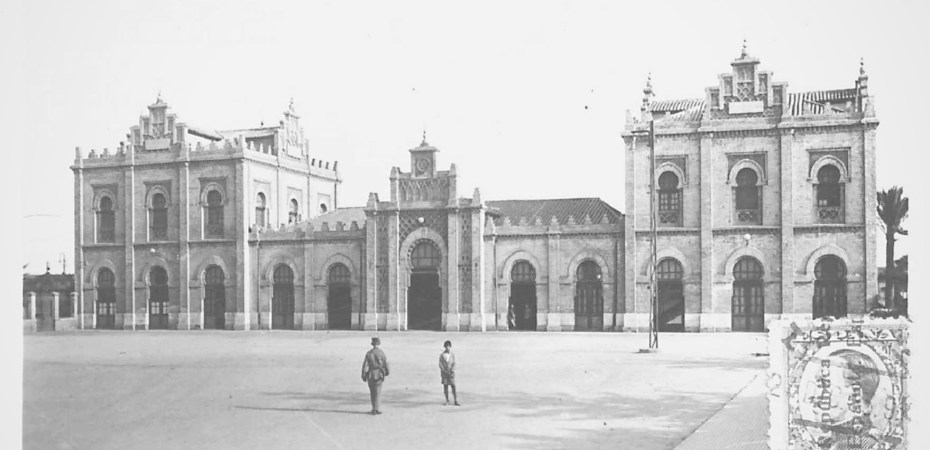
Yesterday, the 15th of March, 1880, marked a date that shall forever be commemorated as the genesis of Huelva’s true grandeur. The long-awaited railway line connecting our esteemed capital to Seville has at last been inaugurated, a momentous occasion that, by its very existence, overshadows all other notable events in this city’s storied history.
No longer shall Huelva languish as one of Spain’s secluded corners, untouched by the material advancements of our modern age. From this day forth, the locomotive, a symbol of progress, shall bind us to the civilized world. Huelva and its Port now serve as a vital new artery, opening to the vast Ocean, through which the lifeblood of commerce shall flow from distant lands to our own, and by which our own produce shall reach foreign shores. Truly, Huelva has become a pivotal nexus between land and sea, an inexhaustible wellspring of movement and advancement.
The sentiment of our populace, deeply aware of this event’s profound significance, was palpable. Yesterday, nearly the entire town converged to welcome and salute the inaugural trains as they arrived in our capital. The station platforms swelled with throngs of people, particularly at the hour of the mail train’s arrival.
The festivities commenced in earnest at four o’clock in the afternoon, with a band parading through the city’s thoroughfares. They then took their station before the town hall buildings, where they played on until the stroke of midnight. A magnificent display of colourful fireworks illuminated the night sky before the very same edifice. Our esteemed merchants, in a rare show of communal spirit, declared yesterday a holiday, closing their establishments by mid-afternoon. Public buildings, along with numerous private residences, clubs, and casinos, were adorned with hangings and brilliant illuminations. Notably, the facades of the establishments belonging to D. José Montiel and D. Antonio García Ramos were illuminated with lanterns of various hues, their showcases proudly displaying grand transparencies that proclaimed: “To the illustrious adopted son of the city of Huelva D. Guillermo Sundheim, in testimony of gratitude, and honour to work!”
It is with utmost gratitude that we acknowledge the tireless efforts and unwavering perseverance of D. Guillermo Sundheim and the construction company, to whom belongs the glory of having bestowed upon our province this magnificent engine of prosperity. This railway shall fundamentally transform Huelva’s very essence, invigorating its talents and capital, and swiftly elevating it to the standard of the most civilized communities, securing its rightful place within the social, commercial, and industrial spheres.
For the time being, the train service is provisional. Two passenger trains—an express and a mixed service—will convey passengers in 1st, 2nd, and 3rd class carriages, while a single freight train will also carry a 3rd class carriage.
The express train shall depart Huelva at 5:15 in the morning, reaching Seville by 9:40, completing its journey in 4 hours and 25 minutes. For the return, it will leave Seville at 2:45 in the afternoon, arriving in Huelva at 7:07, a journey of 4 hours and 22 minutes.
The mixed train will depart Huelva at 3:30 in the afternoon, arriving in Seville at 8:54 in the evening, with a journey duration of 5 hours and 24 minutes. From Seville, it will depart at 7:47 in the morning, reaching Huelva at 1:04 in the afternoon, taking 5 hours and 17 minutes.
The freight train is scheduled to depart Huelva at 8:10 in the morning, arriving in Seville at 5:50 in the afternoon, requiring 9 hours and 45 minutes. Its return journey from Seville will commence at 8:10 in the morning, arriving in Huelva at 6:22 in the afternoon, a total of 9 hours and 12 minutes.
Furthermore, plans are afoot for “reduced price” trains during the upcoming Holy Week and the esteemed Seville Fair. These special services will utilize the ordinary trains, thus maintaining their regular departure and arrival times.
