
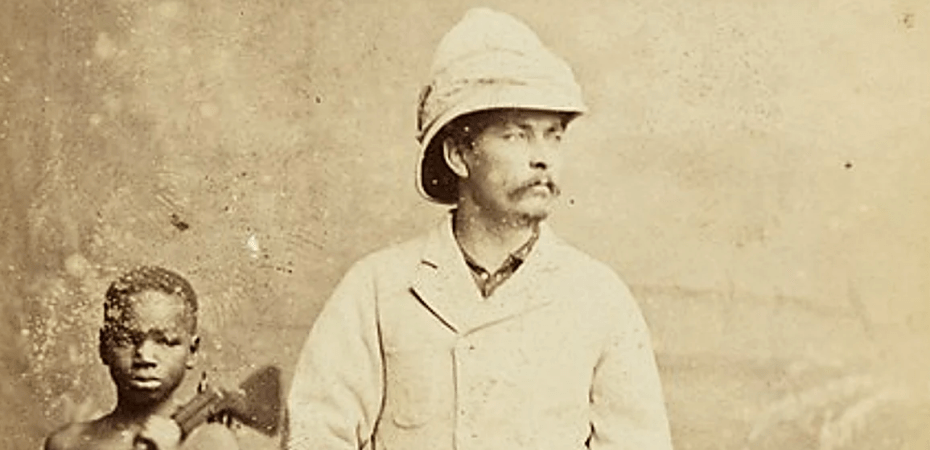
Though perhaps not always—by his own showing—very judicious in his treatment of uncivilised tribes, Mr. H. M. Stanley is undoubtedly a man of great energy and perseverance, and he has now added to his former exploits one of the greatest feats in the annals of exploration, in that he has crossed the continent of Africa from east to west, and solved the chief of the remaining geographical problems connected with that country, by discovering the true source of the Congo, and tracing its course from Nyangnwé down to the Atlantic. Besides this, he has cleared up matters which were more or less shrouded in mystery, by his circumnavigation of Lakes Victoria and Tanganyika, thus completing, as he himself claims, the discoveries of Burton, Speke, and Grant in many important particulars. We cannot, of course, from want of full details, at present estimate the true value of the scientific and geographical data collected by Mr. Stanley during his arduous and protracted journey, which has now been brought to such a successful termination. We fully concur, however, in the opinion expressed by Sir Rutherford Alcock in his opening address to the Royal Geographical Society last week, that ” the information thus obtained must have an important bearing both on future exploration and the development of commerce along the course of the Congo” ; and that Mr. Stanley’s last achievement will, without doubt, ” form a new era of trade and progress by laying open to commercial enterprise a vast and practically unlimited market for the barter of tropical produce and manufactured goods.” In regard to this particular point, Mr. Stanley’s letter from Loanda of September 5 is fall of interest, though somewhat general in its treatment of the subject. He describes the region above the lower falls as one vast, populous plain, than which he knows no part of Africa so thickly inhabited, with the exception only of Ugogo. The natives congregate in towns two miles long, and their “every thought seems engrossed with trade, and fairs and markets are established everywhere.” Ivory is most plentiful, and “the entire plain is also distinguished for its groves of oil palm. In Ukusu there are large forests of this tree. Almost everything that Africa produces is to he obtained in the Livingstone [i.e. Lualaba-Congo] Basin–cotton, india-rubber, ground-nuts, sesamum, copal (red and white), palm kernels and palm-oil, ivory, &etc. By means of its glorious waters a journey to the gold and copper district of Katanga is, moreover, rendered very easy.” Much, of course, must be done before this magnificent field for commercial enterprise can be made available, and indeed, it must naturally be a work of time ; but we do not doubt that eventually British energy will overcome all obstacles, and that a large and constantly increasing trade will spring up with the rich districts bordering on this great river. There is, again, another benefit to be reaped from pushing commerce into the interior of Africa which must not be overlooked-viz., the extinction of the slave-trade-a consummation which every true Briton must earnestly desire. From various causes, the interest taken by the public at large in Africa and its people has of late years been somewhat fitful, but we would hope with Sir Rutherford Alcock, that ” this brilliant triumph
of Stanley will renew the lively interest once felt in the object of all Livingstone’s labours, and the strong feeling of sympathy for the unhappy victims of a slave-trade in which all that wickedness, greed, and cruelty can devise, seems to culminate.”
(As published in The Colonies and India)
