
(Illustrated London News. August 7, 1875)
These mines, which have of late attracted much attention in connection with the payment of the Spanish coupons, are situated in the mountain districts of Andalusia, about sixty miles from the port of Huelva. Their immense copper deposits have been well known since the dawn of history. There is tradition that they were worked by the Phoenicians, or even the early Celtic inhabitants. Great quantities of slag, differing from that left by the Romans, confirm the belief that prior to their establishment there considerable works had been carried on. The Romans worked these mines during three centuries. Evidence of their operations remain in the hills of slag outside, and the great galleries and caverns inside the mine. After the fall of the Roman Empire and during the sway of the Moors in Southern Spain—indeed, until about a century since—they appear to have been almost entirely neglected. A Swede began to work them in the last century, and at intervals since operations have been carried on; but the want of suitable transit, capital, and skill rendered them comparatively unremunerative. The Spanish Government. therefore, after the revolution of 1868, decided to sell the property, and early in 1873 it was purchased for the present Rio Tinto Company, Limited.
The deposits of cupreous ore are to all intents ineхhaustible, and now that the sulphur in them is used in the manufacture of sulphuric acid, they have become greatly enhanced in value. The company have, therefore, made every preparation to work them, both for copper and sulphur. Considerable skill has evidently been displayed and much capital expended in the preliminary works for the development of the property.
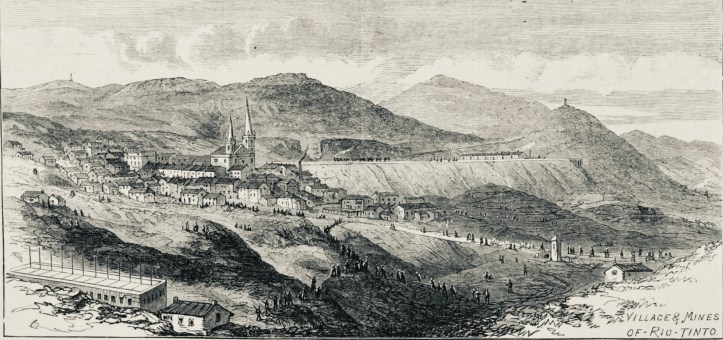
From the illustrations we give this week some idea may be formed of the works at these mines. The overburden has been removed so as to lay bare already at the top of the lode a very large mass of ore. This overburden forms the enormous embankment stretching across the centre of the view, and on which workshops have been erected and a railway laid down. The level of this line marks the top of the lode, while at the base of the conical hill, on the right, a tunnel is being driven that will be on a line with the known base of the ore.
The work of the Spanish Government proves that, in the small part of the lode on which the company is thus working, there are about 20,000,000 tons available for immediate export, with an average of about 3 per cent copper and 46 to 50 per cent sulphur. It will suffice to give an idea of the immense deposit when we add that three lodes are from 150 to 300 yards wide, and from 1000 to 2500 yards in length. The depth is unknown, but ascertained to about 100 yards of solid mineral ; and it is estimated that the deposits contain about 200,000.000 tons of ore.
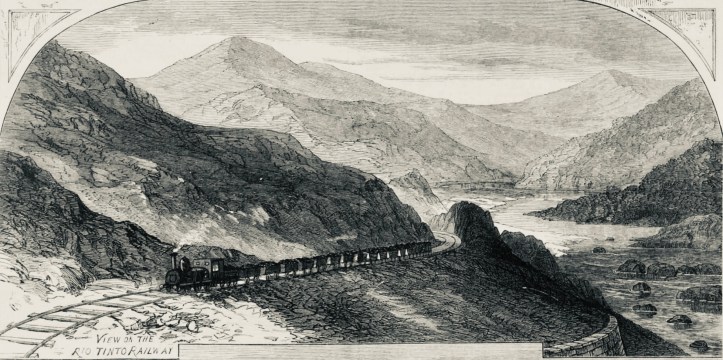
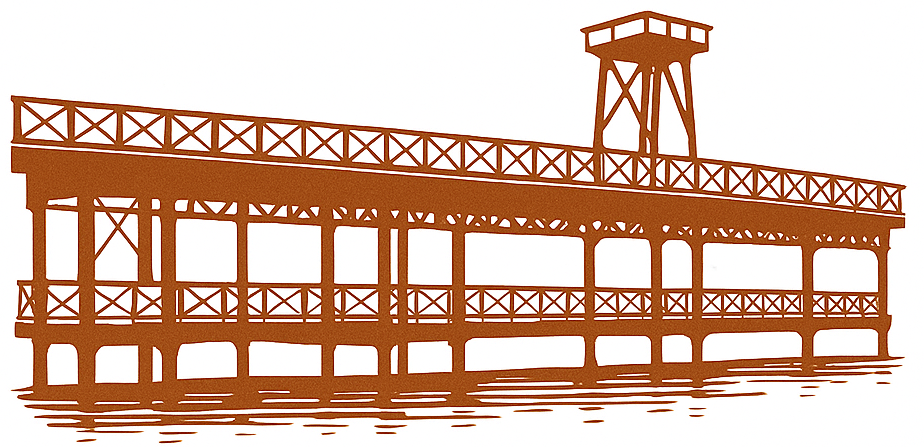
The railway, just opened for traffic, a view of which we give, has been constructed to connect these mines with the port of Huelva. At this port a pier, about 700 yards in length, is almost finished, arranged with upper and lower platforms, where three steamers may be loaded or discharged simultaneously.
The ores that are unsuitable that are unsuitable for export will be burned in heaps at the mines, and the waters from these heaps conducted into the cementation tanks. There, coming in contact with scrap and pig-iron, they deposit the cement copper that has now become so valuable to copper-smelters. We give a view of some of these tanks now in operation.
Already a considerable fall has taken place in the price of sulphur, and we are evidently approaching a revolution in the chemical trade and manufacture of manures. With cheap sulphur, low produce phosphates that could not hitherto bear the cost of removal may have the means to reduce them taken to the localities where they are found, and so become available for agriculture. The numerous manufactures in which sulphuric acid is employed will gain by the development of Rio Tinto: and it should serve to assure the chemical trade for agricultural purposes that this inexhaustible deposit can be worked at a normal price for centuries to enable the production of cheap manure.
The port of Huelva is an ancient harbour, formed by the junction of the rivers Odiel and Rio Tinto. Near their junction still stands the Rabida Convent where Columbus completed his preparations for the great enterprise in search of America; and from a spot near this he embarked on that famous voyage. Huelva has again come prominently into notice, within the past few years, as the outlet for the numerous mines in the district. Now that to them is added the produce of Rio Tinto, and that a railway is to be at once constructed from Huelva connecting it at Seville with the interior of Spain, it may probably become one of the most important ports in the Peninsula.
