(As published in La Epoca Madrid Diario Politico)
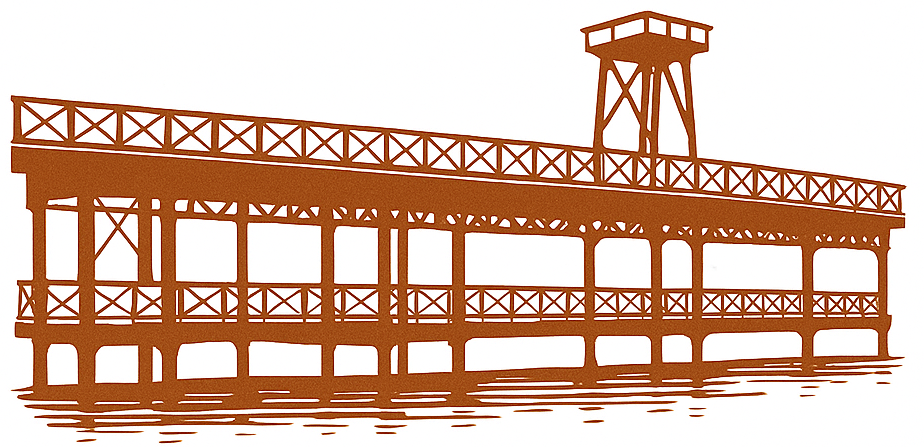
Anyone who, having left Huelva little more than a year and a half ago, were to return today without any idea of the works carried out for the reception and shipping of the Río Tinto minerals, would surely be astonished to see how, in so little time, sites once nearly deserted and abandoned have undergone a prodigious transformation. From the end of Monasterios Street, following the line of the Seville road to the river on one side, and to the San Cristóbal orchards on the other, there once stretched a vast marsh cut by inlets, periodically flooded at high tides and entirely unproductive—now converted into a great esplanade, whose construction required the use of over 300,000 cubic metres of earth removed from the nearby hills. It is crossed by railway tracks, covered with rolling stock and construction materials, dotted here and there with buildings intended as coach houses, workshops, etc., and ending at the river with a colossal iron pier, the completion of which will still require several more months. On the other side of the road, the orchards are disappearing and many newly built houses can be seen, others are under construction, and many plots are ready to be built upon, so that one may confidently state it will not be long before Huelva has here a new neighbourhood, as populous as it is elegant in its modern construction.
On the 19th of this month, the official reception of the railway line from Río Tinto to Huelva took place, and the construction company decided to hold a preliminary inauguration—since the grand ceremony will take place when the two most important works on the line are completed: the mine tunnel and the station pier in Huelva, which due to their magnitude could not be finished at the same time as the rest of the line. To this end, on the 24th, at five in the morning, the invited guests gathered at the esplanade previously described: several ladies, public officials, employees of the construction and concession companies, etc. The train was ready; the engine was gaily adorned with flags and garlands; the carriage designated for the ladies drew attention for both its elegance and its luxury and comforts. Despite the early hour, many people had come to witness the departure of the train, which took place at approximately six o’clock.
The track winds around the San Cristóbal hills and runs through the marsh between the Río Tinto and the Seville road. The first significant structure encountered is a bridge over an inlet at kilometre 4, near El Rincón; this bridge is made of two iron spans of about six metres each, resting on screw-pile iron piers and abutments. The railway crosses the Anicoba riverbank, close to the road, via another bridge consisting of twelve iron spans similar to those of the previous one, and in the same form. A short distance further lies the station known as La Alquería, the closest to Huelva, located near San Juan. The line passes close to the village’s doors, and the canal that serves it. The company has constructed, for the service of this small port, a very convenient sloped pier that permits docking at both high and low tides. Many people had gathered to witness the passing of the train, which stopped there briefly before continuing towards the historic town of Niebla.
The most important works found on this section include the bridge over the Candón stream, a masonry structure 36 metres long with arches spanning 10 metres each, and another bridge over the Río Tinto at the foot of Niebla’s ruined walls. This bridge is 110 metres long, composed of four iron spans of 20 metres each, supported by screw-pile iron piers. The station at Niebla is situated on a promontory; the train was received there with music, triumphal arches of greenery, and a lively and moving celebration, in which all construction workers and equipment had taken part. Shields with allegorical motifs were prepared to match the solemnity of the occasion. The train stopped for about an hour.
Near the station stood a richly decorated pavilion, where the ladies enjoyed chocolate and refreshments. The decoration of the station, so elegantly and tastefully done, is said to have been the work of Mr. Pring, the engineer in charge of this section of the line.
The train departed Niebla at approximately eight o’clock. Our limited space prevents us from giving a detailed description of every element of the journey, kilometre by kilometre, as would be required.
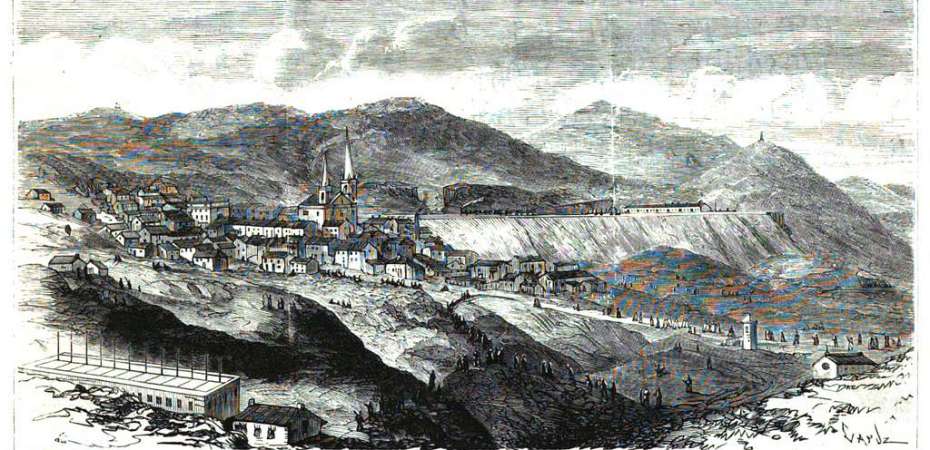
After Niebla, the railway enters the mountains, following the course of the Río Tinto, which runs tightly hemmed in between steep, inaccessible slate peaks. The landscape is rugged, solitary, and sombre. The horizon is bounded by large hills sparsely covered with rock roses (jaras). It is rare to see any path or trail indicating human presence in such areas. A distant herd of goats and a few eagles perched on the mountain crests were the only signs of life, adding to the wild charm of the setting. Enhancing the scene’s strangeness were the dark red waters of the Río Tinto, which in certain places appear fully black. To build the railway through these places—rarely if ever trodden by human feet—it was necessary to cut through rock, in some cases forming genuinely colossal cuttings, to frequently raise large retaining walls above the river, to construct five tunnels, and to build numerous bridges.
The track covers a distance of 83 kilometres and includes 243 engineering structures, broken down as follows: 164 culverts, 54 small drains, 11 viaducts, and 14 bridges. It is prepared to run twenty trains daily, capable of transporting more than 2,000 tons of mineral, with 10 stations and the necessary rolling stock.
The inaugural train reached the mines at approximately noon, where it was greeted with cheers by over 4,000 people awaiting its arrival.
At one o’clock, lunch was served, attended by some 150 guests. It was organised by Mr. Domingo Felipes, owner of the English restaurant. Under his direction, three tables had been artistically arranged in as many rooms, the walls adorned with trophies and banners from Spain, Britain, Germany, etc.
Numerous and enthusiastic toasts were given. While we cannot list them all, we note the following speakers:
- Mr. Marcos Carr, general director of the Río Tinto Company;
- Mr. William Galkey, chief engineer of the construction company;
- Mr. Theodor Blum, technical director of the mines;
- Mr. William Ridley, chief railway engineer;
- Mr. Manuel Graham, district inspector engineer;
- Mr. William Roediger, chief engineer of the fifth district;
- Mr. Thomas Roberts, chief engineer of the mine tunnel;
- Mr. Thomas Down, consulting engineer in England for the Tharsis company, currently residing in the area;
- Mr. Justo Rodríguez de Alba, representative of said company;
- Mr. Cecilio Edge, bookkeeper for the Río Tinto Company;
- Mr. Blas Tello, vice-president of the provincial council;
- Mr. Guillermo Sundheim;
- Mr. Rafael Clemente, chief public works engineer for the province;
…among many others. Toasts were made to the prosperity of the country, the province, the companies present, those who had initiated, driven forward, and executed the project being inaugurated, the pioneers of copper pyrite mining in the province, the prosperity of industry and commerce, the union of the nations represented, and their respective governments.
Other notable attendees included:
- Mr. Federico Pring, Mr. Arthur Truman, Mr. George Norton, and Mr. Frederick Mayboll, engineers of the first, second, third, and fourth districts respectively;
- Mr. Nicolás Pérez Vázquez and Mr. Ricardo Hunt, paymasters for the construction company;
- Mr. Diego Howard, store manager;
- Mr. Manuel Vilaplana and Mr. Manuel Ruiz, assistants;
- Mr. Tomas Gibson, inspector engineer of the pier;
- Mr. Guillermo Langdon, chief workshop engineer, who also drove the inaugural train;
- Mr. Arthur Guilomarde, assistant engineer;
- Mr. Neil Kennedy, mine engineer;
- Mr. Gumersindo Carbonell, Mr. Luis Rossignoli, and Mr. Manuel Rodríguez Pinilla, administrative employees;
- Mr. Tomas Thorne, engineer of the Huelva pier;
- Mr. Jorge Double, master builder of the pier;
- Mr. José María Parejo, company representative in Huelva;
- Mr. Miguel Deisse, mine employee;
- Mr. Jesús Alonso, company doctor;
- Mr. Ramón Sanabria de Rodríguez, provincial administrator;
- Mr. Mayo, secretary of the civil government;
- Mr. Jacinto de Mendoza, commander of the Civil Guard;
- Mr. Hector Schaud
- Mr. Eduardo Díaz, British consul in Huelva;
- Mr. Horacio Bell y Román, director of the provincial institute;
- Mr. José Salcedo, institute secretary;
- Mr. Florentino Zavala, provincial chief mining engineer;
- Mr. Aspiroz and Mr. Margarit, mining engineers;
- Mr. Beas, forestry engineer;
- Employees from Sundheim & Doetsch: Pedro Deisse, Federico Lorent, Otto Layman, Juan Gudeville, Adolfo Rey, and Javier Roth;
- Mr. N. Cowan from the Tharsis Company;
- Mr. José María de León, secretary of the provincial council;
- Mr. José García Cabanas, director of La Provincia;
- The customs chief, Mr. Pedro Pérez Ponce, legal advisor to the company;
- Mr. Felipe Vázquez, and the mayor, secretary, and parish priest of Riotinto, the Protestant pastor, and others whose names we do not recall.
At four in the afternoon, the train departed from Río Tinto for Huelva, arriving at ten at night. The journey, both outbound and return, took place without the slightest mishap. According to expert opinion, the construction is solid and carefully executed, and both the rolling stock and fixed track material are excellent, even luxurious. Large-scale exploitation of the mines will not be long in coming.
We conclude this report by expressing our best wishes for the prosperity of an enterprise which so greatly contributes—and will continue to contribute—to the development of public wealth in Huelva and its province, and by congratulating both the initiators and those who, through perseverance and support, have seen it through to such a successful conclusion.
