(From a Report by Vice-Consul Diaz in Huelva, as published in the Journal of Commerce)
The returns of import and export trade and of the shipping movement at this port from the year 1856 to 1872 show that this city owes its commercial importance chiefly to the working of the mines in the neighbourhood, the products of which are shipped in its river, and also to the exportation of agricultural produce, which is yearly increasing, and will be still further developed on the opening of the railway to Seville now in course of construction. This line, by placing our capital in direct and speedy communication with several of the most fertile districts of the province, abounding as they do in fruits, wines, and oils, will facilitate the exportation of their crops and thereby open up new fields for enterprise and wealth.
The present is not, however the first epoch of prosperity and commercial importance of this district.
The rich lodes of copper ore in which its mountains abound must have supplied for many years the wants of the ancient markets.
Both history and tradition agree in attributing to the Phœnician the founding of this city. The trade in which this commercial nation chiefly engaged appears to have been that of metals, and unmistakable evidence in support of the theory are still extant in some of the large mines of the province. The Phœnicians were succeeded by the Romans, under whose dominion the search for minerals was greatly extended.
Around the old mines enormous mounds of scoria of Roman formation are yet to be seen. This scoria differs in character from that attributed to the Phœnician, which they cover and extend in a wide circumference, rises to a great elevation, the whole mass representing a weight of millions of tons, at which figure these residues of ancient metallurgy may be fairly computed. According to the most reasonable calculations they may be estimated at from 20,000,000 to 25,000,000 of tons, which would give an equivalent of about 1,000,000 tons of copper.
At the beginning of the eighteenth century, Mr. Wolters, a Swedish miner, acquired possession of the mines at Rio Tinto, a tributary of the Odiel situated 80 kilos inland. Since then they have been continually worked, first by the heirs of Mr. Wolters, and afterwards by the Spanish Government, who has recently disposed of them to an Anglo-German Company.
The desire which then became general to turn the mineral fertility of the province to the best account, favoured by special laws, caused in 1845 the opening of some mines bordering the Rio Tinto, but of minor importance. The yield of these, amounting to 1,000 to 2,000 tons of fine copper per year, has been exported through Seville.
In 1853, Mons. Ernesto Deligny, a distinguished French mining engineer, surveyed this district, and to his great skill and energy is due the opening of the Tharsis mines, distant from this city 50 kilos, those of Calanas, 60, and others in their vicinity, less important, conferring a great boon to this province and incalculable elements of prosperity to British commerce.
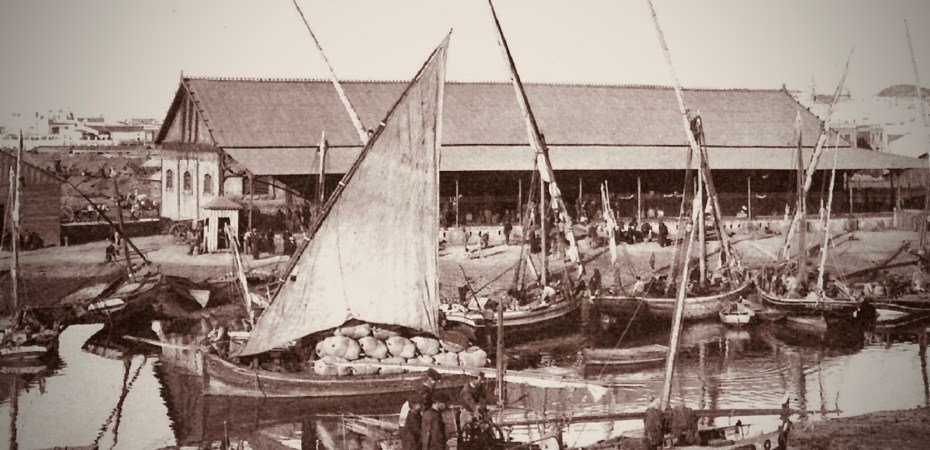
The port of Huelva was naturally destined to be the channel through which the exportation of the mineral products was to take place, and the ores exported are not confined to fine copper, but include ores wrought from the mines and composed of 48 per cent. of sulphur, 45 per cent. iron, 3 to 3½ per cent. copper, and a portion of silver sufficiently rich to repay the expense of its extraction. Since the ore was first exported, British manufacturers have found a ready market for it, and utilised all its component parts.
Those companies to whose mines are attached easy means of transport, either on account of their proximity to places of shipment, or through the advantages of a railway, export the ore instead of smelting it. In 1872, the exportation of pyrites from this port to the United Kingdom amounted to 261,373 tons, which, added to the 169,833 tons exported by the neighbouring mines of Santo Domingo, opened also by Mons. Ernesto Deligny, gives a total of 431,206 tons, that is to say, of near 12,936 tons of copper, 211,290 tons of sulphur, and 194,042 tons of iron furnished by this district to the British market ; 3,350 tones of fine copper were also exported during the year. The Rio Tinto mines and others of that neighbourhood export their products through Seville.
The trade in pyrites ore, which has been increasing yearly in importance, will attain larger proportions as soon as the two projected railways, one from the Rio Tinto mines 80 kilos in length, and the other from the Lagunazo mines to the river Guadiana, 36 kilos long, are opened. The amount exported at present, supplies four-fifths of the total amount of consumption of the sulphuric acid works in Great Britain. It may thus truly be affirmed that the British trade in chemicals and artificial manures is indebted to this province for its present flourishing condition ; for, without the products exported, it would never have acquired so rapid and important a development.
Manganeses ore has, since the year 1859, been an article of exportation at this port. The mineral is found in many different places in the province in the form of pockets, and has hitherto been worked only on the surface. It is held in high estimation for its richness, which varies from 70 to 80 per cent of peroxide, and for its freeness from calcareous gangue.
The exportation of manganese rose, in 1868, to 41,000 tons, but not only amounts to on-half of that quantity owing to the late introduction of the process of vivification, and to the slow and costly nature of the working ; which has now to be performed underground.
There are two railway lines open to traffic, one being that of the Tharsis mines to the Odiel, and the other from the Buitron mines to San Juan del Puerto.
The most important mines of the district are the following – Tharsis, Calanas, Lagunazo, Lapilla, Buitron, and Sotiel.
The important trade has increased in the corresponding degree. That carried on by foreign vessels which was not even known in 1856, exceeded 19,000 tons in 1872, whilst that don in Spanish bottoms has since that year been doubled or trebled.
The large shipping movement arising out of such a considerable export trade has by affording facilities for it, stimulated the exportation of the agricultural produce of this province, which formerly found its way to the Cadiz and Seville markets. This particular trade, as remarked at the commencement of this report, will continue to increase annually for the reasons indicated, as also by the tendency manifested in the farmers, in directing their labours to the production of wine, oil, and fruits, now that they enjoy better facilities for exporting crops.
The quantity of the wine grown in this province, which on an average amounts to 80,000 pipes yearly, merits special notice. Nine-tenths of this is bought up by the exporters at Xerez and Port St. Mary, who afterwards ship it with their brands as sherry wine, in combination with other wines or by itself through the port of Cadiz. Although wanting the fineness and delicacy that distinguishes sherry, the wines of this district somewhat resemble the former and are not infrequently passed off as the produce of the Xerez vineyards. Their purity, colour, and agreeable flavour war justly appreciated. Merchants in England would find it to their advantage, as regards price, to purchase their wines direct from the growers here, and thereby avoid the monopoly so detrimental to their interests, which is carried on by the exporters at Xerez, Port St. Mary, and Cadiz.
