(New York Times, Dec. 3, 1873)
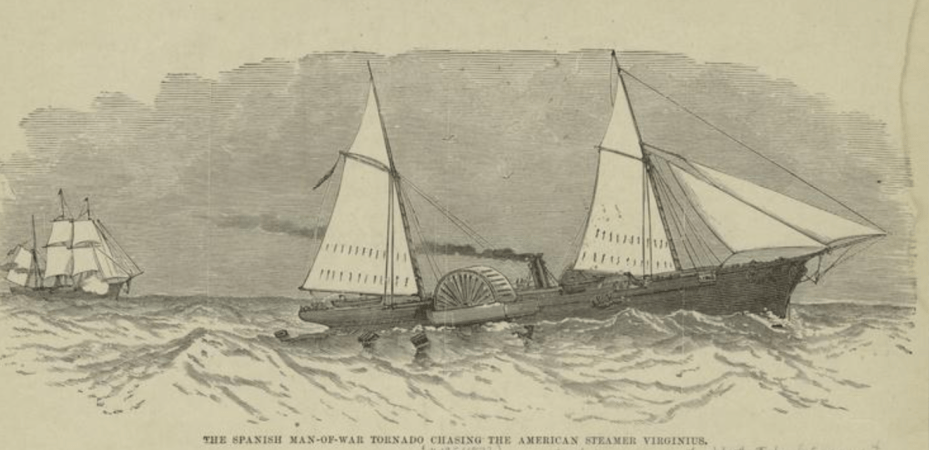
An examination of the text of the protocol of the conference held on th 20th ult. between Mr. Fish and Admiral Polo will reveal, more clearly than any previously published information, the exact nature and extent of the settlement effected between our Government and Spain. By that document it will be seen that the following facts are established by the claim of the United States and the concession of Spain : That the Virginius bore, at the time of her capture, the flag of the United States ; that the capture was made on the high seas ; and that it was so far illegal and improper as to require the surrender “forthwith” of the vessel and the survivors of her passengers and crew. This result of the negotiations confirms the position held from the first by the Times, that the single fact of bearing the flag of the United States on the high seas in time of peace, protects any vessel from capture and adjudication by the armed vessels of a foreign nation. This position has been contested by some persons whose opinions are entitled to respect. But as the course finally adopted by Spain is known to have had the assent of Great Britain, obtained upon consultation by Spain with that Government, and is reported to have had the approval also of the other Great Powers composing the family of nations by which the body of international law is recognised, the doctrine established in the protocol receives authority of a very high character.
The question will then naturally arise—If the flag of a member of the family of nations is primá facie protection against capture and adjudication by any other nation, what is the recourse open to a friendly nation wronged by the fraudulent assumption of that flag, should the flag turn out to be wrong- fully assumed? This question also receives an answer of importance in the protocol. The answer is that the recourse of the nation supposing itself to be wronged, is to apply for redress to the nation whose flag is involved. It is on this doctrine that the protocol proceeds to state that, if the United States is satisfied that the fag was carried by the Virginius “not rightfully,” then the United States will “institute inquiry and adopt legal proceedings against the vessel, if it be found that she has violated any law of the United States; and against any of the persons who may be guilty of illegal acts in connection therewith.”
It may be urged that a vessel fraudulently assuming a national flag may be engaged in an expedition of serious danger to the friendly nation, and it may very properly be asked what course would then be open to that nation. To this question the protocol does not afford any definite or authoritative answer, nor was the conduct of Spain such as would allow of the discussion of such a question. What Spain did was to capture the vessel, and execute a large portion of her passengers and crew. In fixing the means and measure of redress for this offence, there is no opportunity afforded for the discussion of what she might properly have done. But it is probable that the United States would not have objected, nor would the law of nations have furnished condemnation of Spain, had its Government used so much force as was necessary to defeat the alleged purpose of the vessel, and then left to the United States the punishment Spain had a right to demand should be visited on the authors and instruments of that purpose. Had Spain, for instance, stopped the Virginius, and delivered her into the custody of the United States, at the nearest port, or by the agency of the nearest accessible American man-of-war, it is not at all likely that any difficulty would have followed. That this moderate and sensible course was not taken is to be regretted, both on account of the immediate disturbance which has arisen, and on account account of the valuable precedent which would have been contributed to a now obscure and doubtful portion of the law between nations.
It will be further seen by the protocol that the right claimed by the United States of investigating and punishing offences against our laws, even though they result in injury to another and friendly nation, is freely conceded to Spain in the case of the persons by whom the Virginius was seized, and those by the whom her passengers passengers crew, in part were executed. The same clause, which promises a like procedure on the part of the United States, provides that Spain “will investigate the conduct of those of her authorities who have infringed Spanish laws or treaty obligations, and will arraign them before competent courts, and inflict punishment on those who may have offended.” Of course, this portion of the Government’s procedure brings down upon it the reckless censure of those who pretend to believe that nothing but war can establish the dignity of the Government. It is hardly necessary to repeat, however, what we have so frequently pointed out, that the President cannot make war, or do acts which amount to war; and if the President should yield to the wild demands of the sensation press, that press would be the first to condemn him.
(New York Herald, Dec. 3. 1873)
THE terms agreed upon between Secretary Fish and Admiral Polo for the settlement of the Virginius outrage are now before the American people. The protocol, at length officially published, differs but little from the version furnished semi- officially to the press last Sunday, except that in the latter Spain was made to guarantee the institution of proceedings against any of her authorities who may have violated either law or treaty stipulations, while the original document reads that such proceedings, “it is understood,” are to be instituted by Spain. The conditions are, however, in substance such as we have alreadу commented on at length. They are degrading to the United States. They afford no guarantee that Spain relinquishes the right of visitation and search on the high seas which she has claimed and enforced with such fatal results. They give no protection for the future to our commerce or to the lives of our citizens. They leave the atrocious rule in Cuba untouched. They quench no spark of the firebrand which for the past five years has been brandished at our threshold, and from which we are in constant danger of a conflagration. They recall no word of the outrageous proclamations of the Cuban Captains, General Dulce and De Rodas, against which our Secretary of State—always as sweet as molasses towards the Spanish Government—has fulminated his doughty protests. They leave us, in fact,
with all these Spanish-Cuban complications, insults and outrages, threatening and injuring us, as they have threatened and injured us ever since the flames of the Cuban revolution were first kindled on the unhappy island.
The disgraceful protocol is an abandonment of the demands first made by our Government on Spain.
(New York Tribune, Dec. 3. 1873)
IT is pleasing, also to know that the earlier accounts of the slaughter at Santiago were grossly exaggerated, as there are now reported as in prison there 101 of the Virginius captives awaiting the demand of our authorities. Their release. we presume, will be promptly effected, and there is now reason to hope that the whole affair may be honourably concluded without further bloodshed. For this consummation our acknowledgments should be equally divided between our own Government for its judicious firmness and moderation, and the Castelar Cabinet for its unflinching honour and courage in daring to concede a just claim in the face of a powerful prejudice.
(Daily News Telegram, Dec. 17.)
MADRID, TUESDAY.—Señor Castelar, the President of the Republic, called on the American Minister, General Sickles, to-day, and officially announced that the Virginius had been delivered up at Bahia-Honda to an American vessel, and that the survivors of the crew had been surrendered to the American fleet at Santiago. Señor Castelar was accompanied by the Minister for Foreign Affairs. The utmost cordiality was shown on both sides.
