
(THE HOUR. July, 14, 1873)
THE RIO TINTO COMPANY (LIMITED).
SHARE CAPITAL £2,250,000.
PRESENT ISSUE £2,000,000, in 200,000 SHARES OF £10 EACH.
The remainder is reserved for the present and when issued will be offered in preference to the Shareholders. Payment on application £1 per share, and on allotment £2 10s. per share. And the balance to be called up as required, it being intended that the calls shall be at intervals of not less than two months.
ABRIDGED PERSPECTUS
The company has been formed with the principal object of purchasing and developing the well-known mining property of Rio Tinto, the the South of Spain, containing the richest and most important of all the great mineral deposits with extend from Seville to beyond the mines of Santo Domingo in Portugal. The property is freehold in perpetuity, and contains 4,710 English acres in one connected tract, embracing nearly the whole of the town of Rio Tinto. The celebrated Tharsis mine is situated on the same mineral range.
The distinctive feature of this undertaking, and in which it differs from almost all other mining adventures, is the undoubted fact that the enormous deposits of ore known and actually proved to exist in the mines, fully secures their future against the usual risks attendant upon mining operations in general. It is merely a question of the demand and the cost of working. The directors believe the first to be fully sufficient to ensure a sale at good prices ; and that the second can, by judicious management, be kept down to a point which will ensure a large return upon the capital employed.
A personal inspection of the property on behalf of the company has been made by David Forbes, Esq., F.R.S., who has submitted an exhaustive report on its condition, and a plan for working the mines which the directors have adopted. He estimates that the small protion on which the company has commenced its works will yield, between the surface and the depth at which it is proposed to construct a horizontal outlet, no less than 11,700,000 tons of ore. The company has abandoned the old imperfect method of mining, and has adopted the system of “open cast” working, or quarrying, which is now proceeding satisfactorily.
In order to provide sufficient and economical means of transport a railway is to be constructed by the company to connect the mines with the seaport of Huelva, a distance of about 50 miles. It will give access to the lode at a depth of 85 metres (95 yards) below the surface of the mineral, or 20 metres lower than any of the present workings. This will provide not only for complete drainage, but also for the extraction and removal of the ore without any lifting power, an exceptional advantage derived from the natural formation of the ground, and of the highest importance in dealing with such large quantities.
Mr. Forbes estimates that on completion of the railway the company will be enabled to quarry and deliver in the English, Continental, and other markets 500,000 tons of ore per annum. He reports that the Rio Tinto ore contains on average 48 per cent. sulphur, and 2½ to 3½ per cent. of copper, and can be delivered in England at a cost of £1 7s. per ton. Putting its selling price at £3 3s. per ton, which may be taken as the average value of such ores, based on their sulphur and copper contents, for the last 10 years, although considerably lower than the present market value, a net profit will be realised of £1 16s. 3d. on each ton of ore exported from the mines. The directors, however, have thought it well to put forward a still more moderate estimate of value, based upon sulphur at 7½d. per unit, and copper at 11s. 6d., which will yield a profit of £1 11s. per ton. Before the opening of the railway, the only profit will be from the manufacture of copper by the cementation process. This was estimated by Mr. Forbes to yield £60,000 per annum, but from improvements in the mode of dealing with the minerals, this amount will, in all probability, be considerably increased.
The net revenue of the company, when the railway is completed, would, according to the preceding calculations be:
| From exportation of pyrites ore, 500,000 tons, at a profit of £1 11s…. | £775,000 |
| From manufacture of copper, at the lowest estimate… | 60,000 |
| Total: | £835,000 |
The property was purchased by the Spanish government by a combination of capitalists, among whom were some of the directors of the present company, and the purchase was sanctioned and confirmed by the law of National Assembly of Spain, on the 17th. of February, 1873, (which also authorised a concession for the construction of a railway), the the price of 92,800,000 pesetas, payable in ten yearly instalments, together with 1,195,912 pesetas for the valuations of the plant, buildings, stock of minerals, &c., equal in all to about £3,850.000, more or less, according to the variations in the rate of exchange.
The original purchasers have entered into an agreement with the company to transfer to it the entire benefit of this purchase, and to bear all the expenses of forming and issuing the company up to the date of allotment (other than the company’s expenses of taking possession and managing the mines and obtaining the conveyance thereof), for £150,000 in cash, with interest at 6 per cent. per annum from the date of public issue of the company, and £600,000 in debentures of the company at par, bearing interest at 8 per cent. per annum from the same date, and with an accumulative sinking fund of 2 per cent. per annum, commencing for years later.
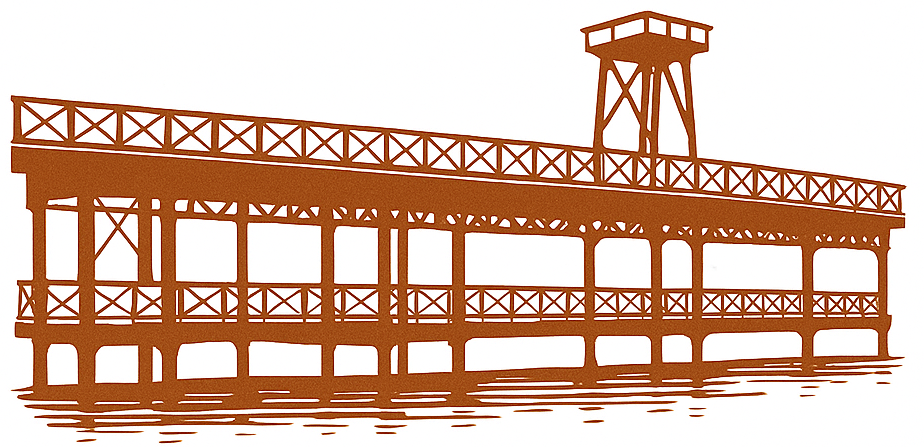
A contract has been entered into with Messrs. Edwin Clark, Punchard, and Co., for the construction of the Railway and Pier, including a tunnel to the face of the ore, and the necessary amount of rolling stock, for a sum not exceeding £775,000, under which contract the whole of the works are to be completed in two years from their commencement.
The directors estimate that the sum of £2,737 will be required for capital expenditure during the first three years. It is intended to raise this amount by the issue of the £2,000,000 of shares now offered and the remainder by debentures.
When the works are in full operation, and the railway completed, the annual revenue of £835,000, as above estimated, would be sufficient to meet the necessary annual outlays, and to pay a dividend of 18 per cent. to the shareholders, even if the whole of the subsequent instalments due to the Government were paid out of revenue. The company, however, may if thought expedient, provide the funds for meeting these instalments in whole or in part by the further issue of debentures. After all the instalments are paid, the calculations promise, at the moderate prices assumed in this prospectus, a dividend of fully 35 per cent. on the share capital. The Tharsis Sulphur and Copper Mines, which lie on the same line of mineral deposit, about thirty miles to the west, are an illustration of the richness and profitableness of similar lodes when effectively worked. The dividend declared by the Tharsis Company for last year was 40 per cent. upon its capital, notwithstanding that it is burdened with a royalty of 4s 3d. per ton of ore exported, and 2s 3d. on ore worked at the mine from which this company is free. If such a royalty existed upon the contemplated production of Rio Tinto, it would represent interest at 5 per cent. per annum on a capital of two and a half million sterling. The £10 shares of the Tharsis Company are at present quoted at above £40. It is proposed to pay interest of 6 per cent. per annum during construction, on the amount from time to time paid up on the shares.
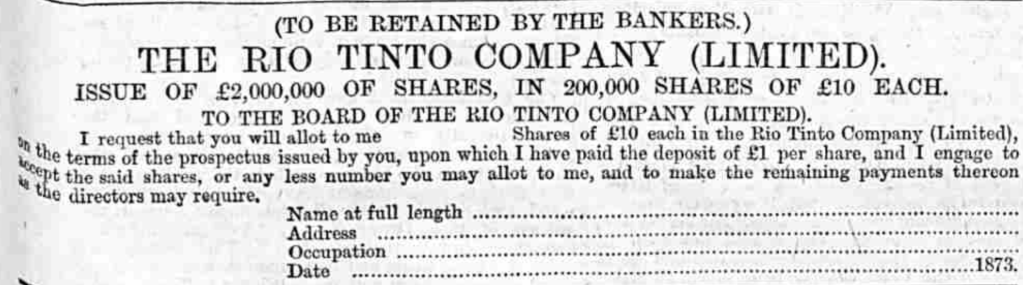
Applications must be made in the annexed form, accompanied with a deposit of £1 per share applied for, and lodged with any of the following bankers, viz. :—Messers. Smith, Payne and Smiths, London; Messers. Arthur Heywood, Sons and Co., Liverpool; The Union Bank of Scotland, Glasgow, and Branches.
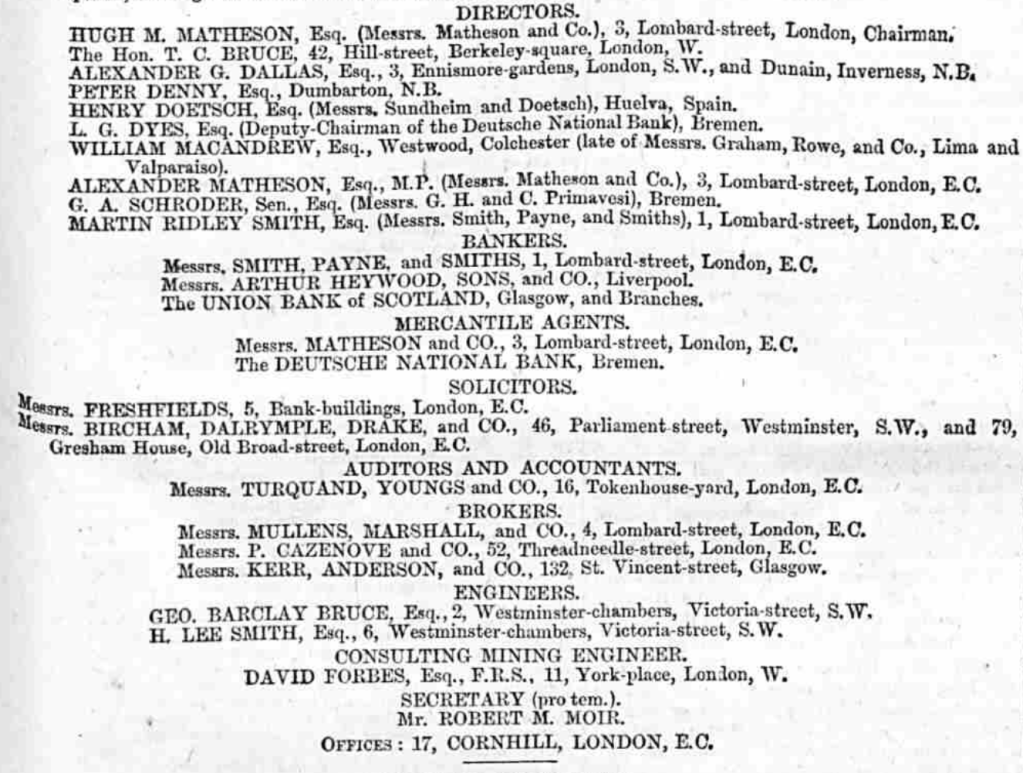
Prospectuses and forms of application can be obtained at the company’s office, or of Messrs. Matheson and Co., 3 Lombard Street, London, E.C., of the company’s bankers and brokers.
8th July, 1873