(As published in The Glasgow Herald)
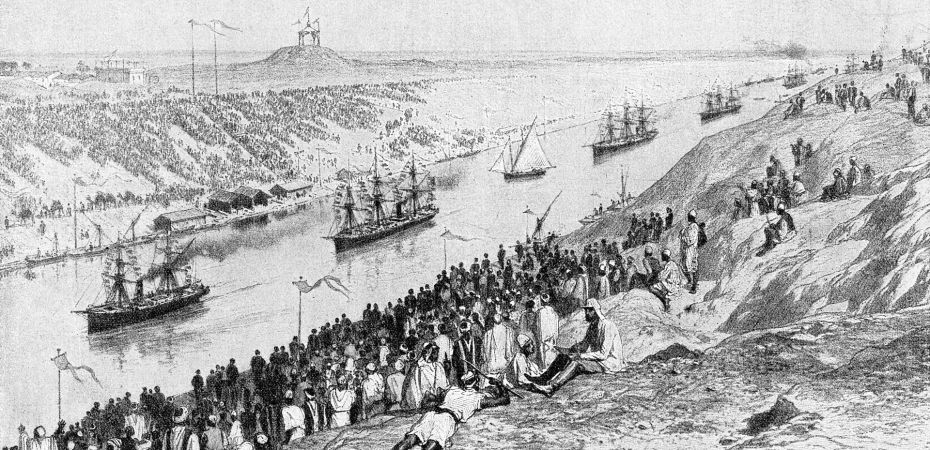
The Suez Canal, which connects the Mediterranean with the Red Sea, is to be opened to-day with splendid ceremonies. In point of length this stupendous work is surpassed by a canal in China, which was commenced in the tenth century, extends 2000 miles, and connects 41 cities. It is also surpassed in length by the canal which irrigates the country between the Ganges and the Jumna, over 500 miles of which were open in 1854, and which, when finished, will extend to nearly 1000 miles. Even the present Suez Canal is itself but the revival, though not in precise locality, of an ancient one which some half-dozen centuries before the Christian era connected the two seas. Of course the canals of China, India, and ancient Egypt, though in themselves very notable undertakings, could not possibly equal in the quality of them the mightier work of M. Lesseps. Yet, as most nations, in the most primitive times, contrived somehow to construct the works that exactly suited their needs, and as no modern nation can do more, if so much, a sort of proportional equality ought to be recognised between the works of the ancients and the moderns. While, therefore, as compared with the one just finished, the ancient Suez Canal was a humble enough affair, it was yet a splendid work for the time, both in idea and execution. No doubt it took the old Egyptian workmen a hundred years to complete it, whereas the actual labour spent upon the canal of M. Lesseps has been performed in the small space of ten years. In the days of the Pharaohs, however, time was not essentially of the same value as it is in our electric and railway era, while the mechanical instrumentalities were fewer and immeasurably inferior. Yet so long as the Pyramids fling their vast black angles on the sand, and the Temples of Luxor and Carnac (mighty still, though in ruins) withstand the grinding tooth of time, no artist or engineer of the new generations will be able to say that the genius of those old heathens was unequal to the tasks of its own day.
In the ancient canalisation of the Isthmus the smaller size of the ships then built enabled the engineers to make use of the Nile up to that point of the river which impinges most closely upon the Red Sea. As, however, the irregular depth of the Nile at different seasons would be wholly inadequate for the modern vessels and the regular demands of modern commerce, the great canal of M. Lesseps runs from Port-Said, 150 miles east of Alexandria, on the Mediterranean, to Suez on the Red Sea, so that the ports at both ends are maritime – all vessels being thus enabled to sail out of the one sea into the other, through the whole course of 1000 miles, unimpeded by a lock. It may easily be imagined that so grand a piece of engineering could not even be commenced without encountering numerous preliminary difficulties. Many real and many imaginary lions had to be slain before the sand of Egypt could be bitten by the first spade. But the enthusiasm of M. Lesseps, and his unconquerable belief in the feasibility of his project, were equal to the task. It is perhaps fair to mention that the credit of reviving the idea uniting the two seas belongs to Napoleon First, whom it struck during his campaign in the East. But if to the Imperial Frenchman is due the honour of re-conceiving an old idea, to a French civilian belongs the glory of embodying the conception in the hugest and most splendid form – even the probable impermanence of which will survive and surpase in fruitfulness for good many of the most impossible deeds of the Emperor. Having, after two years of conferences, got plans prepared, a company formed, and money subscribed, the formation of the Suez Canal was actually commenced in the latter end of 1860. One of the most difficult parts of the work lay in the employment, provisioning, and proper government of thousands upon thousands of labourers, in number equal to the population of some European cities. These were at first supplied, to the extent of 25,000, by the Viceroy, under a contract with the company. The mind of Europe, however, and particularly the mind of England, becoming troubled about the manner in which the Fellahs were engaged, or compelled to engage, to work at the Canal, there was a deal of talking and writing on the subject, and the Viceroy thought it politic, for that and other reasons, to withdraw latterly from the contract, for which step he was compelled to pay a very large sum. At various points along the course of the works towns and villages sprang up, and in order to supply the populations and multitudes of workmen with water it was found necessary to construct a second canal, over 90 miles in length, which, like a mill-stream, caught the Nile nearly 50 miles above the sea – a fact sufficient in itself to prove the surpassing magnitude of the scheme and the obstacles which lay in the way of its proper execution. Perhaps the toughest and most expensive portion of the works was encountered at Port-Said, where not only two enormous breakwaters had to be constructed, one of them two miles in length, but the space on which the town is built had to be conquered from the sea, while huge blocks of stone bedded in European lime and Egyptian sand, had to be manufactured for the purpose. In its course the canal passes through a series of lakes mounting of about two-thirds of its length. As these lakes were comparatively shallow, the canalisation of them entailed a stupendous amount of labour of combined dredging and embanking. Mensaleh, the first lake passed through, may be taken as an illustration. Through this lake, with an average depth of five or six feet, the canal channel was dredged, and then embanked on both sides to fifteen feet above the water level. Two other lakes give thirty miles of dredging. Lake Zimsah and the Bitter Lakes were differently managed, being artificially filled with water, and the course of the canal marked off by buoys. In fact the whole work, whether done by digging, dredging, embanking, or flushing with water, was on the most gigantic scale, and would in more primitive times have been attributed to the giants or the gods.
In result, the canal is, or ought to be, 26 feet in depth and 72 feet wide at the bottom ; while it ranges from more than 300 to 200 feet wide at the surface. It is intended to float vessels drawing 24½ feet, to which will be allowed only a maximum speed of 6¼ miles, the journey of the canal being thus a matter of 16 hours, or double the time taken by the railway from Alexandria to Suez. Among the grand and humane objects of modern science and art is the abridgement of space and pain. the whole coastline of Africa has hitherto intervened between Europe and India. More than half of this vast sweep has been abolished by the Suez Canal, which, in a manner, cuts the Continent of Africa through the neck, so that its tremendous material bulk may no longer hamper the swift designs of Europe – the brain of the world. Between seven and eight thousand miles saved at a single stroke has more than a merely physical significance. Every such drawing together of the widely separated countries of the earth is a benefit to the populations of these countries in all their commercial, social, moral, and religious relations. The leading questions of the moment, however, refer to the probable commercial success of the canal, and its consequent prospects of permanence, for the latter eventually will depend mainly upon the former. If it can be inaugurated in an unquestionable condition of efficiency, and command sufficient traffic to pay, its efficiency may be maintained indefinitely. There is, of course, no certainty in the calculation, for the sandy breath of the desert may prove ultimately more than a match for human art. But it ought not to be forgotten that the canal constructed by the ancient Egyptians was in active use for many centuries, during which it was several times partially destroyed, and there is no reason to believe that it fell to ruin less through the ceaseless action of nature than from the barbarism and indolent inaction of man. The present magnificent canal has two enemies to contend with – the blowing sand above, and the shifting sand beneath – both of which combined, we greatly fear, may in the end reduce it to a non paying point, by demanding a continuous expenditure in the work of keeping it in repair. It is also possible that the successful navigation fo the Red Sea may be found very difficult for sailing ships. This country, it must be confessed, has all but disbelieved in the permanent utility of the scheme. So great an engineer as Robert Stephenson and so great a statesman as Lord Palmerston were provincial or narrow enough in their ideas to give it the cold shoulder. Perhaps they were right. Yet the canal is finished – a noble and splendid reality ; and if it can be maintained, the distance and time saved by it between the West and the East ought to make it a great commercial success.
