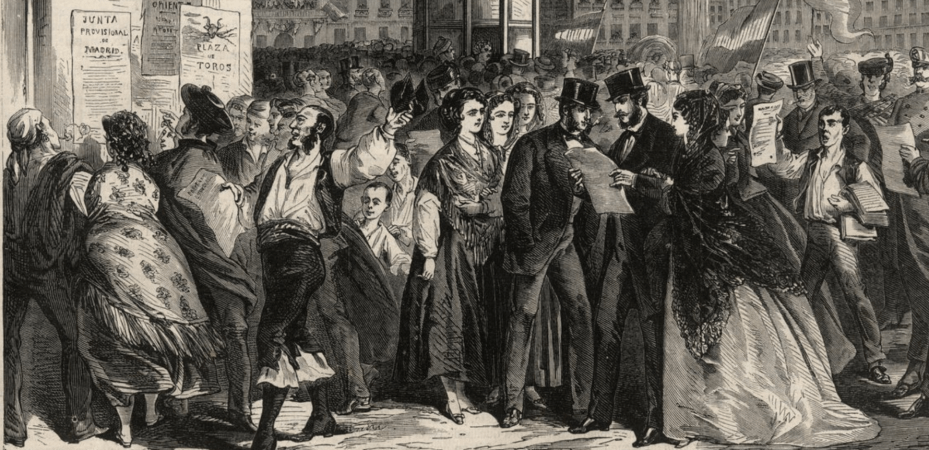
(The Times —October 1, 1868)
Queen Isabella has fallen after a reign of exactly 35 years. She succeeded to the Throne at the death of her father, on the 29th of September, 1833, and on the same day of 1868 the revolution reached her capital and terminated a reign that had been almost coequal with her life. In that long period the troubles of the Spanish nation have been almost continuous. There has been no certain assurance of private well-being or public tranquillity. There may have been intervals of uneasy repose, but there never has been that sense of full security which is necessary for happiness. No man could count upon the duration of any Government or Administration, and there was always the likelihood that the fall of this or that personage would lead to an appeal to arms. Some of the worst, some of the most reckless, and some of the most stupid people that have ever had to do with a Government had during the present generation wielded power in Spain. The Queen Mother, one of those women who unite gross ignorance to much craft and insatiable lust of power, has had a baleful influence on her daughter’s life, and when the unhappy career of the latter is described the judicious narrator will not forget what public principles were inculcated on her youth, what domestic example she had before her eyes, and how her best and most natural affections tended to pervert her character, and make her not only forgetful of self-respect, but utterly regardless of public opinion. The political material that Queen Isabella leaves behind her is of no very hopeful kind. She and her instruments gradually corrupted each other. He political education was of the worst, and she “bettered the instruction” in communicating it to the later series of politicians and soldiers who stood around her Throne. All that can be hoped is that the men who have conquered will see it to be their own interest as well as that of the State to hold together, to keep in check their individual vanity and ambition, and to gain reputation and permanent power by conferring tranquillity upon Spain… The Spaniards will have only themselves to blame if they fail in establishing a decent Constitutional Government. Eligible young Princes are plentiful enough. Spain, in the midst of its troubles, has advanced with the rest of the world sufficiently to supply the materials of a satisfactory Assembly, and to furnish Ministers who can learn their duty. The country is compact, peopled by a race which feels itself a nation, and which will combine for any great purpose in peace and war. There is no barbarous element like that of the half breeds and Indians in the American Republics, and the tradition of monarchy will prevent the supreme power, from being sought by means of arms and intrigue. The Central Government, too, will be stronger than ever, through the facility of modern communications. You man now go by rail from the French frontier to Cadiz. The noble ports of the sea coast are united by lines of steamers, and the telegraph is stretching over the land. Capital only requires to be assured of the tranquillity of the people and the honesty of the Government to enter the country and develop its extraordinary resources. Five years of good government will make Spain a new land, and the path of prudence and public virtue is in this case so easy that we can hardly conceive it to be missed except by wilful dishonesty.
