
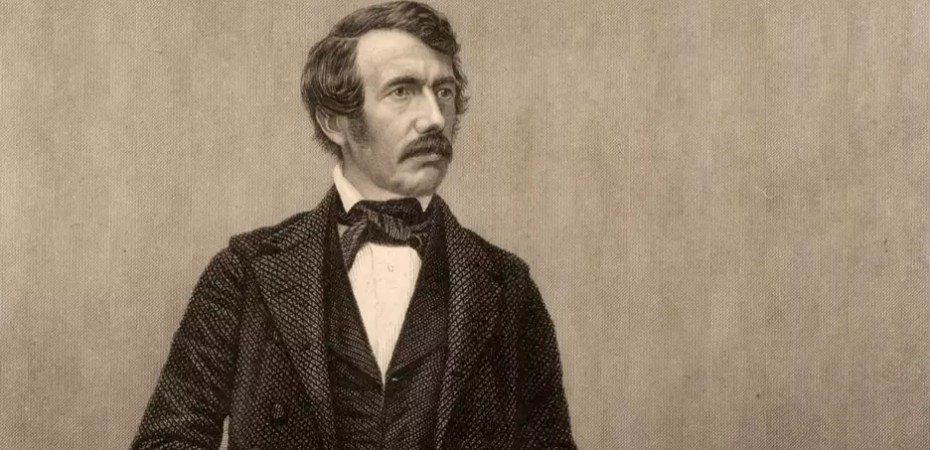
At the annual meeting of the Royal Geographical Society on Monday, Sir Roderick Murchison referred to the explorations of Dr Livingstone. He said- Not to dwell on what Livingstone has already accomplished, we way now speculate on his future steps, and if we form a right estimation of the course he is now following out, we way not unreasonably calculate the period of his return home. At the date of his lest letters-2d February, 1867-the great traveller was at Bemba, lat. 10 deg. 10 sec.; and at that time all the problems respecting the outflow or inflow of the great lake Tanganyika, about 200 miles to the north of his position, had yet to be determined, He had, indeed, to ascertain whether that vast body of water, about 300 miles in length, and the central part of which only was known to Burton and Speke, was fed by waters flowing into it at its southern end, or sent off a river or rivers to the south-west, Now, this point, I have no doubt, he will have completely ascertained; for as by the last accounts brought by the Arabs he was at Ujiji, which lies in the central part of the eastern shore of Tanganyika, in the middle of October, so we know that he had eight months to settle that important question. If the Tanganyika be found shut in on the north, and a great stream ascertained to flow from it to the West or south- west, why then my dauntless friend may follow that course of water across a great and entirely unknown region of Africa, and emerge on the west coast either by the settlements on the Congo or by the territory of the Portuguese, to which he penetrated in his first grand travels across South Africa. In this case a very long time, perhaps eighteen months, may elapse, during which we shall be held in anxious suspense. On the other hand, if the view of Mr Finlay be sustained-that a water communication exists between Tanganyika and Albert Nyanza-we can much more readily estimate the probable period of his return. In this event, the great physical problem of the true watershed of South Africa and the ultimate southern water basin of the Nile will have been determined; and in touching the south-end of the Laire Albert Nyanza, Livingstone will have, in fact, reached the known waters of the Nile. If such be the case, opinions are various as to the course he would next follow; some persons believing that he would push on northwards, and, traversing Equatorial Africa, would endeavour to reach Gondokoro, and so descend the Nile to its mouth. For my own part, I have already expressed the opinion that having once determined the great geographical problem which he went out to solve, it is more probable that he would turn to the south coast and find his way to Zanzibar by a route to the north of that traversed by Burton and Speke. Should such have been his decision, there is nothing unreasonable in the hops of seeing him at home in the autumn. If, however he should be led through his unrivalled intrepidity and self-confidence to navigate the huge long sheet of water the Albert Nyanza, and thence endeavour to reach Gondokoro and descend the Nile to its mouth, I give you the following estimate of Sir Samuel Baker, as published at my request :-” If Livingstone,” says Sir Samuel, ” were to reach the north end of the Lake Tanganyika by the end of November, he would have fine weather until the 15th February, and might reach the south end of the Albert Nyanza by the end of December; and, if all went well and canoes were obtained, he might reach Magungo or the Nile junction in one month, or by the 1st of February. Now, if the Arabs should have established a depot since I left Magungo, they would receive him. The Arab traders quit their depots annually in March, to deliver their ivory, &c.; and if the traveller should arrive among them before the 15th March this would take him on to Gondokoro. – All the boats that decend the Nile leave Gondokoro for Khartum at latest on the 15th April, and if the Arabs receive Livingtone before that time they will bring him to Khartum about the end of May. The post from Khartum roaches Alexandria in about twenty-five days, and therefore if the great traveller should have to keep this line and reach Gondokoro and Khartum, we should hear from himself by the end of June, if he is to appear this year via the Nile. In that ease be might be in England in August. On the other hand, if, having taken this line, Livingstone misses the Arabs he will have the greatest difficulty in reaching Gondokoro; and again, if he should not attain that part till after April, there will be no boats to bring him down the Nile to Khartum before April, 1869. It is impossible,” Sir Samuel adds, “to foresee the difficulties that may occur between the north limit of Tanganyika and the nearest Arab station; but should all go smoothly, which is seldom the case in Africa, it is possible, but not probable, that he might reach Gondokoro in April, 1868. Since I left, three years ago, the Arabs may have extended their journeys far south, and if so, they will materially assist Livingstone and save him from the annoyance and delays that we suffered in Kamrasi’s country.” In anticipation of news from Livingstone himself, I have thus put his case before the Society, according as he may follow one of the three routes I have indicated; and my hearers must see that much doubt must attach to the adoption of any decided conclusion as to the period of his return to England. But whether after determining the true watershed of South Africa, he should emerge by Zanzibar or by the mouth of the Nile, or deflecting from either of those courses, for the reason above assigned, he should reach the Congo or the Portuguese settlements on the west, Livingstone will have so vastly added to his fame that he must unquestionably he pronounced the greatest of all African explorers, In. any case, I trust that, looking to his long and devoted services, and that he has been acting as Her Majesty’s Consul accredited as such to all the chiefs of the interior of Africa, the Government will think it due to so illustrious a traveller, so zealous a missionary, and so faithful a servant, to grant him an adequate pension for life, as well as some suitable honour of the Crown.
(As published in The Glasgow Herald)
