(The Morning Chronicle. June 4th, 1860)
Lagunazo Sulphur and Copper Company (Limited). Capital £30,000, in 30,000 shares of £1 each. 2s. 6d. per share, payable on application. The remainder as required, in calls not exceeding 2s. 6d. each, at intervals of not less than three months.
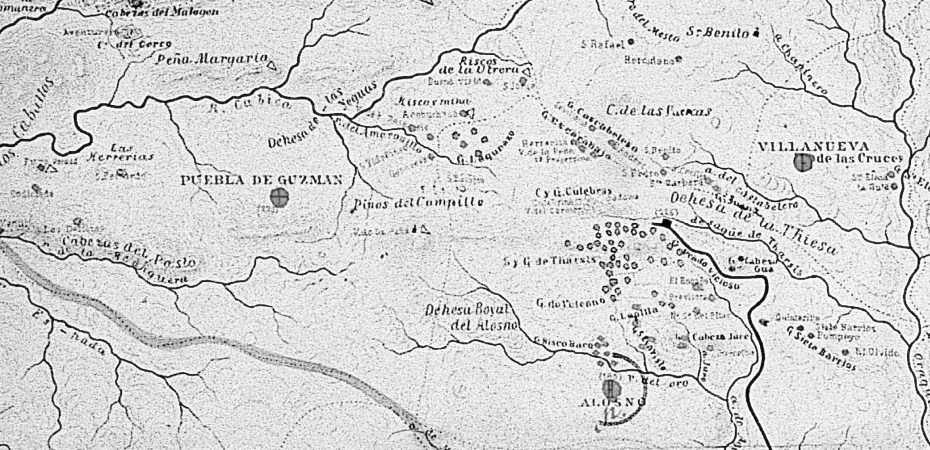
This company is formed under the Limited Liability Act, for the purpose of developing an extensive deposit of pyrites containing copper and sulphur, denominated the Lagunazo Mines, comprising the Anibal, Amarguillo, Amantes, Cristobal-Colon, and Pizarro setts, situated in the province of Huelva in Spain.
The mines throughout the whole of this province were extensively worked by the ancient Romans, in open excavations, as deep as was possible without hydraulic resources. The immense heaps of scoriae, and the magnitude of the excavations on the Lagunazo deposits, prove beyond all doubt their great productiveness. The ores are all of one class, viz. pyrites, containing 40 to 50 per cent. of sulphur, and from 1 to 6 per cent. of copper. The ore is not found, as in ordinary lodes, in small veins, but in immense masses many hundred fathoms long, and varying in width from ten to fifty fathoms. The ore is usually found at a few yards below the surface, and at El Tharsis and other mines wrought in open and wide quarries ; consequently, such deposits, if worked with economy on the large scale, are as free from risk as deposits or iron, stone or coal.
The demand for sulphur ore is greatly on the increase. It is now almost exclusively used in the manufacture of sulphuric acid, large quantities of which are required in the manufacturing of soda, soap, glass, artificial manures, bleaching powder, &c. There are more orders at the port of Huelva than can be supplied. The ores will therefore command a ready market in England.
The Rio Tinto Mine in this province is giving to the Spanish Government, under all the disadvantages of an expensive management, a net profit of from £40,000 to £80,000 per annum, from the extraction of the copper alone by cementation. The sulphur is destroyed. An official report on this mines from the Government engineers in Spain, states the average produce of the ore to be 4.75 per cent. of copper. The Tharsis Mines, which are worked by a French company, at a distance of one league from the Lagunazo, are producing upwards of 100,000 tons per annum. And nearer home, the Wicklow Mining Company of Ireland, working on similar although poorer class of ore, is giving such large profits that its original £5 shares are now worth £65 each.
The Lagunazo Mines are acquired by this Company at at royalty of 2s. 3d. per ton on all available ores extracted, and the concession to the proprietors of one quarter of whatever nett profits may result from the undertaking. The whole of the company’s capital will be therefore applied to the development of the mines ; nothing being paid to the proprietors of the mines except out of profits.
A full description of these mines will be found in the reports of Mr. Evan Hopkins and Mr. John Fetherick, by both of whom they have been inspected.
It will be seen that Mr. Hopkins estimates the total charges on a ton of ore placed in England at £2 16s. 9d. The price containing 2½ per cent. of copper are now fetching in Newcastle is £3 9s. per ton. The following would thus be the profit on 1,000 tons of 2½ per cent ore (which is a very low estimate of the average produce) shipped to England, and 500 tons of a lower percentage, treated on the spot by the cementation process, as is at present done at the Tharsis Mines.
| 1,000 tons of ore placed in England at a cost of £2 16s. 9d. per ton | £2,838 |
| Selling in Newcastle at £3 9s. per ton | £3,450 |
| Monthly profit | £862 |
| Or per annum | £10,344 |
| Or on 2,009 tons shipped, and 500 cemented monthly | £17,088 |
Mr. Hopkins, it will be seen, states in his report that the produce of ore can no doubt be raised eventually to 4,000 tones per month.
A railway is now about to be commenced from the shipping port of Huelva to the Tharsis Mines, a distance of about twenty miles and arrangements will be made for its extension to this property
When this is accomplished, the carriage, which at present forms such a large item in the cost, viz., £1 8s. per ton, will be reduced by about one-half, which will nearly double the expected profit.
This undertaking can hardly be said to enter into the class of ordinary mining speculation. The existence fo the ore in large masses is an established fact. All that is required is the application of capital and facility of carriage to render the profit highly remunerative.
Prospectuses and forms of application for shares may be obtained at the offices of the Company, or of the brokers.
