
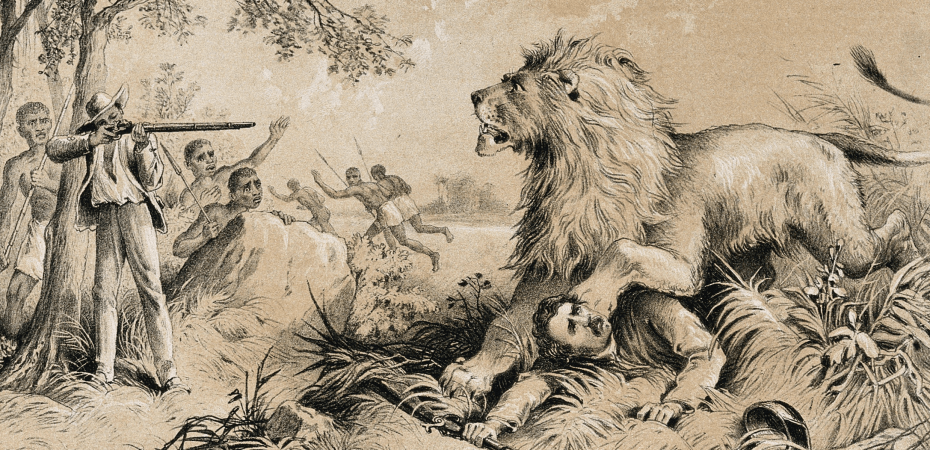
(From the Engineer and republished in the Glasgow Herald.)
The triumphal procession of a returned missionary through the Manchester Exchange, whilst business is hushed to do him homage, and cotton lords are eager to join in their cheers, is a noteworthy sight. That dauntless and intrepid man, with his unclerical glazed cap, has done more to redeem missions from reproach than any of his predecessors. He has not forgotten the man in the missionary. He has not sacrificed the great interests of humanity to the petty triumphs of a sect. He has not discovered in the gospel he went to establish anything antagonistic to the material well-being and social advancement of his race. Broader and healthier views have led him evidently to the conclusion, that commerce must be the great agency for the regeneration of Africa. Not that commerce is Christianity—rather its medium, its channel.
“The band of commerce surely was designed To associate all the branches of mankind; And, if a boundless plenty be the robe, Trade is the golden girdle of the globe.”
Who will not say that the worthy missionary was doing more directly for the reclamation of Africa when, weary and torn, he slept shelterless on his wanderings, with his chronometer in his arm pit as the only possible protection, than any of his predecessors who have trod the ordinary perfunctory paths of evangelism?
It seems to us that he is the most important missionary to America that has arisen in our day. The great question that agitates the States—that has already shaken the Union—and that the most ardent American regards but as a mine that may at any hour explode and sever its bonds for ever, may be settled in Africa, if the sagacious anticipations of the missionary are true. What if the free negro of Africa should supersede the enslaved negro in America? And is there anything unreasonable in supposing that the virgin soil of Africa, whose native richness must smack of the fabulous even to an American, will carry the chances against worn out Virginia, or the lands of the Carolinas, long in process of exhaustion? Is it unreasonable to conclude that a free African on his native soil cannot compete with the enslaved African under the lash of an American planter? Should the visions which glimmer through the revelations of the missionary become realisations, we shall yet have to greet him, not only as the Evangelist of Africa, but as the Emancipator of America. Free Africans may at home produce cotton in such quantities, and at such rates, that it will no longer be worth while to keep slaves in America for the purpose.
We do not wish, however, to speculate; but rather to review the statements made by Dr. Livingstone at Manchester, concerning the productions of Africa and its capability of further development. Western Africa especially is stated to be extremely fertile as far southwards as the twentieth degree, beyond which it abounds in thorny productions. The Zambesi is the great highway to this fertile region, and offers unobstructed means of conveying its produce to the sea. The bar at its mouth has twenty-two feet of water, and therefore is practicable for shipping. The highlands skirting the Zambesi basin are very healthy, and the district is especially favourable for the production of cotton. Cotton is indeed largely cultivated for native purposes now, and is an article of native trade, especially in Angola, which, in English hands, would produce more cotton than the Southern States of America now do. Native labour is abundant and cheap, and can be had from 1d. to 4d. per day. Payment might be made in calico, which, in cotton-producing districts, is now a common medium of payment.
Dyes are numerous in Angola, but the natives are not communicative about them. They use the Columba root, and indigo is widely diffused, and at present exported by the Portuguese. Cereals are abundant, and cultivated with greatest care. Wheat deposited in a slight hole and left to nature produces ears as long as the hand. Millet of several varieties is produced in large quantities. The doctor brought home some twenty-six kinds of fruit unknown to Europeans, many of which he had found highly acceptable as food. Some of these fruits are valuable as affording oil, and some both food and oil. Even the seeds of the cucumber abound with oil. Castor oil is abundant, and is used by the natives as an unguent. The sugar cane abounds, though it is, for want of machinery, useless to the natives. The call of the honey bird in some districts is constantly inviting the traveller to the stores of wild bees, which are vastly numerous. Iron of fine quality abounds, and is made by the natives into hoes and knives. The coal measures crop out in strata of great thickness, forests furnish boundless supplies of wood, and at Kasembi a good deal of malachite is found. Fibrous plants of unusual value abound, and the people of Tete are looking out for the £1000 prize offered by the Times for a paper fibre with apparently a good chance of getting it, as the “buaze” brought home by the doctor is pronounced worth £50 or £60 per ton, and both finer and stronger than our flax.
The natives are represented as most anxious to trade, and assiduous in cultivating trade where it does offer. A trade in wax has sprung up between Loando and Brazil. The missionary and his party found, whilst passing through the forests of Lunda, that the natives had placed hives at frequent intervals for collecting the materials for this wax trade. Their anxiety to reach the sea with the hope of finding an outlet for their productions is very great. Native predilections are everywhere in favour of the English, who are firmly held to be the friends of Africa.
Thus does the worthy missionary disclose scenes of productive fruitfulness, teeming with all that our commercial needs asks, amid a disposition to pour all these riches into our lap in ever increasing abundance if we will put ourselves in the way of them. The vision seems almost too bright to be real, but the doctor seems too shrewd to be mistaken, and is too disinterested to mislead. The harvest will take time to reap, but there seems no room to doubt that it is there, ready to our hand.
(From the Economist.)
Dr. Livingstone has been giving many interesting accounts of his African experience to large meetings in Manchester and Glasgow. He is one of those intrepid travellers who first carry the fame of English energy and the honour of the English character into new regions, where it is not easy for his successors to redeem the promise of national energy and integrity held out by such a forerunner. He has penetrated a totally unexplored region from sea to sea, and South Africa might well say to him as the world, according to his amusing story, is stated to have said to the African tribes when they first reached the sea: “I am done; there is no more of me; there is only sea in front”.
Though it may not be quite accurate to say with the Manchester Chamber of Commerce, that “commerce and industry may be identified with civilisation and Christianity,” yet we heartily agree with them that such travellers as Dr. Livingstone, who opens the way for commerce and civilisation, probably does as much for the eventual spread of Christian, and, alas! also, unchristian influences, as any of those purely religious missionaries who found their modest church and school, and labour unremittingly in their own professional tasks. And as we must believe that good is stronger than evil, and true Christianity than that spurious type which our too eager civilisation often produces,—these great openings of the highways of commerce, though they throw wide the gates for good and evil influences alike, should be a subject of hearty congratulation to us all. Dr. Livingstone spoke a deep, and with the light of his illustration, not an entirely trite truth, when he said at Glasgow: “Commerce shows us that we are dependent upon others; but with the heathens there is no such thing. They like to be independent of everybody else; and they like to depress others. I believe that the restriction upon trade in our own country was but a remnant of heathenism; but it has now been happily removed”.
Unfortunately there are heathen modes of dependence as well as of independence—and though it is quite true that the poor Protectionist cry of “independence of the foreigner” was in itself a heathen catchword, there may be a degree even of commercial dependence which, if it leans hopelessly on luxury, is also heathen and unworthy of a vigorous commercial nation. Manchester has lately borne noble witness to this truth in supporting a war which was temporarily, at least, injurious to commerce, because she conceived that other claims on us were higher and more urgent than the claims of commerce. If England only act as honourably with weaker nations as she ever does with the strong, we shall have no fear for the results of our opening commercial intercourse with South Africa, though it is certain to bring with it commercial temptations of no ordinary kind.
Dr. Livingstone’s principal discovery since exploring the great highland lake Ngami, in the centre of the plateau of South Africa, has been that of the upper course of the Zambesi river, which flows into the Indian Ocean opposite the southern side of the island of Madagascar. This river he himself esteems his principal discovery so far as regards at least the purposes of commerce, but he has also explored and visited the interior, and the western coast of Angola and Congo. In his journey to the Atlantic from Lake Ngami, he was accompanied by natives of the inland country of Barotse, a little west of the central district between sea and sea. From Tete, on the Lower Zambesi, it had been a long journey of more than 1000 miles to the country of Barotse, and when he reached it all his goods were expended; but the chief of that country fitted him out with 15 oxen and canoes, and twenty-seven men, being strongly convinced of the wisdom of opening up communications with the sea coasts. These men accompanied him all the way to Loanda on the Atlantic, without any complaints of hardship, or hope of wages, and while there, they worked hard in collecting all they could to take back to their own country from the Portuguese settlement—and “though from fever and detention,” says Dr. Livingstone, “we returned [to Barotse] as poor as we set out; we were received with the greatest kindness, because we had opened up the path”.
There the same chief gave him a commission to the east coast—the lower Zambesi—and fitted him out well a second time, solely in the hope of having intercourse with the white men. We see, then, how highly many of the interior tribes value intercourse with the white coast settlers. The chief of Barotse told Dr. Livingstone that all the ivory of the country was his if he would only bring him the European machine for manufacturing the sugar cane into sugar. Barotse also produces grain, &c., but the sugar cane seems its most valuable product.
The principal difficulty in the way of reaching this chief of Barotse, who was so eager for commerce, and his territory, seems to be the great number of rapids in the Zambesi as it descends from the high plateau on which lake Ngami lies towards the Indian Ocean. The great falls of Mosioatunya are, Dr. Livingstone thinks, quite equal to those of Niagara, but unfortunately are not the only rapids in its course. Above them the Zambesi is 3000 feet broad, and the falls themselves are 105 feet in depth, passing through a deep cleft in the basaltic rock. Some distance to the east of these great falls the climate, which in Barotse and the interior generally is very unhealthy, becomes healthy even for Europeans. And it is on this district, in the middle Zambesi, between the junction of the Kafue with the Zambesi, and Tete, that Dr. Livingstone builds his fairest hopes of promoting intercourse with the Europeans. It is without forests or swamps, perfectly healthy, and with immense capacities for tillage: it is some 300 or 400 miles up the Zambesi from the sea; wheat, maize, and all grain would be grown here, he says, to the greatest possible advantage, and he describes the ease with which the finest wheat is raised.
There are here, too, nine seams of coal. “He examined one near Tete, which was 68 inches in diameter, the coal having been tilted to the surface by volcanic action”. He tells us that the bar at the mouth of the Zambesi would be no impediment to traffic, as there are 22 feet of water over it. Tete is the highest point on the river much visited by Europeans. But Dr. Livingstone tells us that at Zumbo, from 200 to 300 miles farther up, the grain is twice the size it is at Tete. The Zambesi overflows its banks, like the Nile, which is the cause of the great fertility. There was iron, also, along the whole course of the river. A number of the native hoes had been made into an Enfield rifle for Dr. Livingstone in Birmingham, and the maker considered the iron very good, though not quite equal to the Russian and Swedish. Malachite was also found. The Columba root, exported by the Portuguese of Tete for a dye, is also grown all along the course of the river. Marble, too, was found here by Dr. Livingstone, within 100 miles of Tete,—the Portuguese, nevertheless, being quite unconscious of its existence, send 900 miles to Mozambique for the material of their houses.
The settlements on the western coast of Congo and Angola are those which chiefly produce cotton, where a certain mediocre sort grows plentifully. Here, too, the Portuguese have introduced the coffee tree. The great trade with the natives is in wax, which the Portuguese export to Brazil for manufacture of the wax candles used in the churches there. In Angola and the central country of Lunda, hives were placed every few hundred yards, even in the dense forests, and the natives, guided by the honey bird, seemed to collect every ounce of honey they could get, for sale to the Portuguese. The Angola native labour seems in a degree organised. Skilled labour is worth 4d. a day, field labour 2d. a day, and the latter may be had for 1d. by paying in the usual currency of the country—calico.
One discovery of Dr. Livingstone’s may turn out of very great importance—that of a fibre which is said to be stronger than flax—buaze. The natives had strung their beads on threads made from buaze, and Dr. Livingstone brought some of the root home with him to this country. He gave it for trial to Messrs. Pye, Brothers, in Lombard Street, and they gave it as their opinion, after consulting one of the first manufacturers of Leeds, that the “fibre was finer and stronger than flax, and was worth between £50 and £60 a ton”. It grows abundantly on the north side of the River Zambesi. We may add, that Dr. Livingstone’s evidence makes it an object of quite as high importance to explore the Zambesi as it was to explore the Niger, and we are sure Government will give Dr. Livingstone all possible help in his future researches. We do not yet know the full material value of Dr. Livingstone’s discoveries; but we trust we have already learned something from his return to England of the moral value of having spirits so earnest and adventurous among our fellow-citizens.
