(Published in Lloyd’s Weekly London Newspaper)
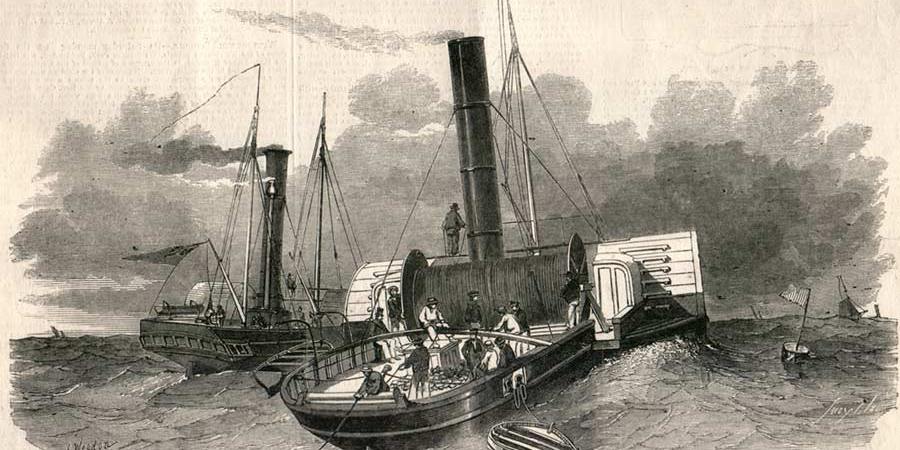
The long-promised experimental operations for establishing a continuous telegraphic communication between Great Britain and the continent, by means of wires sunk between Dover and Calais, were commenced on Tuesday, at Dover. At one o’clock the General Shipowners’ steamer Goliath was in readiness, and steam up, in Dover harbour, to start across the Channel, with all the necessary apparatus on board, and a crew of about thirty men, consisting of pilots and sailors, superintended by Dr. Reid, of the House of Commons, Mr. C. J. Wollaston, C.E., Mr. T. Crampton, C.E., Mr. F. Edwards, and others. Between the paddle-wheels, in the centre of the vessel, was a gigantic drum or wheel, nearly fifteen feet long and seven feet diameter, weighing seven tons, and fixed on a strong frame-work. Upon it was coiled up in careful close convolutions about thirty miles of telegraphic wire, encased in a covering of gutta percha. The point proposed to be reached, Cape Crinez, the nearest landmark to the English coast, and between Calais and Boulogne, is a distance of twenty-one miles, so that a surplus supply of nine miles of wire was held in reserve for the purposes of slackening. The intention was to steam out at five miles an hour, to pay out progressively the whole extent of telegraphic tackle, and to imbed the wire by means of leaden clamps, of which there were some hundreds on board, or weights of 20 and 25lbs. weight, in the bottom of the sea. The vessel was provisioned for the day, and Captain Bullock of her Majesty’s steam-ship Widgeon, caused the track of the navigation to be marked in as direct a route as possible by placing a series of pilot buoys with flags on the route, besides being prepared to accompany the experimental cruise with his own vessel as a tender. The connecting wires were placed in readiness at the government pier in the harbour, and likewise at the cape, where they run up the face of the acclivity, which is 194 feet above sea mark. The necessary batteries and manipulators were all on board, but as a gale and rolling sea unexpectedly sprung up over a previously comparatively calm sea was it, deemed unadvisable by the experimenter to venture out, and the operation was adjourned until four, a m., on Wednesday morning. Some interesting experiments, however, were made upon a small scale to show the practicality of the plan. A mile of wire was paid out off the deck from the pier to Shakespeare’s Cliff, and the sinking process was proved to be a practicable performance. A communication to the following effect was also sent through twenty four miles of wire, “Printed by electric telegraph on board the Goliath steam-boat.”
Straits of Dover, Wednesday Evening. – The sinking of the electric telegraph wire between this port and Calais was practically commenced this morning at half past ten o’clock, at which hour the Goliath steam-ship was brought under weigh within the harbour. The vessel being fully under weigh steamed on at the rate of three or four miles an hour into the open sea, in a direct track for Cape Grinez. The wire weighed five tons, and the vessel was proceeded by Captain Bullock, who accompanied it as a pilot. The operations of paying out the thirty miles of wire commenced on a signal to the sailors to “go a-head with the wheel,” and pay out the wire, which was continuously streamed out over a roller at the stern of the vessel, the men at every 16th of a mile being busily engaged in rivetting on to the wire square leaden clamps, or weights of from 14 to 24lbs., which had the effect of sinking the wire to the bottom of the sea, which on the English coast commences at a depth of thirty fee, and goes on varying from that to 100 and 180 feet. The whole of the casting out and sinking was accompanied with great precision and success. Communications were kept up hourly during the process of submerging the wire, between the gentlemen on board and the shore. The only conjectured difficulty on the route was a point in mid-channel, called the Ridge – by the French, Le Colbart – between which and another inequality called the Varne, both well known and dreaded by navigators, there is a deep submarine valley, surrounded by shifting sands, the one being seventeen miles in length, and the other twelve, and in this vortex ships encounter danger, lose their anchors, and drift ; and the trolling-nets of fishermen are frequently lost. Over this irregular configuration, however, the wire was successfully submerged, below the reach, it is believed, either of ships’ anchors, sea animals, or fishing nets. The remainder of the route, through rougher on approaching the coast of France, was accomplished cleverly, though slowly.
(By Submarine Telegraph)
CAPE GRINEZ, HALF PAST EIGHT, P.M. – The Goliath has just arrived in safety, and the connexion of the under-water wire, with that left at Dover this morning, is being run up the face of the cliff. Interchanges are now passing between France and England under the Straits, for the first time.
