
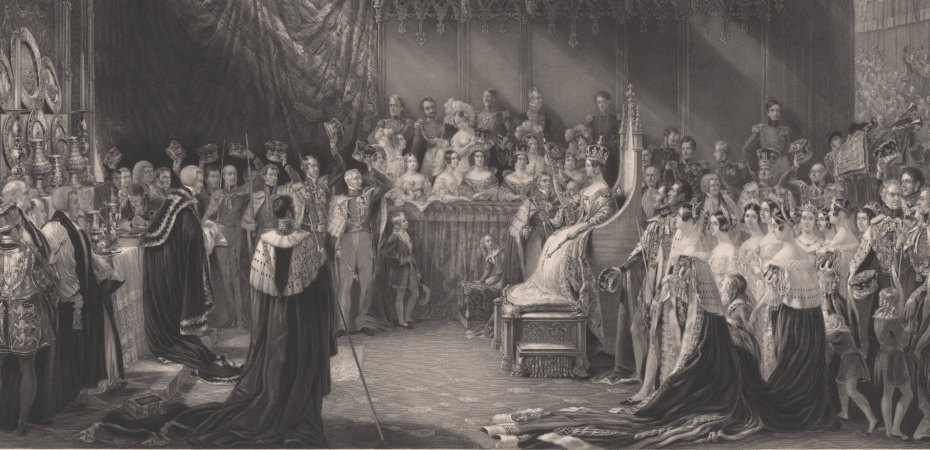
(The Leeds Times – Abridged from the Sun on Thursday 29th June, received last night)
At seventeen minutes past three o’clock this morning, a royal salute of twenty-one guns announced the joyous day, when the crown of these great realms was to be placed upon the head of the most popular and beloved Sovereign that has wielded the British sceptre since the days of Alfred. The whole metropolis was literally awakened, and presented a scene of bustle and excitement rarely if ever equalled. After four o’clock the streets were so thronged with carriages and pedestrians that they were in many places impassable, and the whole population seemed to have poured out in the direction of the Parks and of Westminster Abbey. At ten o’clock the procession began to move and as the several illustrious foreigners were recognised they were much cheered, especially Marshal Soult, who acknowledged the compliment by repeated bows. Up to this time the weather had worn the uncertain aspect which had characterised the weather over the last few days. For an hour it seemed doubtful whether sunshine or rain would prevail, but almost upon the instance when the noble looking tars upon the roof of the triumphal arch hoisted the Royal Standard, as the Queen was entering her carriage, the clouds passed away and the sun shone forth with all the brilliancy of mid summer. The tars waved their hats and cheered as the Standard rose. The immense assemblage responded to the cheer with on tremendous shout of joy, which was continued until the royal courtege had passed over Constitution-hill.
Insights
The contrast with Queen Isabella II of Spain was stark. Isabella ascended the throne at just three years old, was declared of legal age at 13, and married her cousin at 16. Shielded from political realities, indulged in whims, and manipulated by various factions, she lived under the shadow of the Carlist Wars, which constantly threatened her legitimacy. Her education was more suited to a high-society lady than a reigning queen. Victoria, in contrast, despite—or perhaps even because of—the restrictive Kensington System (a strict protocol devised by her mother, the Duchess of Kent, and her comptroller, Sir John Conroy, to maintain control), developed a strong will. She was thoroughly prepared for rule from an early age through a comprehensive curriculum encompassing history, geography, languages (fluent in German, English, French, and proficient in Italian and Latin), and political studies.
Queen Victoria was a symbol for the British presence in Huelva. The 24th of May was declared a public holiday for the more than 10,000 Spanish workers at Rio Tinto Mines, Union Jack flags were flown from the company offices, festivities and sports were organised. Indeed, the Rio Tinto railway timetable explicitly noted that trains did not run on Sundays or on Queen Victoria’s Birthday, and this was an excellent choice for the title of David Avery’s book on the Rio Tinto Company “Not on Queen Victoria’s Birthday”.
